
This is the third post in our theme series, “Selling the City.“
By Emerole Clinton
In the European imagination of the late nineteenth century, the African city did not quite exist. What existed, instead, was a set of images — orderly and exotic in carefully measured proportions — produced by photographers, missionaries, and colonial administrators and circulated through a medium ideally suited to mass persuasion: the picture postcard. Between the 1890s and the 1930s, millions of these cards moved through the European postal network, each one a small act of visual argument, each one selling a version of the African city that the colonial project needed its audiences to believe.
The Library of Congress’s Africana Historic Postcard Collection, which the Library re-released with higher-resolution images in 2023, makes it possible to examine this archive with unusual specificity.1 The cards in it show cities and villages across the continent — Dakar and Accra among them — but they do not show them as their residents knew them. They appear as the colonial machinery needed them to appear: exotic enough to be fascinating, orderly enough to be reassuring, pre-modern enough to justify the intervention being conducted in their streets.
The Postcard as Colonial Marketing Tool
The picture postcard reached its height of popularity precisely when European colonial powers were consolidating their African territories, and the overlap was not coincidental. In France alone, postcard production is estimated to have grown from roughly eight million cards in 1899 to sixty million in 1902.2 Colonial administrations, missionary societies, and military entities all issued postcards, and the medium suited them: it was easily mailed, and it arrived in the hands of the recipient as something personal — a communication, not a broadsheet — which made its ideological content feel like information rather than argument.
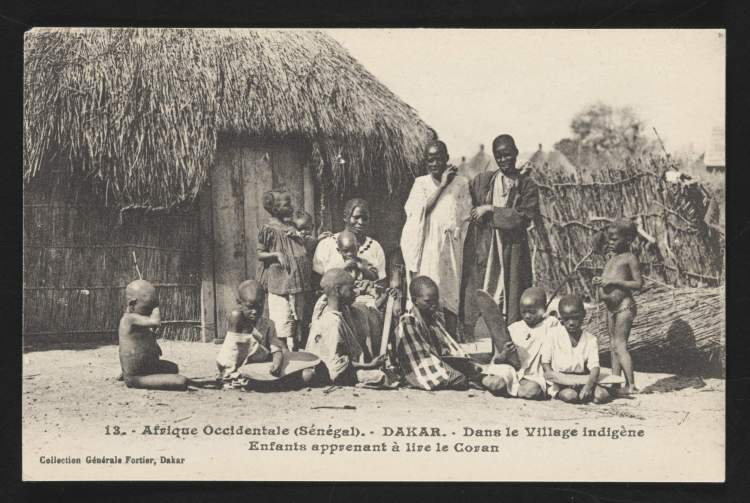
Photographers like François Edmond Fortier, working out of Dakar, and Casimir Zagourski, whose ‘L’Afrique qui disparaît’ series presented central African peoples as timeless and unchanging, were not neutral recorders.3 Much of the output of European postcard photographers rested on staged “ethnographic” scenes calibrated to what European audiences expected and what colonial authority required. Their images of African cities emphasized the European quarter: the administrative buildings, the broad colonial avenues, the harbor infrastructure — the parts of the city that demonstrated that European civilization had arrived and taken hold. The African residential areas, the markets, the spaces of African social and commercial life, appeared in these cards as picturesque background, as ethnographic spectacle, rarely as the functioning urban fabric they actually were.
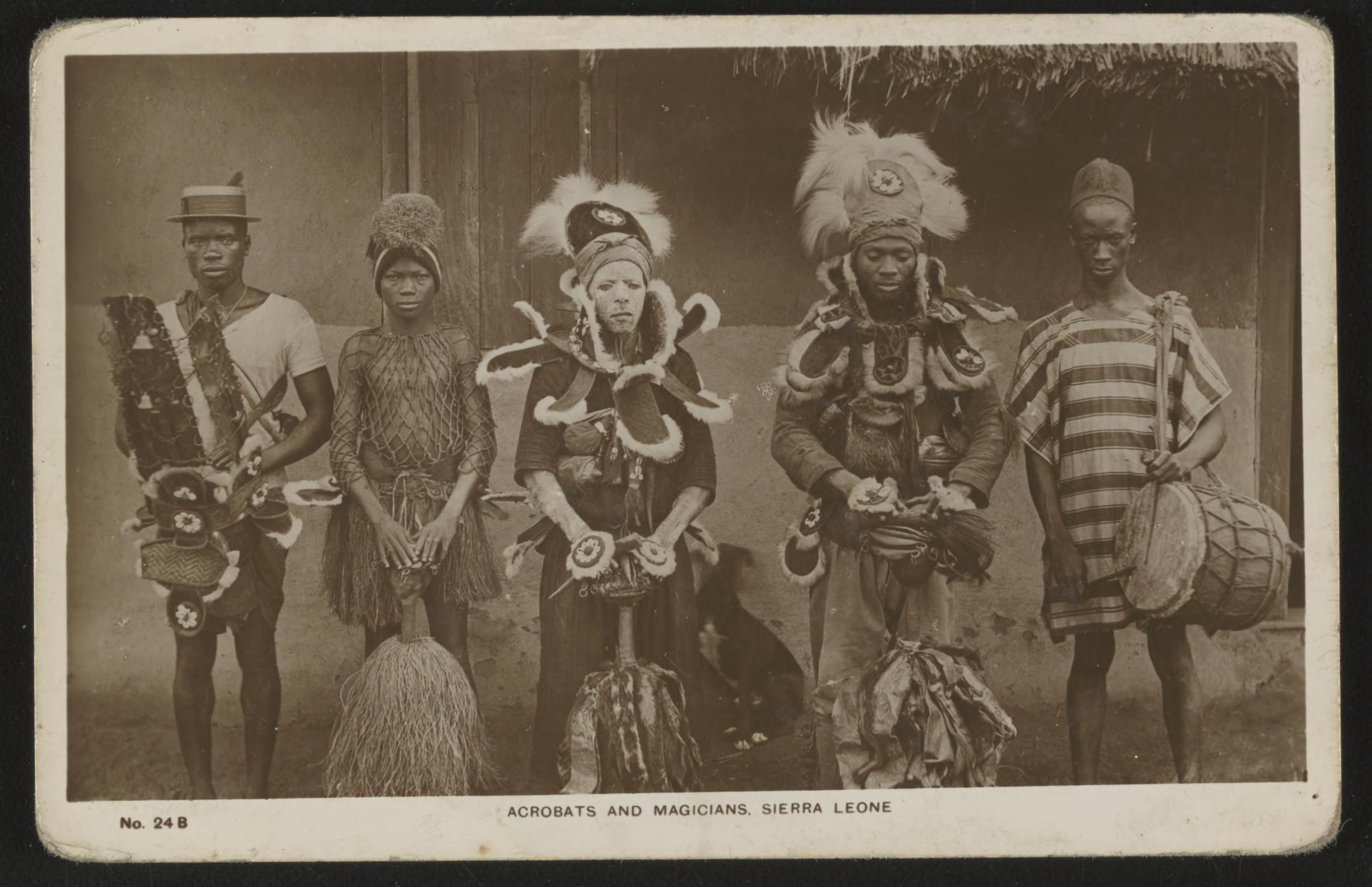
Christraud Geary, co-editor of the volume Delivering Views: Distant Cultures in Early Postcards, has observed that postcards “have helped create standard views of the world.”4 For the colonial postcard, that meant a standard view of the African city: a place possessed visually by metropolitan audiences who would never visit it, and whose possession felt like knowledge. What was being sold, in other words, was not only an image of a place but confidence in the colonial project itself — its necessity, its order, its civilizing efficacy.
The visual grammar of the colonial postcard was consistent enough across different colonial powers to constitute something close to a shared aesthetic of imperial urbanism. The African city in these images is always manageable. It is contained within a frame that emphasizes European infrastructure; its African inhabitants, when present, are positioned as subjects of curiosity rather than agents of their own urban life. The city is defined by what the colonial presence has built, not by what existed before it or what grew up alongside it. This aesthetic reflected the ideological underpinnings of colonial marketing: that the African city be legible to European audiences as a space undergoing beneficial transformation. The more exotic the “before” appeared, the more reassuring the “after'”— the colonial administrative city — could be made to look. The postcard performed this argument at mass scale.
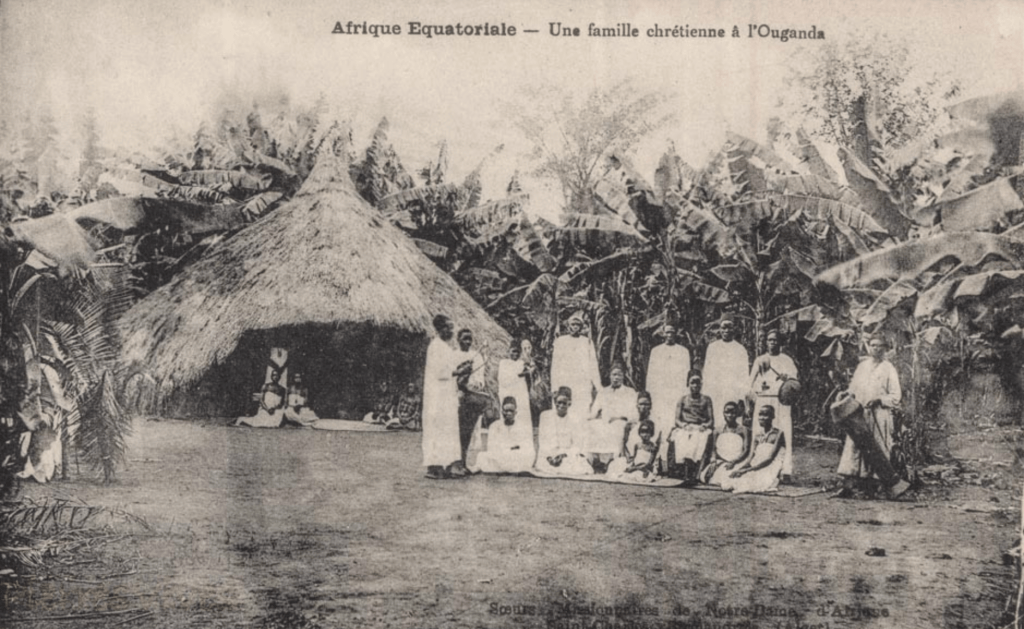
Missionary postcards like this one performed a specific function within the broader colonial marketing system: they cast the colonial encounter as moral rather than commercial, framing African communities not as labor pools or administrative subjects but as souls in transformation. The “Christian family'” attempts to assert that the intervention is working, circulated as personal correspondence through European church networks.
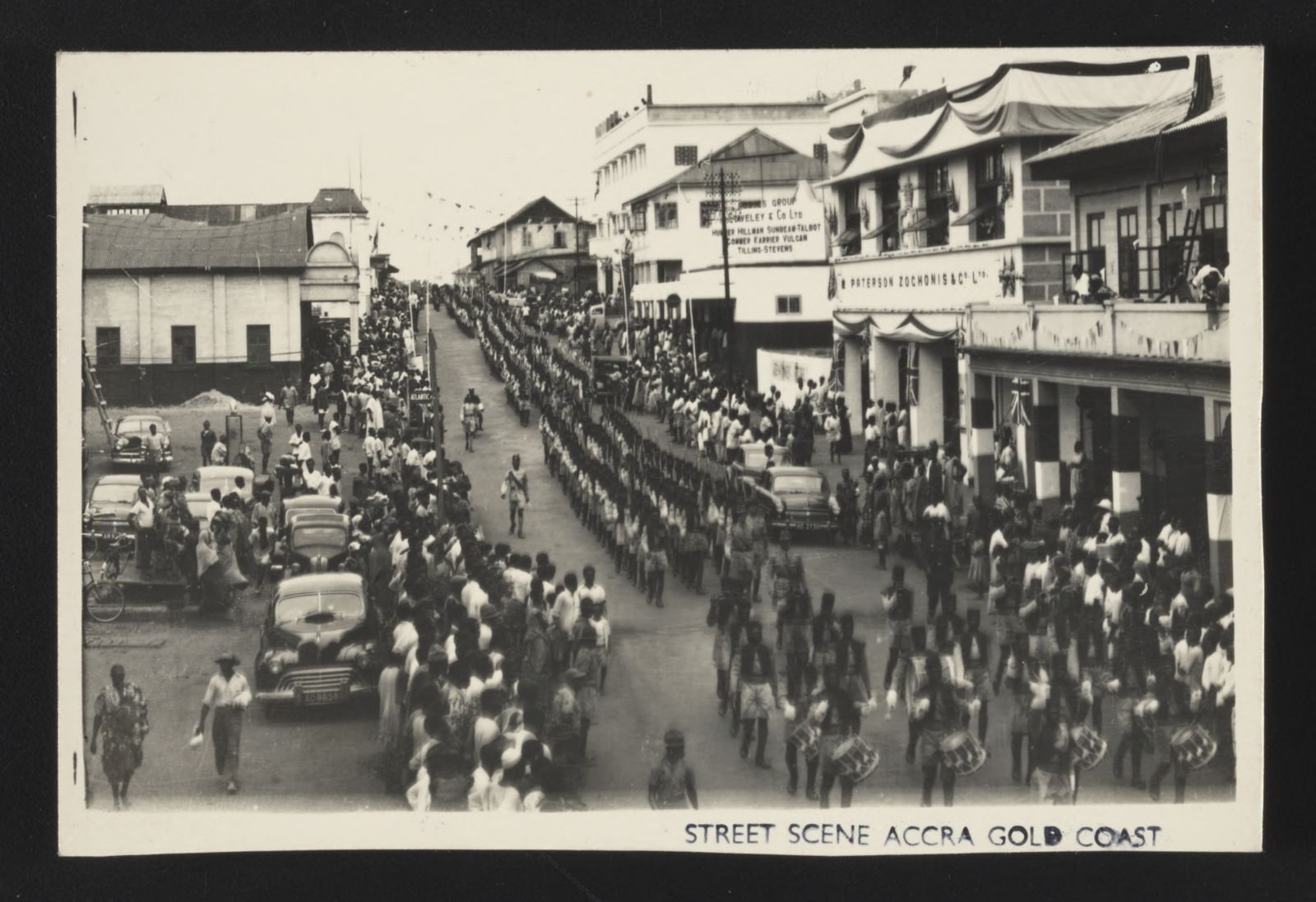
Not every card followed the template. The one below, labelled “Gold Coast,” shows a commercial street in Accra crowded with spectators, parked cars, shopfronts, and a marching band — an urban life that the ethnographic cards edited out.
The Durable Image
Empires ended. The postcards persisted. The image of the African city that colonial marketing produced — exotic, pre-modern, defined by its European quarter, manageable from outside — proved durable precisely because it had been distributed at such scale and over such a long period that it shaped, rather than merely reflected, international assumptions about what African cities were and what they could be.
Post-independence African city branding has had to operate in the shadow of this inheritance, whether or not its architects acknowledged it. The choices available to governments trying to attract foreign investment, international tourism, and global attention were constrained by the prior image — which meant that branding either fought the colonial visual legacy, replicated its logic for new audiences, or attempted to transcend it through a counter-image ambitious enough to displace the old one. Three well-known examples show three different negotiations. All three are addressed outward, to outsiders whose money and attention the place wants, but to different outsiders.
Lagos State, created in 1967, carries “Centre of Excellence” as its official motto.5 The phrase is a claim about capacity and ambition, set against a reputation for overcrowding and gridlock that the city’s growth has done little to dispel. Unlike the Nairobi and Ghana examples below, the slogan names no particular audience: it speaks to investors, visitors, and institutions in general terms, and it does not argue with any earlier image of the city so much as assert a replacement for it.
Nairobi’s “Silicon Savannah” takes a different route. The label grew out of a run of Kenyan technology milestones in the late 2000s — the M-Pesa mobile-money service, the Ushahidi crowdsourcing platform, and the iHub innovation centre that Ushahidi co-founder Erik Hersman conceived in 2008 — and by 2015 it was in wide use as shorthand for a sector courting global capital.6 Its audience is more specific than Lagos’s: the name borrows the prestige of Silicon Valley, and the account of the sector’s growth in a Council on Foreign Relations piece highlights American technology companies and investors.7 Rather than confronting the colonial picture of East Africa as pre-modern, the label ignores it, placing Nairobi in a global conversation about technology in which that picture has no place. The risk of this approach is that it leaves the colonial image intact, so that the counter-image and the inherited image can coexist in international perception without ever meeting.
The third example is national rather than civic, but it is the most explicit of the three about the colonial past. Announced by President Nana Akufo-Addo in September 2018, Ghana’s Year of Return marked 400 years since the first enslaved Africans arrived in Jamestown, Virginia, and invited the African diaspora to come back. The Ghana Tourism Authority describes it as “a major landmark marketing campaign targeting the African-American and Diaspora Market,” and its own account leans on the idea of Ghana as the “gateway to Africa.”8 Where Lagos tries to replace the colonial image and Nairobi tries to bypass it, Ghana names the rupture — slavery and the displacement that followed — and makes it the reason to visit. It speaks to an audience that the colonial postcard never addressed and never imagined.

What connects these three strategies is that they are all in dialogue with colonial aesthetic legacy. Allan Sekula has used the term “shadow archive” to describe the vast, mostly unnoticed body of images that positions people within a social terrain.9 Borrowing his phrase, the colonial postcard can be read as one such archive for African cities: images that arrive before the city does, shaping the expectations of every investor, tourist, and international institution before any contemporary campaign can intervene. Few later image campaigns have operated at the scale, or over the duration, that the postcard did.
To represent a city internationally is to decide to whom it will speak, in what language, and through what images. Lagos’s slogan addresses investors and institutions in general terms and names no country. Nairobi’s label courts, above all, a technology and venture-capital world with an American accent. Ghana’s Year of Return was aimed squarely at the African-American and wider diaspora market.
The African city was sold, between the 1890s and the 1930s, as a particular kind of place for a particular set of ideological purposes. That sale has proved more lasting than the empires that conducted it. Understanding the mechanism of that sale — the postcard, the photographer, the colonial administration, the postal network, the European metropolitan audience — is not merely a matter of historical record. It is a condition for understanding the branding work that African cities are still doing, in the long aftermath of those images, today.
Emerole Clinton is a writer and cultural analyst based in Owerri, Nigeria, writing on urban life, institutional design, and the images through which African cities are seen and unseen. His work has appeared in Busted Halo and Youth Today.
- Library of Congress, “The Africana Historic Postcards Collection,'”4 Corners of the World (blog), February 2023, https://blogs.loc.gov/international-collections/2023/02/the-africana-historic-postcards-collection/. ↩︎
- David Prochaska, ‘The Archive of Algérie Imaginaire,’ History and Anthropology 4, no. 2 (1990): 375, as cited in University of Stirling, ‘Postcards I: Colonial imaginaries,’ https://pieds-noirs.stir.ac.uk/postcards-i-colonial-imaginaries/.
↩︎ - Library of Congress, “The Africana Historic Postcards Collection” (see note 1), on Fortier (1862–1928) and staged “ethnographic” postcard production; Casimir Zagourski, L’Afrique qui disparaît, photographic postcard series.
↩︎ - Christraud Geary, quoted in “Turn-of-the-Century Views,'”Smithsonian Magazine, https://www.smithsonianmag.com/history/turn-of-the-century-views-152815106/ (accessed October 2026). The volume is Christraud M. Geary and Virginia-Lee Webb, eds., Delivering Views: Distant Cultures in Early Postcards (Washington, DC: Smithsonian Institution Press, 1998). ↩︎
- “Lagos State,” Wikipedia, https://en.wikipedia.org/wiki/Lagos_State (accessed October 2026), for the state’s motto and its creation on 27 May 1967. ↩︎
- Aubrey Hruby and Jake Bright, “Kenya’s Silicon Savannah Spurs Tech in Sub-Saharan Africa,'” Council on Foreign Relations, 4 November 2015, https://www.cfr.org/articles/kenyas-silicon-savannah-spurs-tech-sub-saharan-africa. ↩︎
- Oxford Business Group, “Homeward bound: Year of Return campaign encourages members of the African diaspora to engage with Ghana’s history and culture,” The Report: Ghana 2020, https://oxfordbusinessgroup.com/homeward-bound-year-of-return-campaign-encourages-members-of-the-african-diaspora-to-engage-with-ghanas-history-and-culture/. ↩︎
- Allan Sekula, “The Body and the Archive,” October 39 (Winter 1986): 10. ↩︎
Featured image (at top): A postcard from the Collection Générale Fortier, Dakar, captioned ‘Dans le Village indigène — Enfants apprenant à lire le Coran’ (‘In the indigenous village — children learning to read the Quran’). Undated. Library of Congress Africana Historic Postcard Collection.

