
This is the second post in our theme series, “Selling the City.“
By Meenakshi Nair
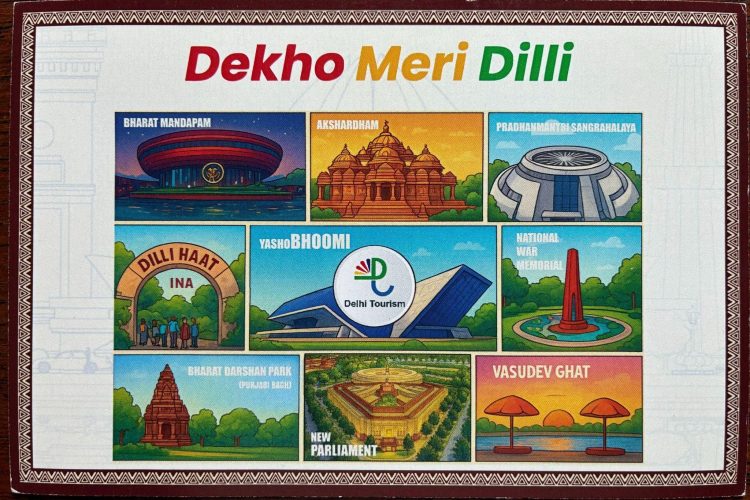
Tucked into the packet of informational brochures handed out at the Delhi Tourism I-Centre in Baba Kharak Singh Marg is a souvenir postcard of Delhi titled “Dekho Meri Dilli,” or “See My Delhi.” It is one element of a sprawling suite of texts that frames and narrates the city as a tourist destination. Below this title is a mosaic of nine tiles, images of the tourist attractions that dot the city. The tiles are labeled with the names of the attractions they represent, while the central tile is also emblazoned with the Delhi Tourism Logo. As a visual object meant to represent the city to tourists, this postcard is both curiously withholding and blatantly revealing.
I parse this postcard’s dually withholding and revealing nature below, taking my cue from Dean MacCannell who considers tourism to be “an ideological framing of history, nature and tradition; a framing that has the power to reshape culture and nature to its own needs.”1 Focusing on the postcard’s use of language, its selection of attractions, and how it frames these attractions, I show how the postcard breaks significantly from conventional representations of Delhi by tourism materials. I suggest that the postcard reframes Delhi, forcing it into a narrow mold and discarding what it finds excessive.
What’s in a name?
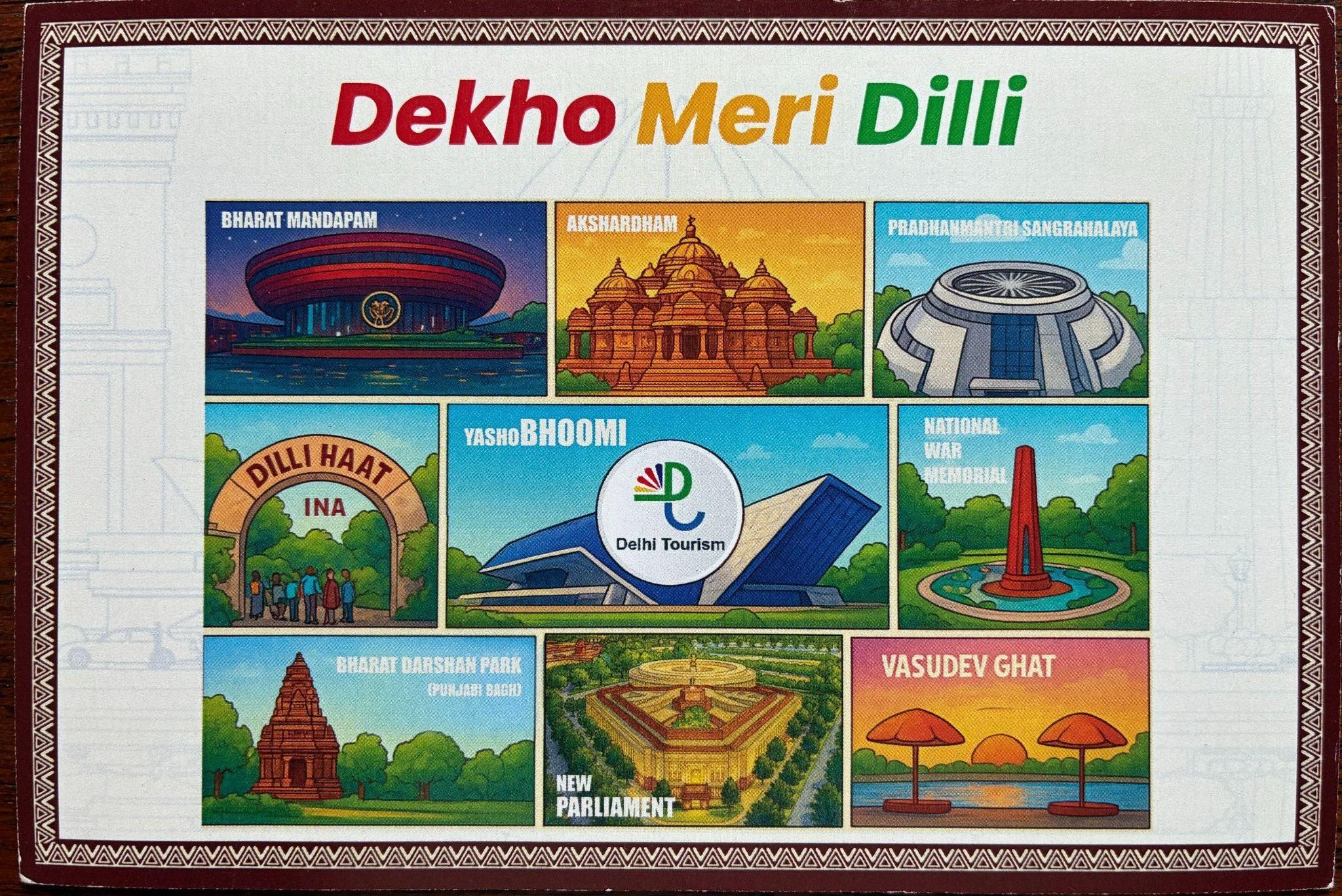
This postcard highlights what it wants viewers to believe are Delhi’s main attractions: Bharat Mandapam, Akshardham, Pradhanmantri Sangrahalaya, Dilli Haat INA, Yashobhoomi, the National War Memorial, Bharat Darshan Park, New Parliament Building, and Vasudev Ghat. This list includes a park, the new parliament building, and a war memorial.The other names are Sanskritized and not immediately communicative about the attraction; here the labels do not help parse the images.
These highly Sanskritized names do not readily signal the role or function of each attraction in the life and history of the city, other than the Pradhanmantri Sangrahalaya whose name does indicate that the building houses the Prime Ministers’ Museum. Meanwhile, Bharat Mandapam is “India Ceremonial Platform” and Yashobhoomi is “Glorious Land.”2 Despite their grandiose names, these structures serve as unexceptional exhibition halls and convention spaces. The Sanskritized names do not communicate these roles either. Although the names don’t communicate this, the other attractions are a temple complex (Akshardham), an open-air crafts bazaar (Dilli Haat), a newly developed riverfront religious destination (Vasudev Ghat), and an amusement park (Bharat Darshan Park).
On the surface, this may seem like a rejection of English, the former colonizer’s tongue. However, it is necessary to note that Sanskrit is a classical language that, in modern life, is reserved for Hindu religious ritual, and signals caste privilege. The choice of language, then, is less about rejecting English and more about asserting Sanskrit and thus a Hindu identity. Embracing Sanskrit is also a departure from the sonic and visual linguistic landscape of Delhi in which English, Hindi, Urdu, and Punjabi (along with many more Indian languages) intermingle.
These Sanskritized names function in two ways based on the imagined viewer. On the one hand, for an international tourist, the names of the attractions (other than the war memorial and parliament building) obscure all meaning and imbue the attractions with exoticism, an essential Indianness. Whereas on the other hand, for a domestic tourist or even a citizen of Delhi, the Sanskritized names are coded Hindu. In the next section, I examine how the use of Sanskrit and the inclusion and exclusion of certain tourist sites contributes to the manufacture of an overtly Hindu Delhi.
Selection
I want to turn my attention now to the attractions included in and excluded from the central mosaic. The attractions included reflect only a very short period of Delhi’s recent history: about 30 years. The oldest of these attractions, Dilli Haat, was established in 1994 while Akshardham Temple was consecrated in 2005. All the others were constructed and inaugurated between 2019 and 2024. This is a strange and telling choice.
Strange given that there exists archaeological evidence for at least 3000 years of settlement in the region across a range of architectural styles and cultural influences but none of it finds reflection in this postcard. Telling because the majority of the attractions included were built in a brief five-year period that coincides with the second term of the Hindu nationalist Bharatiya Janata Party (BJP) led central government. During this period, the government has proposed and executed several redevelopment plans (for instance as noted by Prem Chandravarkar3 and Michael S. Dodson4) to alter Delhi’s cityscape to better reflect its own narrative of the city. The postcard, then, seeks to highlight the redeveloped cityscape and elide the diversity, architectural heritage, and urban history of Delhi.
Break From Convention
This elision is a departure from how Delhi is generally represented in tourist-facing material. For instance, a glancing survey of the most popular contemporary walking guides of Delhi yields route after route incorporating a range of attractions from across periods of history.5 Even the colonial era Murray’s Handbook to India and Ceylon (1892) mentions a large number of attractions, making careful note of the different periods to which each belongs.6
Turning to other tourist-facing visual representations of Delhi, a post-Independence photobook titled Delhi: A Portrait (1983) commissioned by the DTTDC itself makes clear how and why each walking route is able to include so many different attractions.7 The modern city is always sharing space with remnants of previous versions; photographs show a 16th century mausoleum serving as the backdrop to 20th century agriculture, while a 13th century stepwell is a 20th century water park, offering reprieve to a young capital city racing to grow in the background.
A canon of Delhi’s tourist attractions emerges from these materials. These attractions include the Qila Rai Pithora (1060), the Qutub Minar (1199/1220), the Red Fort (1648), the Jama Masjid (1656), Humayun’s Tomb, the Dargah of Nizamuddin Awliya, India Gate (1921), and the Lotus Temple of the Baha’i faith (1986), any of the nine Sikh Gurdwaras built in 1783, and Jawaharlal Nehru Stadium (1983). This canon reflects the changing architecture of Delhi under the rule of the Rajputs, Mamluks, Tomars, Sayids, Lodhis, Khiljis, the Mughals, the British, and even the architecture of the capital of Independent India. The postcard rejects this canon, and instead props up a new clutch of buildings, almost all built in the 21st century.
Framing the City to Frame the Nation
I refer deliberately to attractions excluded from the central mosaic of the postcard and not to attractions excluded from the postcard entirely. This is because a closer look at the postcard reveals that the mosaic is not, in fact, set against a blank cream background. Instead the cream background bears faint line drawings of abstracted details of the India Gate, the Lotus Temple, and the Qutub Minar—identifiable only to those who already recognize them.
The established canon of attractions is largely ignored by the postcard, other than when it relegates these attractions to the background, rendering them faint and partial in contrast to the defined wholes of the central mosaic. Effectively, what this postcard does is withhold parts of Delhi’s cityscape while forcing an entirely new (and newly constructed) built environment onto the skyline.
Five of the nine attractions refer to or represent India without offering any glimpses into Delhi’s specific urban histories or culture. Two attractions, Bharat Mandapam and Bharat Darshan Park, include the word Bharat, which is India’s non-English endonym. Bharat Darshan Park is an amusement park that features reproductions of over twenty historical monuments from across India. The National War Memorial memorializes Indian martyrs while the New Parliament is the seat of the Indian Parliament. The Pradhanmantri Sangrahalaya is a tribute to the office of the Prime Minister of India.
And in this way, Delhi is subdued by national imagery. The Delhi Tourism Website sees no problem with this: its “About Delhi” opens with a description of Delhi as “[a] symbol of the country’s rich past and thriving present,” and insists that “[a]s a Capital city it is fittingly a window to the country.”8 According to these materials, it is natural that as India’s capital city, what Delhi is like should indicate what India is like.
In their work on religion and identity in India’s heritage tourism industry, Ranjan Bandhopadhyay, Duarte Morais, and Garry Chick draw from existing tourism scholarship to discuss how heritage functions for the state as “bogus history” that communicates a national identity for the domestic tourist.9 Visiting heritage attractions, then, compels the (domestic) tourist to develop a sense of national identity. Through the careful selection, naming, and framing of attractions it is possible to compel the domestic tourist to develop a particular sense of national identity.
The “bogus history” that is told about Delhi is often a history of India according to whoever is ruling or administering the state from Delhi. For instance, writing in 2008 about tourist-facing material from the late 1990s and early 2000s, Bandopadhyay et al note that the material (across state, trade, and popular media productions) emphasize the “unity in diversity” of all religions. This phrase is shorthand for the conventional post-Independence understanding of Indian secularism: a nation is built of the co-equal presence of religious (and other) diversity.
And so depending on how Delhi is framed, the postcard forwards a similar framing about India as a whole. Tourism material seems to take seriously the aphorism that holds “To rule Delhi is to rule Hindustan” and employs this idea rhetorically: “to frame Delhi is to frame India.” And this postcard frames Delhi, and thus India, narrowly along linguistic, religious, temporal, and architectural lines.
Whose Delhi?
For the reasons outlined above, the postcard breaks yet again from convention by projecting a solely Hindu and contemporary identity. Delhi is evacuated of its living Islamic heritage and linguistic diversity. The postcard lingers obstinately on the extremely contemporary built environment of Delhi that consolidates a Hindu identity for the city.
Yet the postcard says cheerily, invitingly, “Dekho Meri Dilli” or “See My Delhi.” Whose Delhi is this? Certainly not everyone’s.
Meenakshi Nair (she/her) is a PhD candidate at the Department of English at the University of Massachusetts Amherst. She works on the representation of cities across forms and genres, and is particularly interested in speculative fiction, planning documents, visual material, and experimental forms. She is from Delhi.
- MacCannell, Dean. Empty Meeting Grounds: The Tourist Papers. (New York: Routledge, 1992), 1.
↩︎ - Translations by author.
↩︎ - Chandavarkar, Prem. “The State of a Nation Seen Through an Urban Design Competition.” PLATFORM. December 2019. https://www.platformspace.net/home/the-state-of-a-nation-seen-through-an-urban-design-competition ↩︎
- Dodson, Michael S. “Reimagining Delhi’s Central Vista.” PLATFORM. November __. https://www.platformspace.net/home/reimagining-new-delhis-central-vista-part-i
↩︎ - See: Liddle, Swapna. Delhi: 14 Historic Walks. (Delhi: Westland Books, 2011); Jalil, Rakshanda. Invisible Delhi: The Hidden Monuments of Delhi. (Delhi: Niyogi Books, 2013)
↩︎ - A Handbook for Travellers in India, Burma and Ceylon: Including the Provinces of Bengal, Bombay, Madras . (London: J. Murray, 1911).
↩︎ - Singh, Khushwant and Raghu Rai. Delhi: A Portrait. (Delhi: Delhi Tourism Development Corporation. Oxford University Press, 1983)
↩︎ - Delhi Tourism Website. “About Delhi.” https://delhitourism.gov.in/aboutus/index.html
↩︎ - Bandyopadhyay, Ranjan, Duarte B. Morais, and Garry Chick. “Religion and Identity in India’s Heritage Tourism.” Annals of Tourism Research 35, no. 3 (2008): 790–808. https://doi.org/10.1016/j.annals.2008.06.004.
↩︎

