
This is the final entry in our 10th Annual Graduate Student Blogging Contest, “Revolution.”
By Emi Higashiyama
Green on Their Terms: Cairo’s Counterrevolutionary Landscape
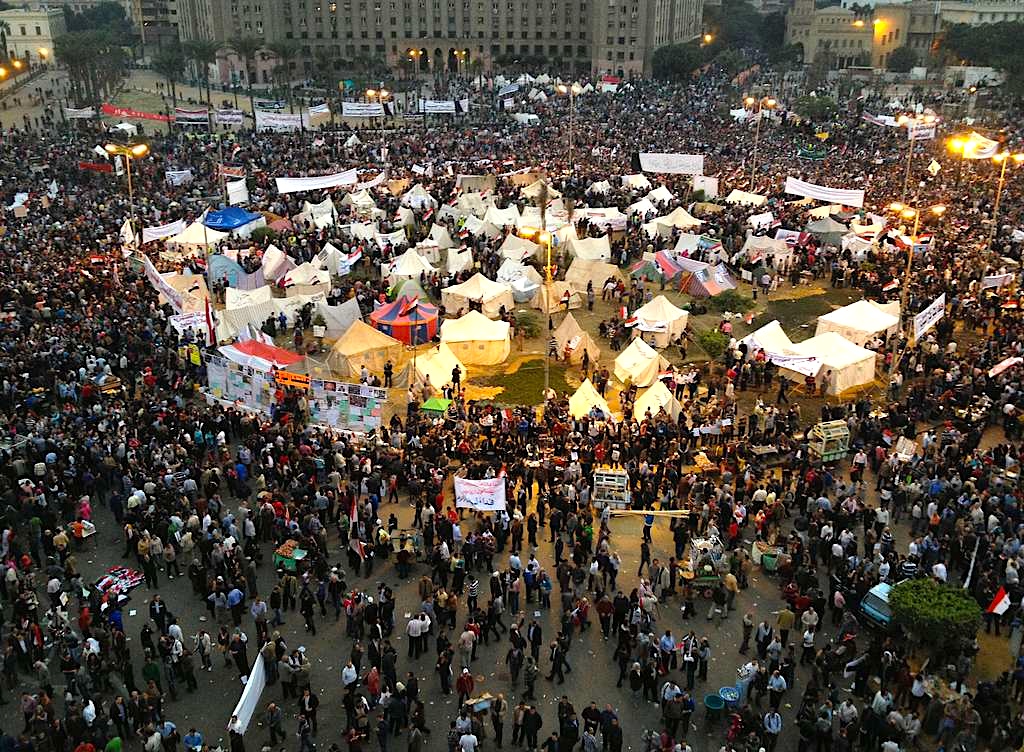
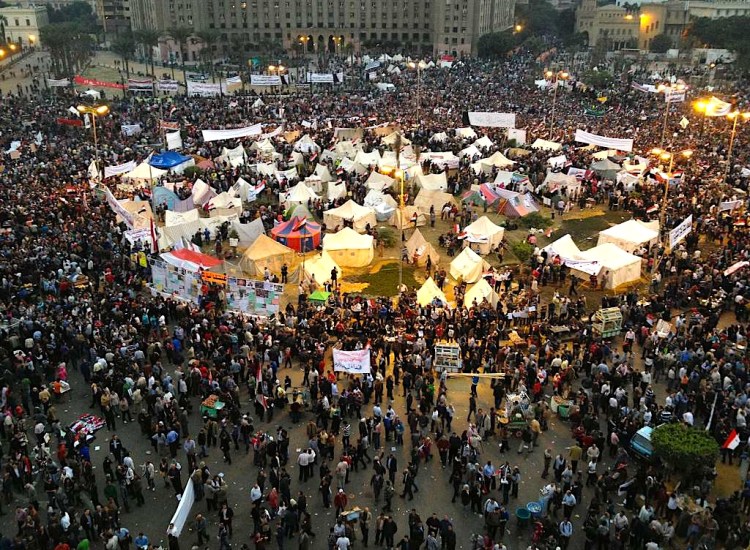
On January 25, 2011, Cairenes began filling the vast traffic circle at the center of downtown known as Tahrir Square (Midan al-Tahrir, or “Liberation Square”). They stayed for eighteen days, and the most significant result of this revolutionary gathering was the resignation of Hosni Mubarak on February 11, who had held the presidency since 1981.1 Two and a half years later, the square filled again, this time with crowds demanding the departure of Egypt’s first freely elected president, Mohamed Morsi. The army, led by General Abdel Fattah el-Sisi, removed Morsi, and Sisi has run the country ever since.2
The usual lesson drawn from those weeks is that a crowd can topple a government, but in this case, the revolution’s happily-ever-after is marred by history repeating itself. In Cairo, the right to gather has always depended on who owns the open space where people gather. Since 2013, Sisi’s government has answered Tahrir not only with laws and force but with landscape design: steel gates across streets, a renovated square, parks laid out on cleared land, and a new capital built in the desert (far from the neighborhoods that fed the crowds). Urban planning in Cairo is less a matter of architectural style than of political economy: who pays for monumental ambition, and who is allowed to use the space it produces.
A Square Built to Be Watched
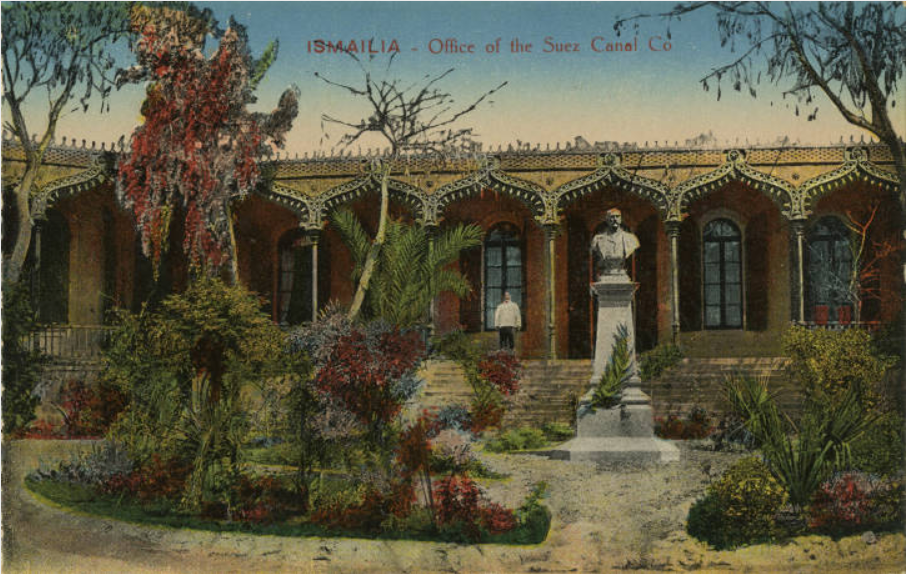
Tahrir was never designed as a people’s square.3 In the mid-19th century, Khedive Ismail (khedive was the title of Egypt’s viceroy, ruling under the nominal authority of the Ottoman sultan) set out to turn Cairo into a European capital. Having grown up in Paris during Baron Haussmann’s urban reform (and later invited to organize the Egypt Pavilion at the 1867 Paris World’s Fair4), Ismail’s ambitions of creating a kingdom separate and unique from the Ottomans seemed to take a page out of the Parisian urban planner’s “Lessons from the French Revolution” guidebook. As historians of Paris have argued, Haussmann’s wide boulevards and circular plazas did double duty.5 They were as much showpieces that solved sanitation problems of a medieval slum as they were embodied crowd control tactics (the widened streets were more difficult to barricade than the tangled streets they replaced). Before creditors came calling, Khedive Ismail’s urban geometry was headed towards a downtown district that made it a place the government could see and control with ease. In Cairo, Ismail’s planners laid out a new district west of the medieval city on similar lines, a grid of straight avenues radiating from squares, and the largest of those squares took his name: Ismailia Square.
The name did not last.6 Cairenes were calling the square Tahrir after the 1919 revolution against British rule, and the government made the name official after the 1952 revolution that ended the monarchy. The architect and historian Nezar AlSayyad adds a caution: Egyptians, he argues, did not widely regard the square as the emblem of their liberation until 2011.7
The reasons for why Egyptians repeatedly revolted can be traced back to Ismail’s other building projects. As a matter of policy, Ismail’s Paris on the Nile was built on credit. Egypt’s national debt grew from a few million pounds when he took power in 1863 to somewhere between £90 and £100 million by 1876, depending on how it is counted.8 His signature project was the Suez Canal, opened in 1869. In 1875, short of cash, he sold Egypt’s 44 percent stake in the canal company to the British government for about £4 million.9 Egypt’s finances were placed under Anglo-French supervision,10 Britain and France pushed Ismail from power in 1879, and in 1882 the British started occupying the country.
Under Hosni Mubarak’s thirty-year authoritarian rule, much like Khedive Ismail’s rule, economic freedom and opportunity were elusive. As the Arab Spring bloomed across North Africa, Egypt’s revolutionary principle began to take root in the protestors’ slogan: “bread, freedom, social justice” – a list of material demands that needed public staging. Tahrir was the one place in the capital large enough, central enough, and (for eighteen days) open enough for those demands to be voiced at scale. A square built to be watched had become the stage for toppling a regime. That is the problem the state has been trying to nip in the bud ever since.
Gates, Laws, and a Renovated Square
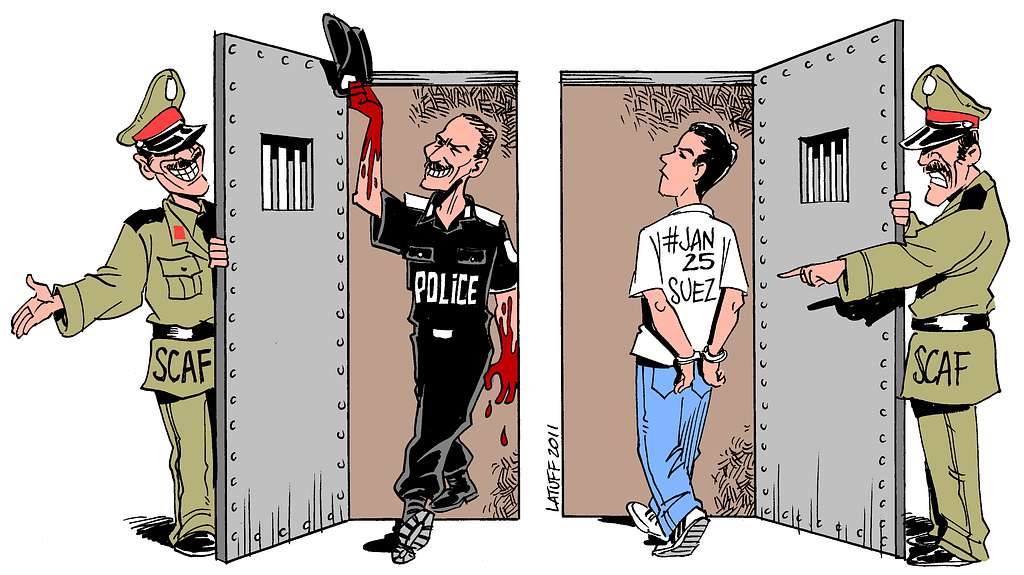
The Mubarak government’s response to revolution was unrefined. After street battles on Mohamed Mahmoud Street (the main artery connecting Tahrir Square to the heavily fortified Ministry of Interior compound) in November 2011, the Interior Ministry walled off streets around Tahrir with concrete blocks to keep protesters and police apart. When the protestors tore down parts of the walls, the ministry simply put them back. When the new democratically elected government under Morsi was unable to make changes fast enough, the public protested again in 2013 – but an ironic twist of events led to a military coup quelling the rebellion and installing el-Sisi, whose rule, by most accounts, is Mubarak’s authoritarianism reincarnate (but stricter and deadlier).11 In the evolution of authoritarian rule, Egypt’s government went from Mubarak’s party-centric model (which carefully managed a margin for opposition voices and independent press) to el-Sisi’s centralized strain (consolidating power directly through state institutions including the military, and effectively neutering public voice). From the people’s perspective, the realization of “better the devil you know than the devil you don’t” was cemented in February 2014: the Ministry of Interior announced it was removing the last of the previous revolution’s anti-protest walls. Citing traffic circulation improvement efforts, the remaining revolution-induced concrete block on Qasr al-Aini Street (the avenue leading from Tahrir toward Parliament and Cabinet offices) would be replaced with a towering steel gate.12 The gate stays open for traffic, but its true purpose is to close the street and prevent protesters from reaching the administrative buildings. Critics promptly dubbed it the “Qasr al-Aini border crossing,” a reference to Egypt’s checkpoint at Rafah on the Gaza border.13
Then came the square itself. In September 2019, the government began a renovation of Tahrir. That same month, Reuters reported “rare anti-Sisi protests had triggered a security lockdown around the square and a wave of arrests.” Officials described the project as an upgrade that would turn Tahrir into a tourist attraction “in line with famous plazas in Europe.”14 The centerpiece is a 3,500-year-old, 19-meter obelisk of Ramses II brought from the Delta province of Sharqia, flanked by four ram-headed sphinxes moved from the Karnak temple complex in Luxor, roughly 500 kilometers to the south (alarming archaeologists who cited conservation risks exacerbated by traffic pollution).15 Building façades were repainted, billboards removed, palms planted, benches installed, and a company was assigned to manage the square (including the deployment of private security).
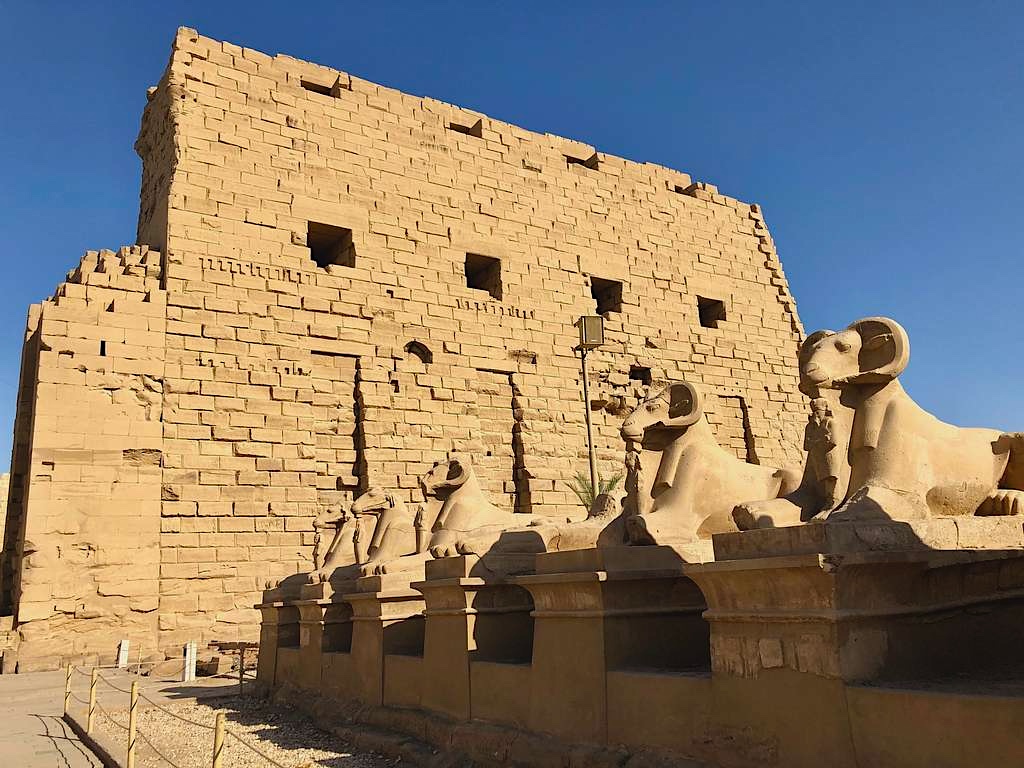
An inscription on the obelisk’s base names 1919 and 2011 among Tahrir’s significant moments but states that the square became a symbol of Egyptians and their freedom with the June 30, 2013 protests – the revolution that directly led to Sisi’s takeover. Khaled Fahmy, a Cambridge historian who took part in the 2011 uprising, interpreted the redesign as a message that Tahrir is now “a square that belongs to the state.”16 While tourists and visitors are welcome, a crowd with a message is a threat to the state.
Parks and Recreation
Cairo is a dense city, suffering from air pollution and starved for green space. Before the 2026 “Greening Cairo” initiative was announced, the only true purpose-built lungs for the city was Al-Azhar Park. Opened in 2005 by the Aga Khan Trust for Culture (the heritage preservation arm of the Aga Khan Development Network), the park was a gift to the city from the family-run AKDN with ancestral ties to medieval Cairo.17 Covering 30 hectares on a hill that had served for roughly five centuries as a rubbish and rubble dump above Darb al-Ahmar (one of the city’s poorest neighborhoods), Al-Azhar Park does a lot of heavy lifting for the city. Perhaps even more valuable than the actual design is that alongside the park, the trust ran job training, microcredit, and housing rehabilitation – an approach often lauded for avoiding displacing residents and contributing to the economic vitality of the city.18 Although it is cited as the perfect example of how a park and its neighbors could be planned together19 (and a private gift being a substitute for public policy), an overlooked significance of this success story is the dubious role of a private gift: if an authoritarian government’s policy is to control dissenting crowds, is a recreational park that seems to enrich without encumbering actually enabling a government that performs spectacle disguised as development?
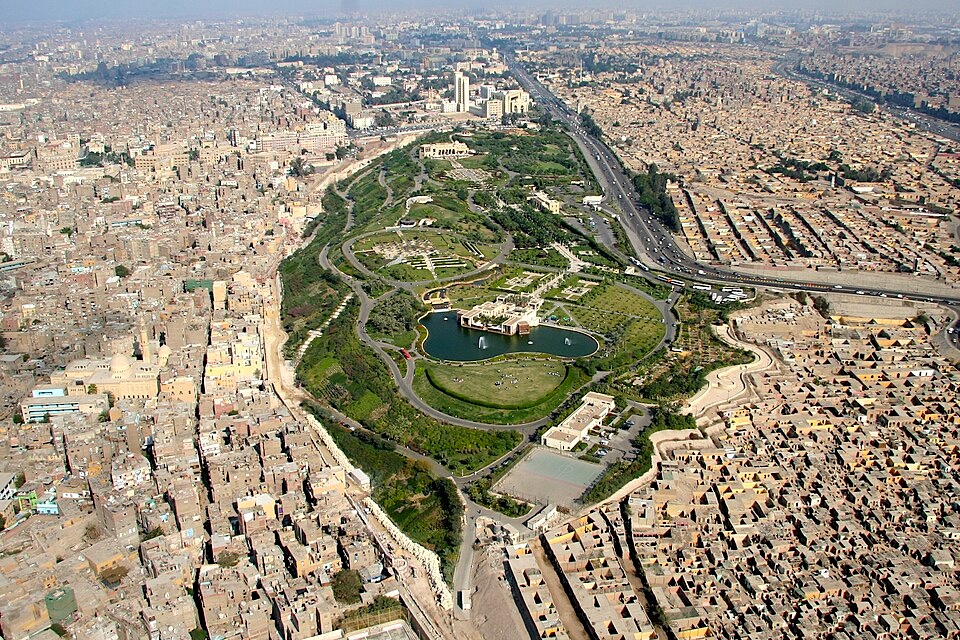
In the twenty years since the ideal green space was realized, landscaping seems more like the government’s latest preferred tool of social control. Prime Minister Mostafa Madbouly’s announcement in June 2026 declared that the Greening Cairo initiative would raise the amount of green space per resident, and, once restoration of the historic districts is finished, make central Cairo an open-air draw for tourists.20 Then in September he ordered the official start, with street planting along Ring Road21 (the highway circling the city) and an inventory of vacant government land for new parks; agencies now occupying undeveloped land in Cairo are to be offered plots in new cities in exchange. Within days, the cabinet announced a ban on cutting down trees.22
Cairo residents, the supposed intended recipients of this greening initiative, have more complaints than praise. Although the plan is presented as making good use of evacuated urban spaces, the postulation is that the land has already been cleared. Actually, much of the cleared land comes from demolitions carried out under a 1990 law (which has been conveniently amended to grant more power to the government), letting the state seize property for “public benefit” with promise of compensation.23 The best-known case is the Maspero Triangle, a riverside neighborhood beside the state television headquarters, much of which had been demolished in 2018. Residents were offered cash, replacement housing, or a promise of return after redevelopment, though former residents have said the cash offered was a fraction of market value.24 Researcher Omnia Khalil notes that Maspero was exceptional in that its residents were compensated at all; in other neighborhoods, thousands of families received nothing, and evictions were interpreted as “part of a broader effort to securitize Cairo’s urban geography.”25
While the environmental gains seem aligned with the making of a modern Egypt, the Greening Cairo order of operations reveals the true costs of a nation that has never succeeded in sustaining a democracy (despite repeat attempts with revolutions): land is forcibly cleared first, residents often have little (if any) say, and the green that follows is designed, funded, and managed by the same authority that controls the gates.
A Capital Out of Reach
Perhaps the most blatant use of green space to suppress revolution is the latest ambitious project that sits about 45 kilometers (28 miles) east of Cairo. The New Administrative Capital was officially renamed “The New Capital” in November 2025, and a bill introduced in February 2026 would rename it Memphis, after the ancient Egyptian capital.26 Evoking the grandeur of absolute rulers plays out in the planning of 700 square kilometers that includes the 2024 Iconic Tower (the tallest building in Africa standing at 394 meters27) and the enormous Green River Park (centered around a 35-kilometer manmade river meant to simulate the Nile River).
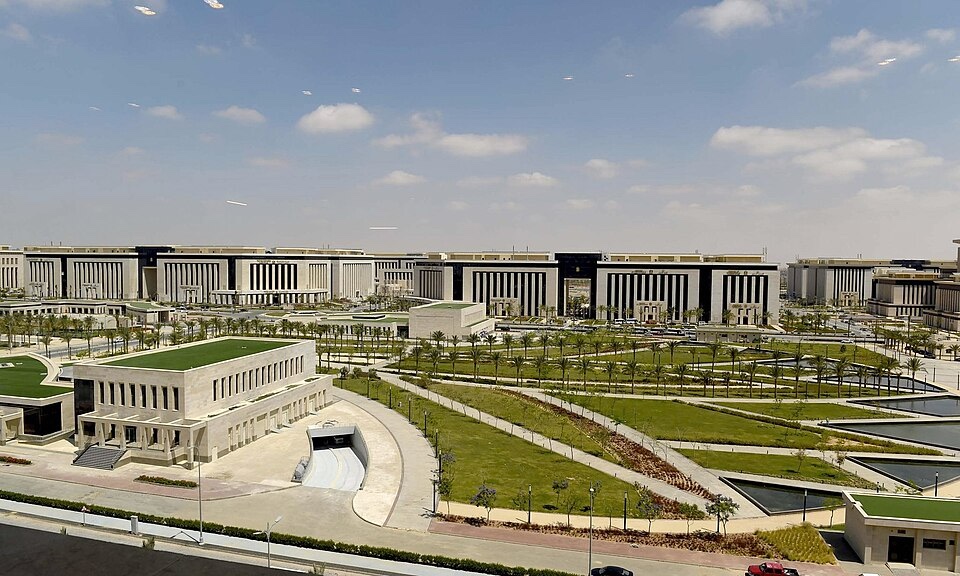
The desert capital is not Sisi’s invention. In 1978, President Anwar Sadat began building Sadat City28, about 93 kilometers (58 miles) northwest of Cairo, intending to move the capital there and draw people away from the crowded Nile Delta; he had started relocating a ministry when he was assassinated in 1981, and the plan went nowhere. Successive governments kept building desert cities anyway. The economist David Sims, a longtime Cairo resident, writes extensively about the countless forsaken projects strewn across Egypt’s desert, most catering little to ordinary Egyptian families in the first place.29 The newest new capital extends this lineage at a grander scale – even after ministries and parliament have moved there, as of summer 2026 the actual residencies are far below the projected number.30
Unlike the failed desert oases for the elite, the new capital’s Green River Park is billed as the premier urban park that would serve all the neighborhoods in the city (just the New Administrative Capital, not the Cairo that had multiple revolutions).31 By size alone (the park will be six times the size of New York City’s Central Park), the plan is for the park to be a green hub for the region. Yet the Cairo population the capital is intended to serve could not afford to live near their seat of government, never mind enjoy a daily stroll at the park or organize a protest. The social consequence is that the people’s voice becomes easier to ignore as the green façade works as a smokescreen to prevent uprisings. In Cairo, the counterrevolution does not announce itself. It builds parks.
Emi Higashiyama is a postgraduate student in the Asian Art Programme of SOAS University of London. Her focus is Islamic gardens.
- “Egypt Crisis: President Hosni Mubarak Resigns as Leader,” BBC News, February 12, 2011, https://www.bbc.com/news/world-middle-east-12433045.
↩︎ - “Sisi Takes Power in Egypt,” Al Jazeera, June 8, 2014, https://www.aljazeera.com/news/2014/6/8/sisi-takes-power-in-egypt.
↩︎ - Nezar AlSayyad, “A History of Tahrir Square,” Nezar AlSayyad personal website, last modified 2023, https://nezaralsayyad.com/historyoftahrirsquare.html.
↩︎ - Alia Nour, “Egyptian-French Cultural Encounters at the Paris Exposition Universelle of 1867,” MDCCC 1800 6 (July 2017): 35-49, DOI: 10.14277/2280-8841/MDCCC-6-17-3.
↩︎ - Tyler Turman, “The French Origins of Urban Renewal,” Civitas Institute, August 22, 2025, https://www.civitasinstitute.org/research/the-french-origins-of-urban-renewal.
↩︎ - Menna Taher, “Tahrir Square: Where People Make History,” Ahram Online, January 20, 2012, https://english.ahram.org.eg/UI/Front/Inner.aspx?NewsContentID=32175
↩︎ - AlSayyad, “History of Tahrir Square.”
↩︎ - V. Lutsky, Modern History of the Arab Countries, trans. Lika Nasser (Moscow: Progress Publishers, 1969), chap. 15, “The Financial Enslavement of Egypt,” https://www.marxists.org/subject/arab-world/lutsky/ch15.htm.
↩︎ - Suez Canal Authority, “Canal History,” accessed October 25, 2026, https://www.suezcanal.gov.eg/English/About/SuezCanal/Pages/CanalHistory.aspx.
↩︎ - Caroline Shaw, “Egyptian Finances in the Nineteenth Century: A Rothschild Perspective,” in The Rothschild Archive: Review of the Year [April 2005-March 2006] (London: The Rothschild Archive, 2006), 34-38, https://www.rothschildarchive.org/materials/ar2006egypt.pdf.
↩︎ - Jon Hoffman, “Ten Years After Coup, the U.S. Still Supports Tyranny in Egypt,” Cato Institute, July 3, 2023, https://www.cato.org/commentary/ten-years-after-coup-us-still-supports-tyranny-egypt.
↩︎ - Reuters, “Towering Gates at Tahrir Square Draw Criticism,” The Peninsula (Qatar), February 11, 2014, https://thepeninsulaqatar.com/article/11/02/2014/towering-gates-at-tahrir-square-draw-criticism.
↩︎ - “Angry Twitter Users Decry ‘Qasr al-Aini Border Crossing,” Mada Masr, February 6, 2014, https://www.madamasr.com/en/2014/02/06/news/u/angry-twitter-users-decry-qasr-al-aini-border-crossing.
↩︎ - “Egypt: Cairo’s Tahrir Square Gets a Contested Makeover,” Middle East Monitor, August 10, 2020, https://www.middleeastmonitor.com/20200810-egypt-cairos-tahrir-square-gets-a-contested-makeover/.
↩︎ - “Egypt Moving Luxor Sphinxes to Cairo’s Tahrir Square,” Middle East Monitor, February 13, 2020, https://www.middleeastmonitor.com/20200213-egypt-moving-luxor-sphinxes-to-cairos-tahrir-square/.
↩︎ - “Egypt: Cairo’s Tahrir Square Gets a Contested Makeover,” Middle East Monitor.
↩︎ - “Aga Khan Creates New 30-hectare Park in Historic Cairo (Media Advisory)”, Aga Khan Development Network, June 15, 2008, https://www.akdn.org/press-release/aga-khan-creates-new-30-hectare-park-historic-cairo-media-advisory.
↩︎ - Marwa Shykhon, The Azhar Park as a Catalyst for Urban Redevelopment (BA (Hons) dissertation, University of Cambridge, 2016), https://www.researchgate.net/publication/319624839_The_Azhar_Park_as_a_Catalyst_for_Urban_Redevelopment .
↩︎ - Agence France-Presse (AFP), “Cairo Park Restores Ancient Glory,” Al Jazeera, March 25, 2005, https://www.aljazeera.com/amp/news/2005/3/25/cairo-park-restores-ancient-glory.
↩︎ - Belal Nawar, “Egypt’s ‘Greening Cairo’ Plan Expands Restoration and Tourism Efforts in Historic City Districts,” Egyptian Streets, June 3, 2026, https://egyptianstreets.com/2026/06/03/egypts-greening-cairo-plan-expands-restoration-and-tourism-efforts-in-historic-city-districts.
↩︎ - Samar Samir, “Government Launches ‘Greening Greater Cairo’ Initiative After Renewed Tree-felling Practices,” Egypt Today, September 7, 2026, https://www.egypttoday.com/Article/1/149347/Gov’t-launches-‘Greening-Greater-Cairo’-initiative-after-renewed-tree-felling.
↩︎ - “Egypt Bans Tree Felling in Nationwide Greening Drive as Cabinet Outlines Broad Policy Agenda,” Daily News Egypt, September 10, 2026, https://www.dailynewsegypt.com/2026/09/10/egypt-bans-tree-felling-in-nationwide-greening-drive-as-cabinet-outlines-broad-policy-agenda/.
↩︎ - Jamal Boukhari, “In Egypt, Ambitious Redevelopment Projects are Forcing Thousands of Residents from Their Homes,” Equal Times, July 26, 2022, https://www.equaltimes.org/thousands-of-egyptians-are-being
↩︎ - Sara Samir, “After the Eviction: ‘Governmental Developments’ Displace Thousands of Families in Egypt,” ARIJ, April 22, 2024, https://arij.net/investigations/displaced-families-egypt-en/.
↩︎ - Omnia Khalil, “Cairo’s Incarcerated Geographies,” Middle East Research and Information Project, October 16, 2024, https://www.merip.org/2024/10/cairos-incarcerated-geographies.
↩︎ - Nell Lewis, “A New City Is Rising in Egypt. But Is It What the Country Needs?” CNN, March 20, 2024, https://edition.cnn.com/world/egypt-new-administrative-capital-spc-intl.
↩︎ - “Iconic Tower,” Skyscraper Center, Council on Vertical Urbanism, accessed October 25, 2026, https://en.wikipedia.org/wiki/Iconic_Tower_(Egypt).
↩︎ - Lorena Rios, “Egypt’s Capital Mirage,” Roads and Kingdoms, May 19, 2015, https://roadsandkingdoms.com/2015/egypts-capital-mirage/.
↩︎ - David Sims, Egypt’s Desert Dreams: Development or Disaster, new ed. (Cairo: American University in Cairo Press, 2018).
↩︎ - “Egypt’s New Administrative Capital Gains Official Momentum, But Residential Occupany Remains Limited,” Asharq Al-Awsat, July 16, 2026, https://english.aawsat.com/arab-world/5296623-egypt’s-new-administrative-capital-gains-official-momentum-residential-occupancy.
↩︎ - “Get to Know the Green River in the New Administrative Capital and the Investment Projects Nearby,” Nile Developments, n.d., https://nile-developments.com/en/get-to-know-the-green-river-in-the-new-administrative-capital/#.
↩︎

