
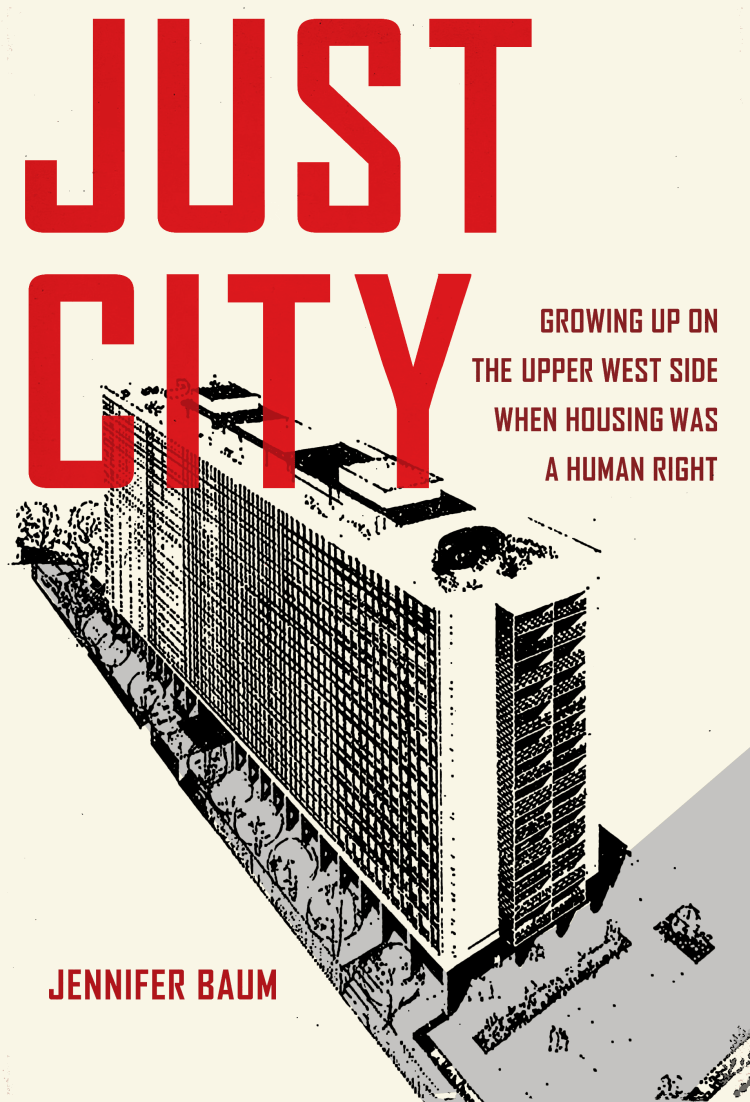
Review of Jennifer Baum, Just City: Growing Up on the Upper West Side When Housing Was a Human Right (Fordham University Press, 2024).
Reviewed by Jonathan Ezra Goldman
New York’s Mitchell-Lama Housing program, launched in 1955, has permeated discussion of New York City public housing in 2026. “Block by Block,” the housing plan put out by the Mayor’s Office, called Mitchell-Lamas “the keystone of affordable cooperative housing in the country, a pioneer of mixed-income development, and a model for resident voice in building governance.” The document proposed new “Mitchell-Lama-style” construction in Sunnyside, Queens and promised to dedicate money and resources to addressing capital issues of the roughly 44,000 Mitchell-Lama homes spread among 90 buildings that the city oversees. The alluded-to struggles of Mitchell-Lamas have drawn other scrutiny, including an audit by the comptroller’s office and City Council hearings on the topic of “Keeping Mitchell-Lama Housing Affordable” prompted by one development’s alarming raises in rent.
This renewed attention creates serendipitous timing for the paperback release of Jennifer Baum’s Just City: Growing Up on the Upper West Side When Housing Was a Human Right, originally published in 2024 by Fordham University Press. The book is part memoir, part paean to the Mitchell-Lama program, and part oral history of public housing in what was called the West Side Urban Renewal area. It is not an urban studies scholar’s or historian’s history of Mitchell-Lama program; it is closer in spirit to, say, Homes for Living by Jonathan Tarleton, which probes the issue of public housing turning private through the lens of two subsidized housing developments as case studies. Baum, without the urban planning background of Tarleton, uses her storyteller instincts and the fascinating particularities of Michell-Lama buildings to expose the complexities of New York City public housing. She is an amiable guide, and the book’s pleasures include archival images, especially city planning documents.
That Baum’s title echoes Patti Smith’s memoir Just Kids makes sense, as Just City is too a wistful revisit to a bygone era. The past tense in Baum’s subtitle both reflects her nostalgia and her view that the city’s public housing policy has lost its humanity over the decades. Within the narrative, the polemical message is first shown rather than told, as Baum earns the reader’s trust. About midway, Baum frees herself to inveigh against the 21st-century city’s homogenization, gentrification, and segregation, and the role played in all that by Mitchell-Lamas going private.
Memoir structures the volume. Baum recounts her family moving in to RNA House as it opens in 1966, the commitment of her parents and other residents to urban living, their devotion to a Jane Jacobs vision of the city, their ethos of mutual aid and progressive politics. The family origin story pairs with a brief history of the Limited-Profit Housing Companies Act, colloquially known as the Mitchell-Lama bill after its sponsors in state government, MacNeil Mitchell and Alfred Lama. The bill, Baum explains, aimed “to provide affordable rentals and cooperative apartments for thousands of middle-income New Yorkers” like, she adds poignantly, “my family.”1 Foreshadowing later chapters, Baum introduces the detail that buildings could opt out of the program after twenty years.
The ensuing narrative is enriched by interspersed reminiscences of neighbors from RNA and other Mitchell-Lamas, who remember the racial diversity of the residents, the same-sex couples, the mix of economic backgrounds. One interviewee thinks of Tower West, at 96th and Columbus, as “a small town in the midst of a metropolis,” encapsulating the book’s overall view of buildings in the program, at least during the late 1960s through the 1980s, the years of Baum’s youth.2 Baum conveys a sense of a neighborhood dotted with such communities, neighborly street and playground cultures, family-run businesses, and interracial community-room dance parties with Willie Colón playing.
Not all is utopia, however. At RNA house, some self-segregation sets in, manifesting in school choice and even apartment elevation. Baum is caught between worlds; a thoroughly middle-class Jewish girl, she attends first P.S. 75 before getting sent off to the tony Columbia Prep, where for the first time she develops resentment for her family’s financial limits and reliance on public housing. The teenaged Baum fails to see the boon that Mitchell-Lama offered, the way it “eased [her] family’s financial strain,” taught her tolerance and inclusiveness, and provided community not easily found in a megalopolis.
Baum eventually leaves the nest, leaves New York City, and then comes back. While unfurling these personal stories, Baum digresses into historical details of Mitchell-Lama and other public housing programs of the time. Eventually, the biographical details start mattering less, all except one: when her mother passes away, Baum, per Mitchell-Lama regulations, has no succession rights. Her sense of loss is mitigated by appreciation for the principles of public housing, and spurs the book’s substantial contemplation of privatization, in which Baum surveys buildings throughout the much-changed Upper West Side of the 2000s that have debated and voted to stay in or leave the program. She recounts campaigns that turn vicious, including the one at RNA house, where the pro-privatization faction spreads fear and deliberate misinformation, claiming that staying in Mitchell-Lama would mean that “homeless people” would be moving in, along with “not the kind of people we knew growing up.”3 Baum includes a plethora of voices—full disclosure: I, as lifetime Mitchell-Lama cooperator, was interviewed for this part of the book—decrying the loss of public housing and a few others. One neighbor sums up much of the ethics of the argument, saying “The city is becoming too exclusive, and forgetting that we were once the entry city for inclusivity to our nation.”4 Dissent is not always brushed aside: Baum acknowledges that for Black residents, there is a valence to home ownership that goes beyond the question of whether privatizing is good economics. It is one of several places in the book where Baum makes gestures toward reckoning with her own privilege and registers how the more precarious histories of others can lead to different conclusions.
Baum allows herself, here at this late stage of the book, to weigh in from her own experience and observation: “There must be a consensus, by the public and politicians, that housing is a human right, that earlier legislation funding affordable housing was beneficial to the common good, and that we need similar legislation today.”5 Her girl-next-door plea and plaintive language renders it simple; but it isn’t that simple, surely?
Although Baum sets up the book’s idiosyncrasies and limitations nicely, some readers might still wish for greater historicization of the Mitchell-Lama program and principles that Baum espouses in general. For that they might go to, say, Robert Fogelson’s writings that trace the Mitchell-Lama ideal to the 1920s and an unsuccessful proposal by Al Smith.6 Indeed, 1920s NYC saw cooperative precursors to Mitchell Lamas in the form of, for example, the Amalgamated Houses in the Bronx and Amalgamated Dwellings on the Lower East Side for union members and their families.7 It was in 1920 that New York passed its first version of rent control, and that year, the The Evening World bruited about the idea that housing might be a human right: “greedy landlords” were “driving tenants to the conclusion that the only remedy open to them is the definition of housing as a public utility.”8
Just City stands on its merits, an unprepossessing reminder of the presence in our midst of an ambitious social housing program that has helped thousands of New Yorkers find financial stability in the midst of the city. Baum’s message matches a view that “Mitchell-Lama is an essential program with much to teach us and we cannot allow it to be relegated to the past and we must fight to ensure that it has a long future ahead of it.” That was then-Public Advocate Letitia James’s testimony at a state assembly hearing in 2016, still needed as a call to action today.
Jonathan Ezra Goldman (he/him) is Distinguished Professor in the Department of Humanities, New York Institute of Technology, author of Hidden Histories of Jazz Age New York from the Suppressed to the Strange, and Modernism Is the Literature of Celebrity and editor of the collections Joyce and the Law and Modernist Star Maps. He directs the digital project, NY 1920s: 100 Years Ago Today, When We Became Modern, and is president of the James Joyce Society. He lives in the Mitchell-Lama building where he grew up.
- Jennifer Baum, Just City: Growing Up on the Upper West Side When Housing Was a Human Right, (New York: Fordham University Press, 2024), 3.
↩︎ - Baum, 41. ↩︎
- Baum, 209. ↩︎
- Baum, 199. ↩︎
- Baum, 200. ↩︎
- Robert M. Fogelson, Working-Class Utopias: A History Of Cooperative Housing In New York City, (Princeton: Princeton University Press, 2022), 103 ↩︎
- Nicholas Dagen Bloom, Public Housing that Worked, (Philadelphia: University of Pennsylvania Press, 2008), 17.
↩︎ - The Evening World, August 2, 1920, 14 ↩︎

