
This is the fourth entry in our 10th Annual Graduate Student Blogging Contest, “Revolution.”
By Heather N. Jahrling
White police in white helmets.
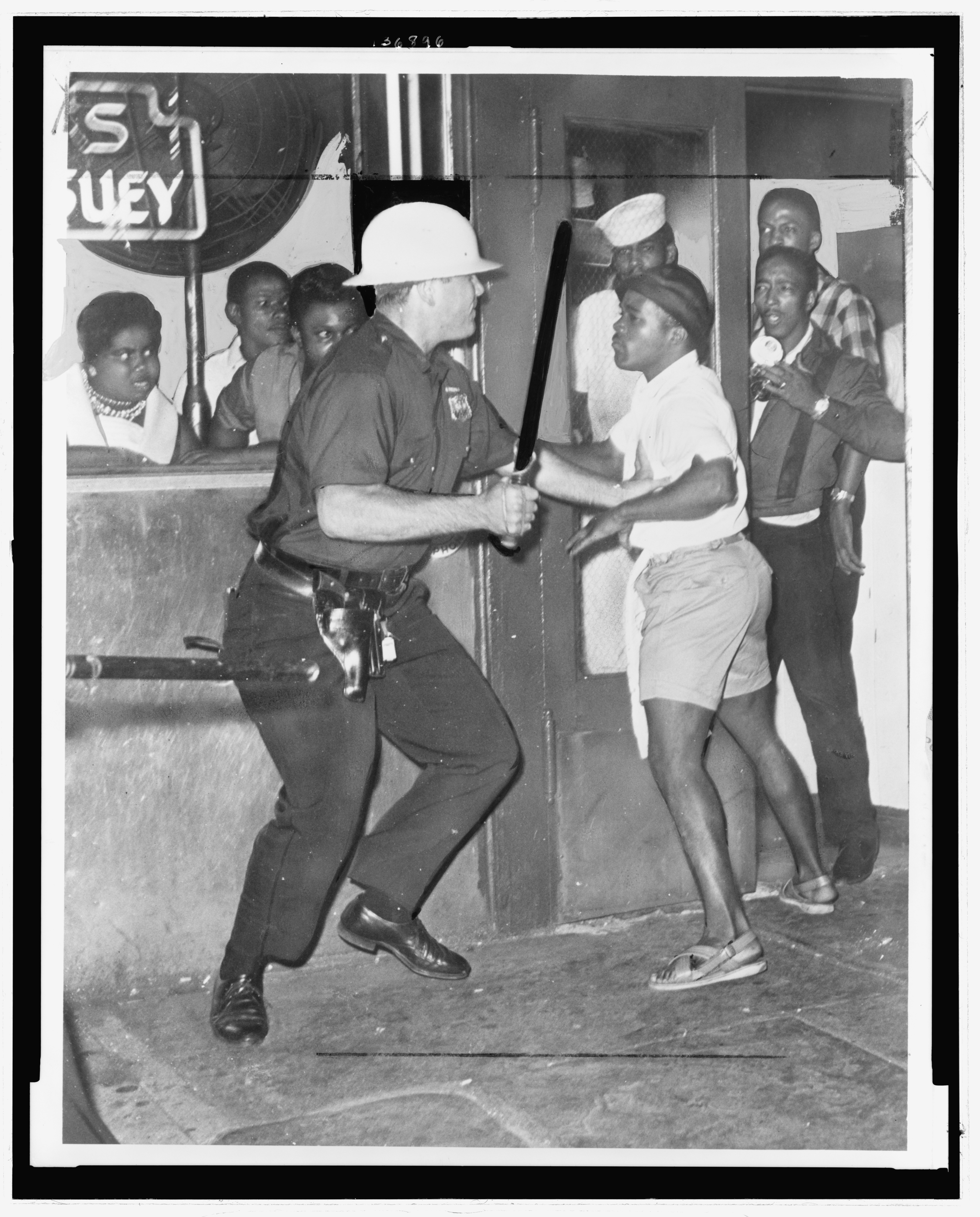
Jimmy Breslin spotted them in Harlem in July 1964, as protests over the fatal police shooting of fifteen-year-old James Powell spiraled into six days of fiery disorder: “The cops were everywhere, four and five of them on a street corner,” he wrote for the Herald Tribune, “wearing white steel helmets.”
Breslin was hardly alone in noticing patrolmen under “steel hat[s].”1 Inside a bar at 125th Street and Seventh Avenue, a reporter for the New York Amsterdam News found Harlemites confronted by “helmeted Cossacks.”2 The same domed helmets bobbed through David Henderson’s 1967 poem “Keep on Pushing,” as he framed the white occupation of the Black metropolis: “Phalanxes of police / march up and down / They are dispatched and gathered helmet heads.”3
A few blocks away, in East Harlem, members of a Puerto Rican peace patrol feared these “helmet heads” would inflame tensions in their own community. As the patrol’s founder put it to Gay Talese of the New York Times, “When we see helmets, we think of war.”4
By the long, hot summer of 1964, Manhattan police had amassed hundreds of military-style helmets. In a July 25th memorandum to Police Commissioner Michael Murphy, precinct commanders reported their helmet inventories—90 in the 19th, 101 in the 22nd, 150 in the 26th, 144 in the 34th, and so on—while the Operations Bureau tallied more than 1,500 across the borough, ready for domestic deployment.5
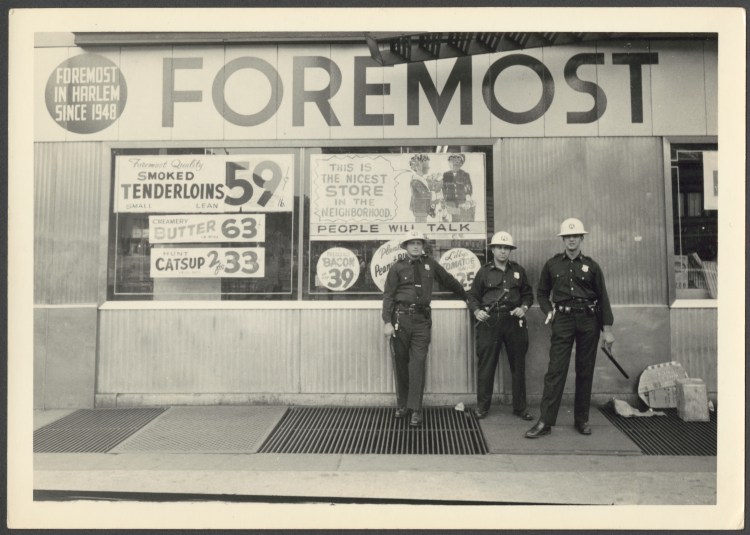
As helmets recurred across photographs, inventories, and press coverage, I continued to circle the same core questions: Where did all these white steel helmets come from? Why did precincts across Manhattan stockpile them in the hundreds? And why did the helmets’ insignias (take a close look at the photograph above) differ—some marked with “PD,” others with a red-and-white-striped triangle inside a blue circle?
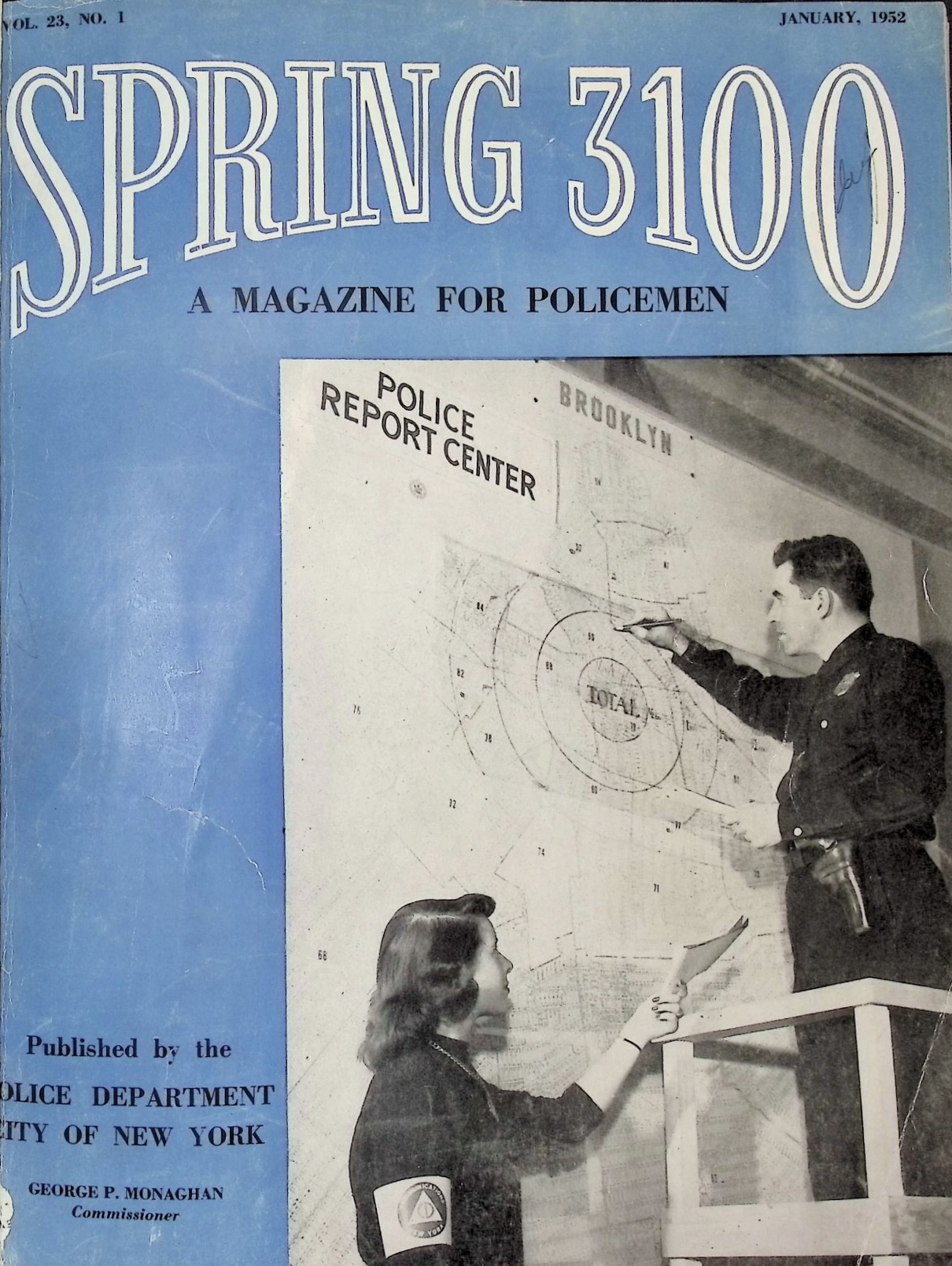
Unexpectedly, these loud helmets in Harlem led me to the source of a silent revolution in American law enforcement: Cold War civil defense. While most people know civil defense through the famous “duck and cover” drills and yellow fallout shelter signs, the program was far more expansive (see the nationwide civil defense campaign “Alert America”). Civil defense promised to protect American “life and property” from atomic attack through coordinated federal, state, and local preparedness efforts.6 Created by Congress in 1950, the Federal Civil Defense Administration (FCDA) divided these ambitious efforts into ten major volunteer services: warden, police, fire, rescue, engineering, health, welfare, supply, transportation, and staff. At the local level, civil defense directors often structured their survival programs around police services, leaning on their preexisting personnel, command structures, and emergency infrastructure. For civil defense planning director Russell J. Hopley, police, then, were the lifeblood of the entire program: “Not only will the direct police functions of protection and preservation of order be of prime importance in an emergency, but all the varied services of civil defense will be effectively performed only if the police successfully perform their tasks.”7
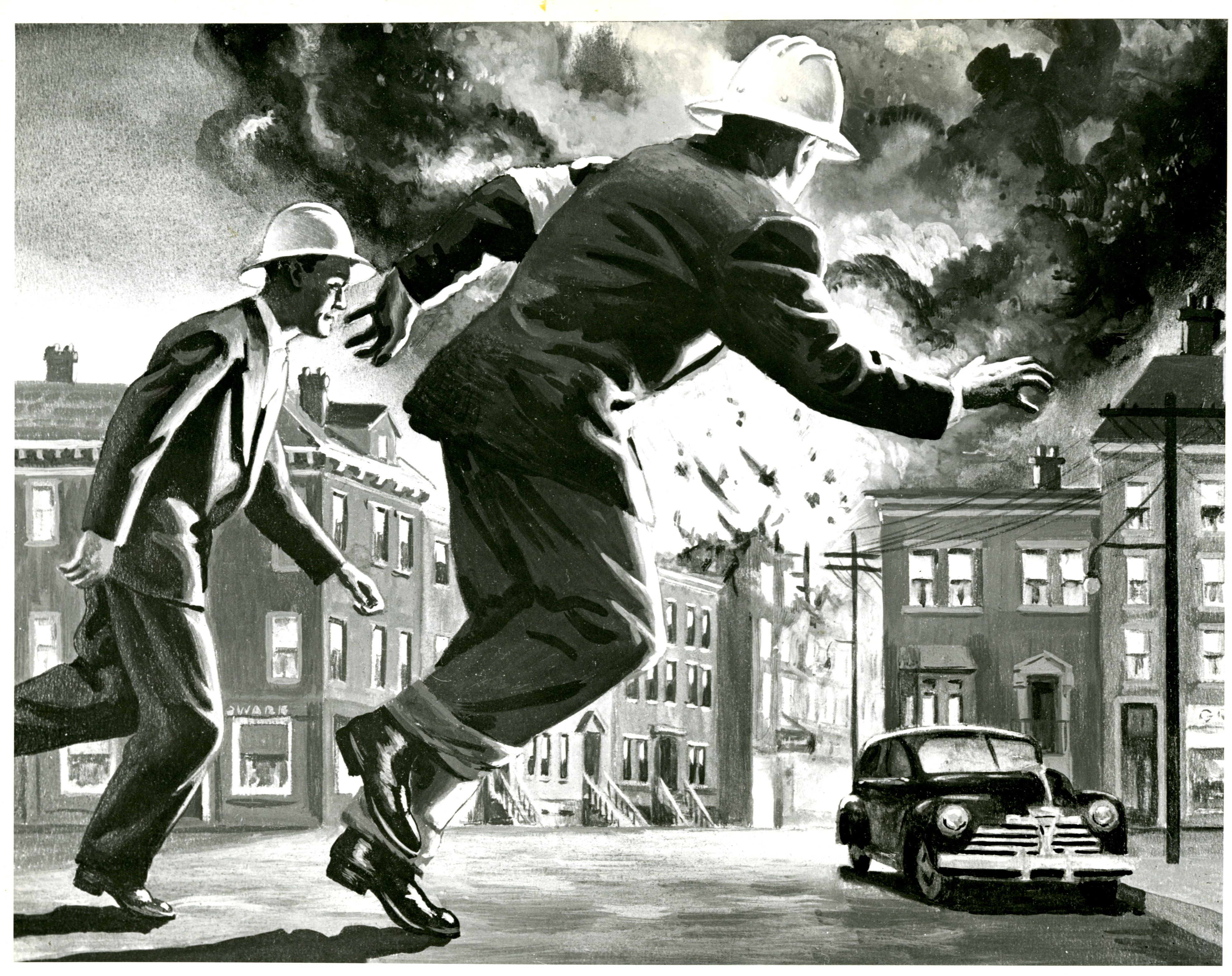
In preparation for what federal officials publicly called an “all-out, smashing attack that struck a dozen of our cities at once,” the FCDA tasked police services with controlling crowds, directing traffic, coordinating communications, and preventing panic (listen to CD Director Arthur Wallander interview Police Commissioner Thomas F. Murphy).8 In New York, police also supervised the air warden service and ground observers as part of their “heavy extra duties.”9 While wardens formed a vast network of neighborhood volunteers trained to guide their communities to safety, ground observers scanned the skies for enemy aircraft to warn the public. Nowhere did these police tasks matter more than in urban areas like New York City, where dense concentrations of population and industry made them “prime targets.”10 Imagining their cities as the nation’s atomic bullseyes, anxious municipal leaders across the country demanded heavy extra equipment to match their heavy extra duties.
That equipment came from the largest surplus stockpile in American history. When World War II ended, the federal government was saddled with some forty billion dollars’ worth of property—aircraft, trucks, tanks, firearms, radios—suddenly transformed from wartime necessities into “disposable” peacetime surplus.11 In 1956, under the threat of nuclear war, concerned lawmakers authorized surplus donations to civil defense agencies for national security purposes. That critical decision placed civil defense alongside only two other American sectors—education and public health—with priority access to free federal property. Civil defense agencies, and through them police services, could then accept motor vehicles, motorcycles, generators, weapons, and, of course, helmets: “PD” for police, a striped triangle for air wardens. In other words, the hundreds of white steel helmets in Harlem were meant to shield against debris after a detonation, not bricks and bottles thrown from rooftops.
Yet by the summer of 1964, these donated helmets were being used not to protect residents from atomic attack but to police Black communities during urban unrest. This was not the first time civil defense had turned to civil offense. In theory, federal restrictions limited the use of surplus property to three civil defense purposes: readiness, training, or reserve stockpiles. In practice, recipients often diverted equipment from these authorized uses. A 1962 audit by the General Accounting Office found that civil defense personnel, particularly police services, consistently used surplus property for “normal needs.” One department converted a “38-foot picket-boat into a police patrol boat”; shotguns and revolvers intended for emergencies were “issued to regular police for use in normal police duties”; and seven of twelve helicopters approved for civil defense were instead being used for ordinary governmental work.12 Taken together, these cases reveal more than isolated misuse. They expose the complex infrastructure of that silent revolution: a federal pipeline moving surplus property, albeit indirectly, into local police hands well before politicians declared a war on crime.
As an urban historian, the year 1968 has been burned into my brain. Historians have largely traced the origins of police militarization back to that year, particularly to President Lyndon B. Johnson’s Omnibus Crime Control and Safe Streets Act. Passed largely in response to the urban uprisings of the 1960s—Harlem’s among them—the act created the Law Enforcement Assistance Administration (LEAA) to funnel federal money and property directly into local police departments for the war on crime. Elizabeth Hinton refers to this intervention as a “law enforcement revolution,” one firmly steered by the federal government. As she convincingly claims, the legislation created “a direct role for the federal government in local police operations…for the first time in American history.”13
The scale of that revolution is difficult to overstate. By the 1970s, the LEAA had become the fastest-growing federal agency, distributing billions of dollars through grants and equipment transfers. But its scale was matched by its visibility: this was a revolution written into federal law, debated in Congress, and publicly announced as a fundamentally new relationship between Washington and local police.
If the LEAA marked a de jure revolution in American law enforcement, then civil defense marked a de facto one—an earlier transformation never legislated as crime control at all. This earlier history does not diminish the importance of the LEAA or undermine Hinton’s account of the revolution it produced. Rather, considering the two transformations in tandem—the de jure revolution Congress enacted in 1968 and the de facto revolution civil defense had been quietly building for more than a decade—widens both the chronology and the scope of police militarization and, in turn, our understanding of what Heather Ann Thompson calls the “criminalization of urban space.”14
The war on crime that targeted low-income urban communities of color did not build its federal-to-local pipeline from scratch. It inherited and intensified one first constructed under the shadow of the bomb.
Heather N. Jahrling is a Ph.D. candidate specializing in twentieth-century American urban, technological, and carceral history at Princeton University. Her dissertation, “Beyond the Bullseye,” offers a new framework for understanding the origins of America’s postwar urban crisis: Cold War civil defense. Her research for this post was supported in part by the Gilder Lehrman Scholarly Fellowship in Cold War Studies. You can follow her on Bluesky @heatherjahrling.bsky.social
Featured Image (at top): Civil defense helmets were improvised riot gear, preceding the plastic visored helmets that would more fully armor police against bricks, bottles, and other projectiles later in the decade. Source: Shawn W. Walker, Police in “Riot Gear” (Civil Defense Helmets) after Riot on 125th Street, Harlem, 1963–1964, gelatin silver print, Library of Congress Prints and Photographs Division, Washington, DC, https://www.loc.gov/pictures/item/2021638451/.
- Jimmy Breslin, “Fear and Hate—Sputtering Fuse,” New York Herald Tribune, July 20, 1964.
↩︎ - “Another Look at ‘Why the Harlem Riots?’” New York Amsterdam News, August 1, 1964, 3.
↩︎ - David Henderson, “Keep on Pushing,” in The East Side Scene: American Poetry, 1960–1965, ed. Allen De Loach (Garden City, NY: Anchor Books, 1972), 125.
↩︎ - Gay Talese, “Puerto Rican Peace Patrol Acts to Keep East Harlem Calm,” New York Times, July 23, 1964, 13.
↩︎ - Alexander Walchak to Michael Murphy, memorandum, July 25, 1964, folder “Papers of Detective Gilligan CORE Report,” box 1, New York Police Department Demonstrations and Disturbances Records, New York Municipal Archives, New York, NY. ↩︎
- U.S. Congress, Senate, Subcommittee of the Committee on Armed Services, Hearings Before a Subcommittee of the Committee on Armed Services, United States Senate, Eighty-First Congress, Second Session, on S. 4217 and S. 4219, to Authorize a Federal Civil Defense Program, and for Other Purposes, December 6, 7, 8, 11, and 12, 1950 (Washington, DC: Government Printing Office, 1950), 1.
↩︎ - Russell J. Hopley, Civil Defense for National Security (Washington: U.S. Government Printing Office, 1948), 136.
↩︎ - Federal Civil Defense Administration, Annual Report for 1951 (Washington, DC: Federal Civil Defense Administration, 1952), ix.
↩︎ - Ibid., 58.
↩︎ - Associated Universities, Inc., Reduction of Urban Vulnerability, part 5 of the Report of Project East River (New York: Associated Universities, Inc., 1952), 1.
↩︎ - Senate Committee on Expenditures, “Investigation of Surplus Property and Its Disposal” (Washington: Government Printing Office, 1948), 2.
↩︎ - Joseph Campbell, Review of Federal Surplus Property Program, Office of Civil and Defense Mobilization, Executive Office of the President: Report to the Congress (Washington: U.S. General Accounting Office, October 1962), 1.
↩︎ - Elizabeth Hinton, From the War on Poverty to the War on Crime: The Making of Mass Incarceration in America (Cambridge, MA: Harvard University Press, 2016), 2.
↩︎ - Heather Ann Thompson, “Why Mass Incarceration Matters: Rethinking Crisis, Decline, and Transformation in Postwar American History,” The Journal of American History 97, no. 3 (December 2010): 706.
↩︎


Such an eye-opening deep dive by Heather Jahrling into the de facto roots of police gear pipelines.
LikeLike