
This is the second entry in our 10th Annual Graduate Student Blogging Contest, “Revolution.”
By Vanessa Christman
I must have driven my husband insane when we first tuned into Apple TV’s The Studio. Instead of enjoying the comedic hijinks, I went heavy on the pause button to examine the fictional Continental Studios headquarters. A tour guide in the show calls it “a Frank Lloyd Wright building, built in 1927, in his signature Mayan style,” a “temple of cinema.”1 The building is a set, but a good enough one that architecture magazines ran pieces clarifying it is a television homage, not real.2
That style has a name. Mayan Revival swept Los Angeles in the 1920s, lifting the iconography of ancient Maya sites and stripping it of its context. I grew up near Los Angeles and never passed one of these buildings without fuming, as a former archaeology undergrad would, about the conflation of Aztec and Maya. The most dilapidated of them, the Aztec Hotel out on old Route 66 in Monrovia, is where Robert Stacy-Judd, the architect who popularized the style, first plied his trade. The show’s small joke, Wright and “Mayan” and a studio “temple,” compresses a whole history of who borrowed the Maya past, from whom, and to what end. Follow that thread far enough and it runs to a revolutionary socialist government in Yucatán.
Imperial Discovery, Commercial Form
Los Angeles’s Mayan Revival architects, like Frank Lloyd Wright and Robert Stacy-Judd, drew from the headwaters of imperial discovery. In 1841 and 1843, the American traveler John Lloyd Stephens and the British artist Frederick Catherwood published their illustrated accounts of the Maya ruins and made a revolutionary claim for their moment: that the ancient cities were built by the ancestors of the living Maya, not by wandering Egyptians, lost Israelites, or refugees from Atlantis.3 It was a real flip of the Eurocentric script, and an incomplete one. The living Maya appeared in their accounts as the help, and their ancestors’ artifacts, even their bones, left the country as cargo.4 Stephens and Catherwood divorced the living from their inheritance, founding Mesoamerican archaeology on a U.S. claim of possession: the Maya past belonged to whoever could document, cast, and possess it.
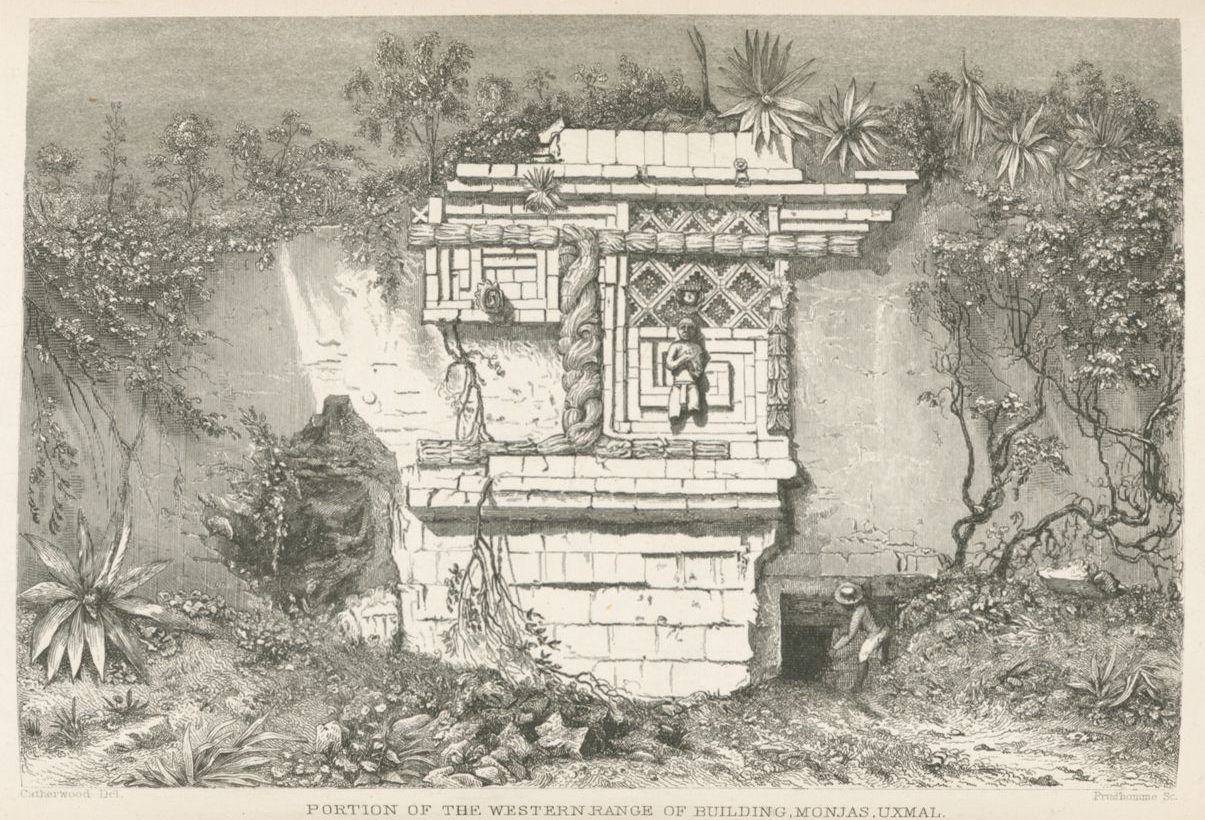
The plaster casts that carried those same politics into Los Angeles were made in Yucatán by a man from Massachusetts. Edward Thompson, the U.S. consul at Mérida, prepared full-size casts of the great portal at Labná and three structures at Uxmal for Chicago’s 1893 World’s Columbian Exposition. The Peabody Museum staged them at the rear of the fairgrounds, in the section reserved for the customs and arts of native peoples, at a fair celebrating four hundred years of progress since pre-Columbian times.5
Frank Lloyd Wright never saw the ruins in person. He said the ancient architecture of the Americas had stirred his wonder as a boy, while also insisting that no outside influence, foreign or native, had ever touched his work. What he had were Stephens and Catherwood’s volumes, Désiré Charnay’s photographs, and the casts themselves, which he visited repeatedly at the fair in 1893 while working on Chicago’s Adler and Sullivan’s Transportation Building. He carried them to Los Angeles thirty years later, metabolized into an abstract system he would cast in concrete at the Hollyhock (1921) and Ennis (1924) houses. 6
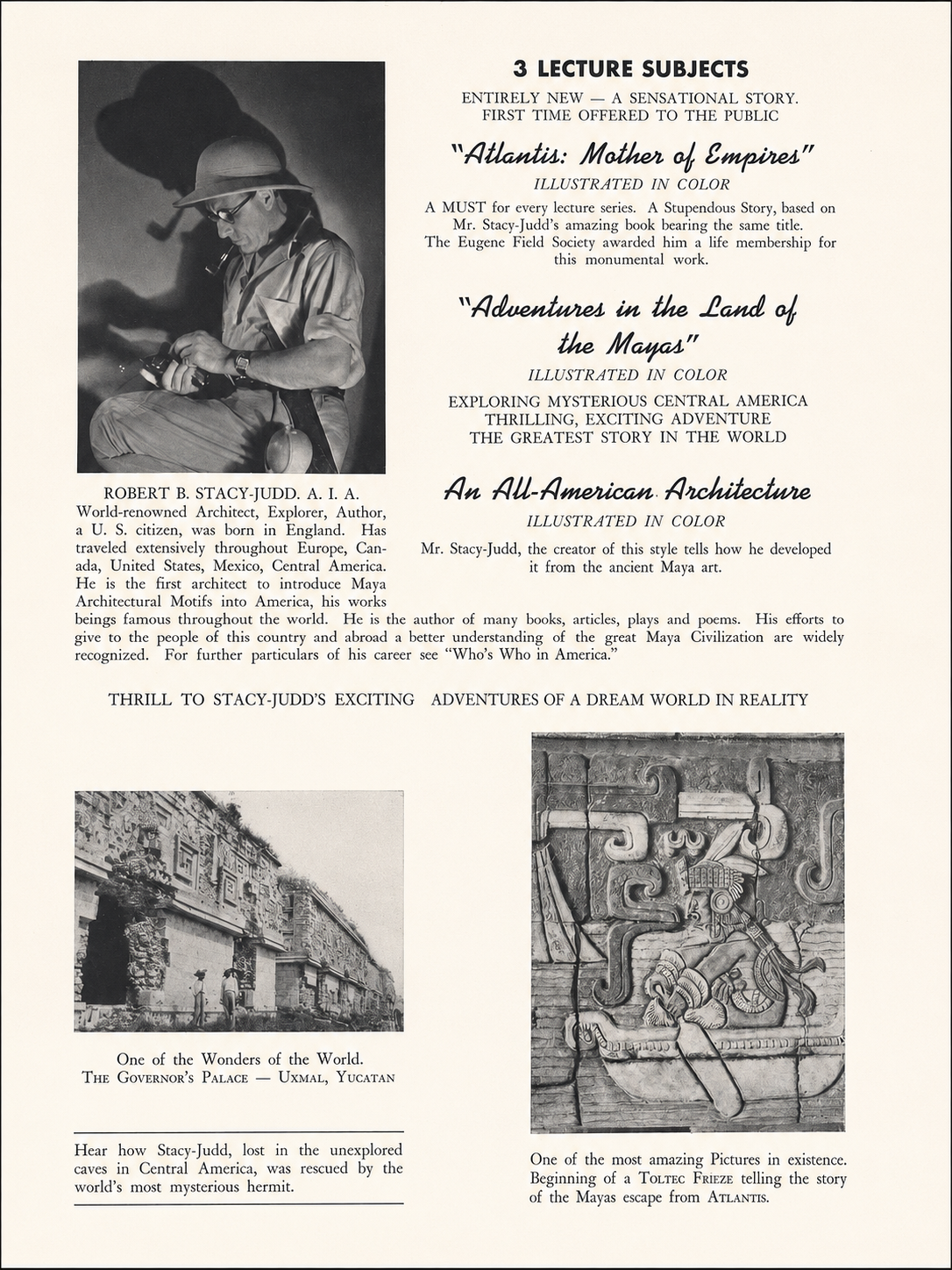
Robert Stacy-Judd, a self-mythologizing British émigré, also came to the style through Catherwood’s etchings and performed the part, having himself photographed in both a pith helmet and a plumed “Maya lord” headdress. He later published Atlantis: Mother of Empires (1939) and lectured on it for years, arguing that the ancient Maya were too accomplished to have been Indigenous and must have descended from Atlantis.7 He had visited Yucatán by then. It did not change his mind.
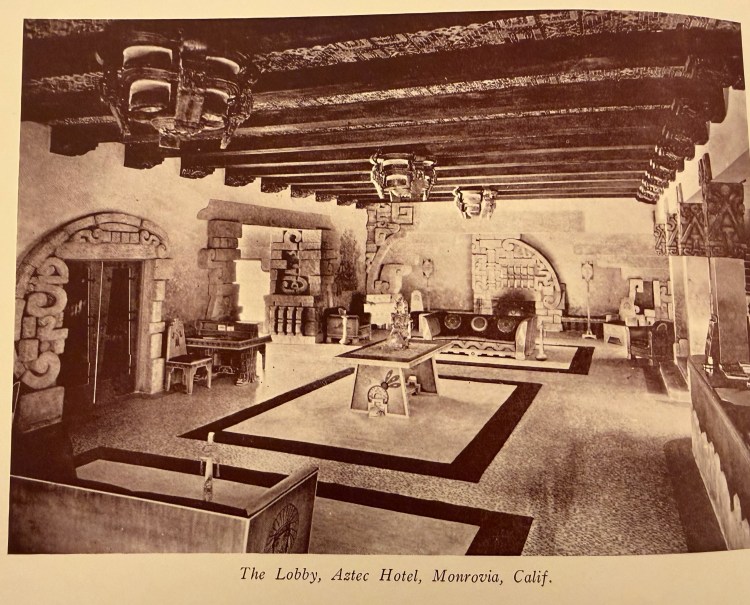
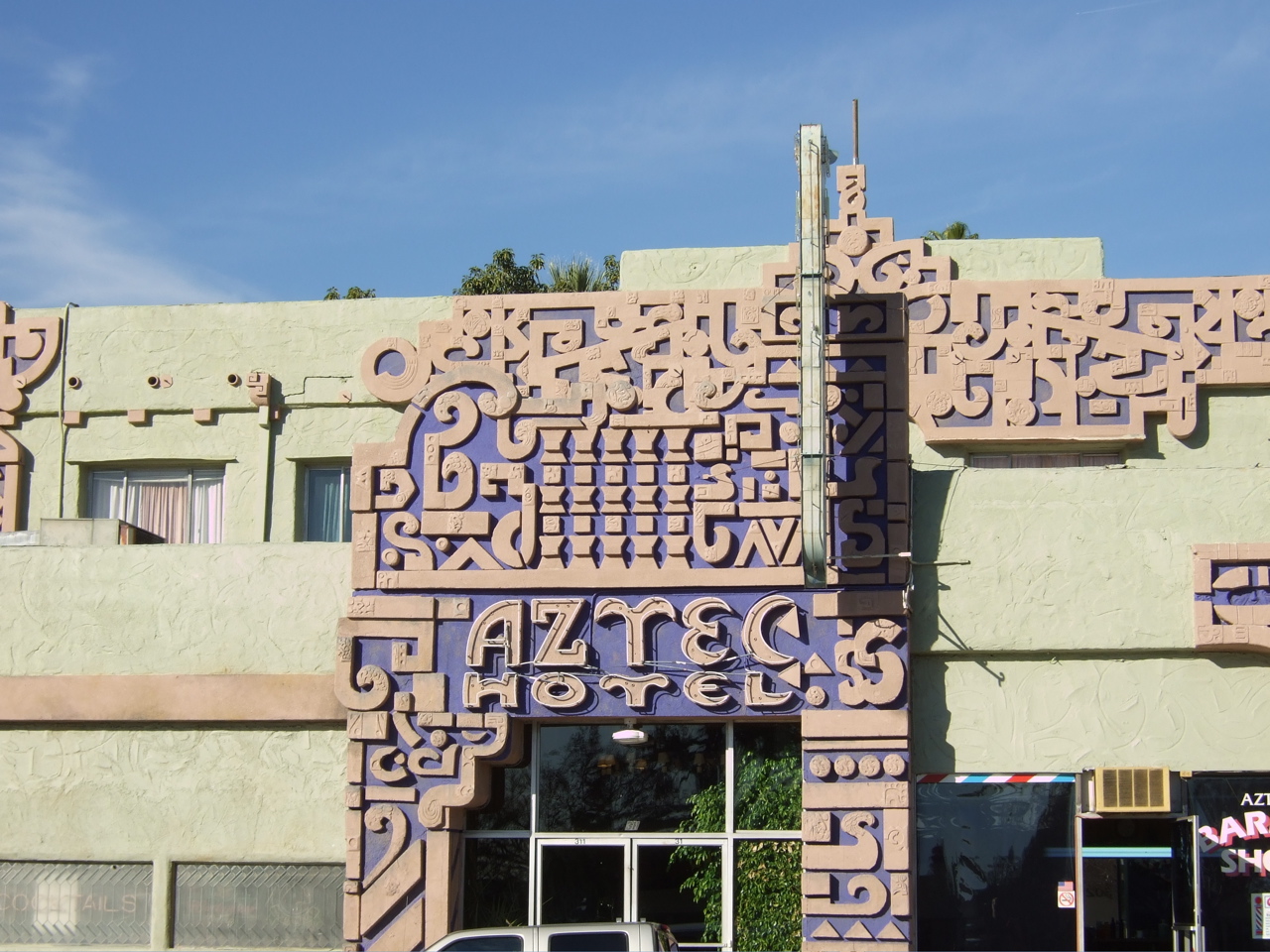
Stacy-Judd’s Aztec Hotel opened on Route 66 in Monrovia in September 1925, and the name gives the game away. By his own account he arrived at the plan first and clothed it in Maya motifs afterward. He named it Aztec because he judged that the word Maya meant nothing to the layman, “although all the decorative motifs are Maya.”8 The Monrovia Chamber of Commerce got it built, raising nearly $140,000 from local residents who bought into the vision.9
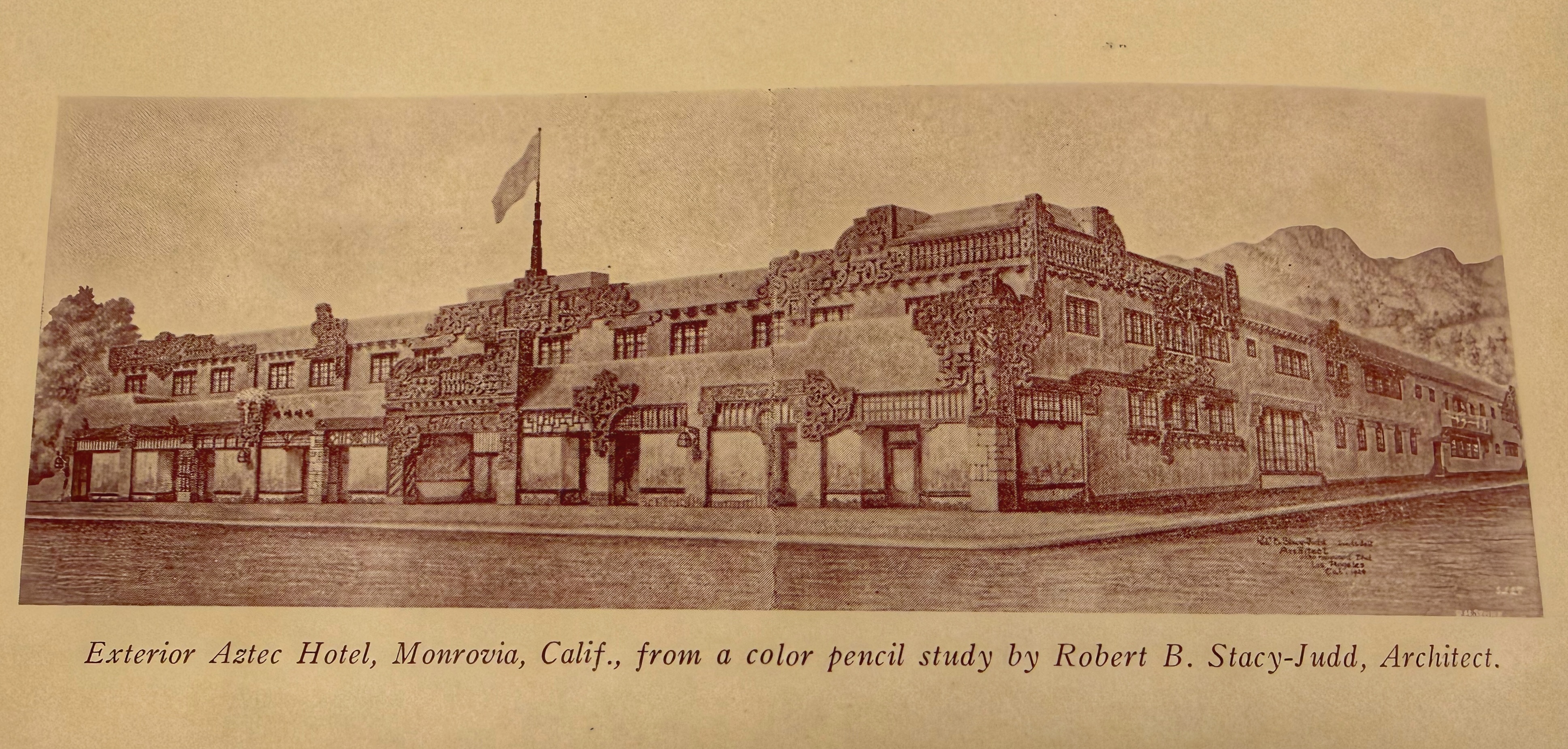
This is the distinction The Studio’s sight gag flattens. Popular memory collapses Wright and Stacy-Judd, “Maya” and “Aztec,” into one exotic mishmash. But you cannot lift the mask of a Maya rain god and keep only its shape. What Stacy-Judd sold to Monrovia as decoration was a living people’s system of meaning, taken without its name.
Neo-Maya in Revolutionary Mérida
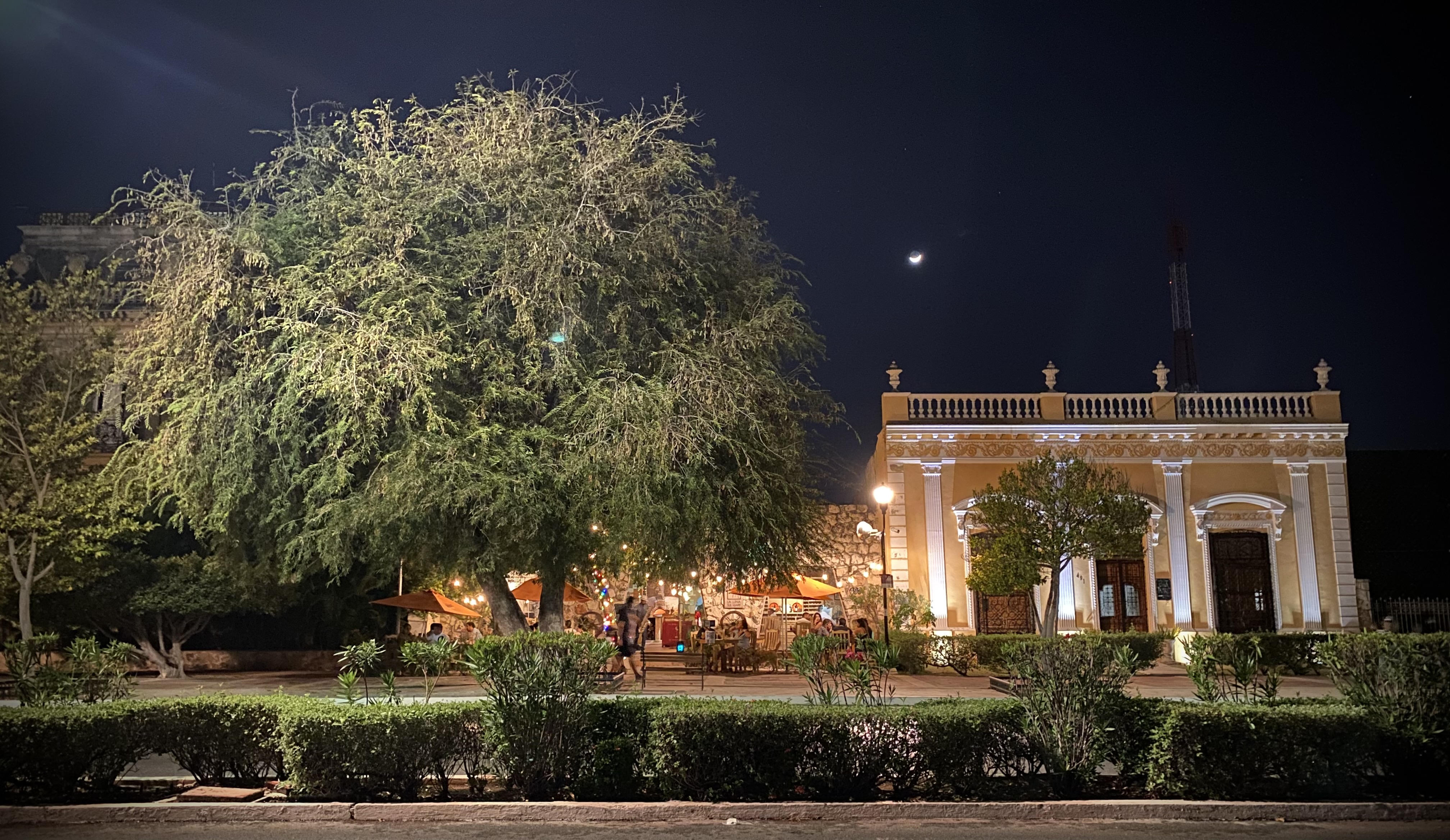
Some fifteen hundred miles south, the same borrowed motifs were made to do the opposite. Mérida’s wealth came from henequen, the sisal fiber that bound the world’s harvests before synthetic twine, grown on estates worked by Maya labor. The interconnected oligarchy that owned them became known as the Casta Divina, the Divine Caste, and they built their prestige on Spanish descent, which in their minds set them above the Maya and mestizo majority whose labor made their fortunes.10 They built their houses to match, lining the Paseo de Montejo with French Beaux-Arts mansions raised from European blueprints and Carrara marble.11
Arquitectura Neomaya went to Uxmal and Chichén Itzá directly, without the Western travelogues. It was aimed at the men on the Paseo de Montejo.
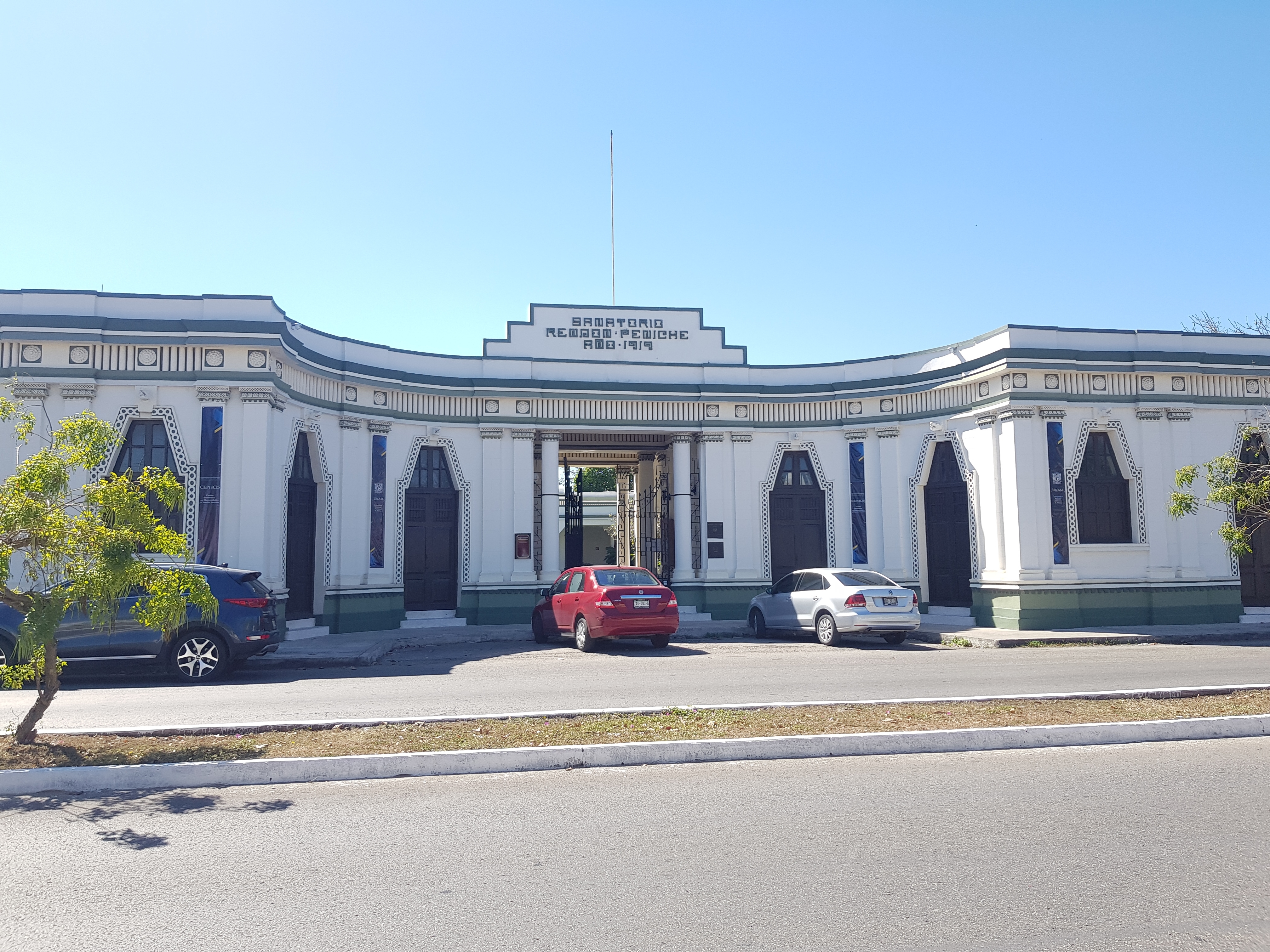
Manuel Amábilis went first, and he built for the state. He joined the freemasons and the revolutionary government in 1915, and in 1918 gave Mérida’s Masonic Temple a Neo-Maya facade laid over a colonial chapel. The following year he persuaded the railway workers’ union to put Neo-Maya finishes on the Sanatorio Rendón Peniche, a hospital an American architect had already designed. Salvador Alvarado, the revolutionary general governing Yucatán, had seized the oligarchy’s railways and seated the union on the board. The hospital opened in 1920 for those workers: Maya forms, socialist medicine, and the planters’ own confiscated infrastructure, in one building.12
There is a complication. Amábilis was a Paris-trained elite, and the revival he helped launch was, as Gilbert Joseph put it, a “revolution from without”: mestizo intellectuals deploying Maya symbolism on behalf of the Maya majority.13 He also believed, as Stacy-Judd did, that the Maya had come from Atlantis, and published a book saying so.14 Whether the Yucatecan revival was Indigenous reclamation or a state’s use of Indigenous heritage is contested, and it should be.
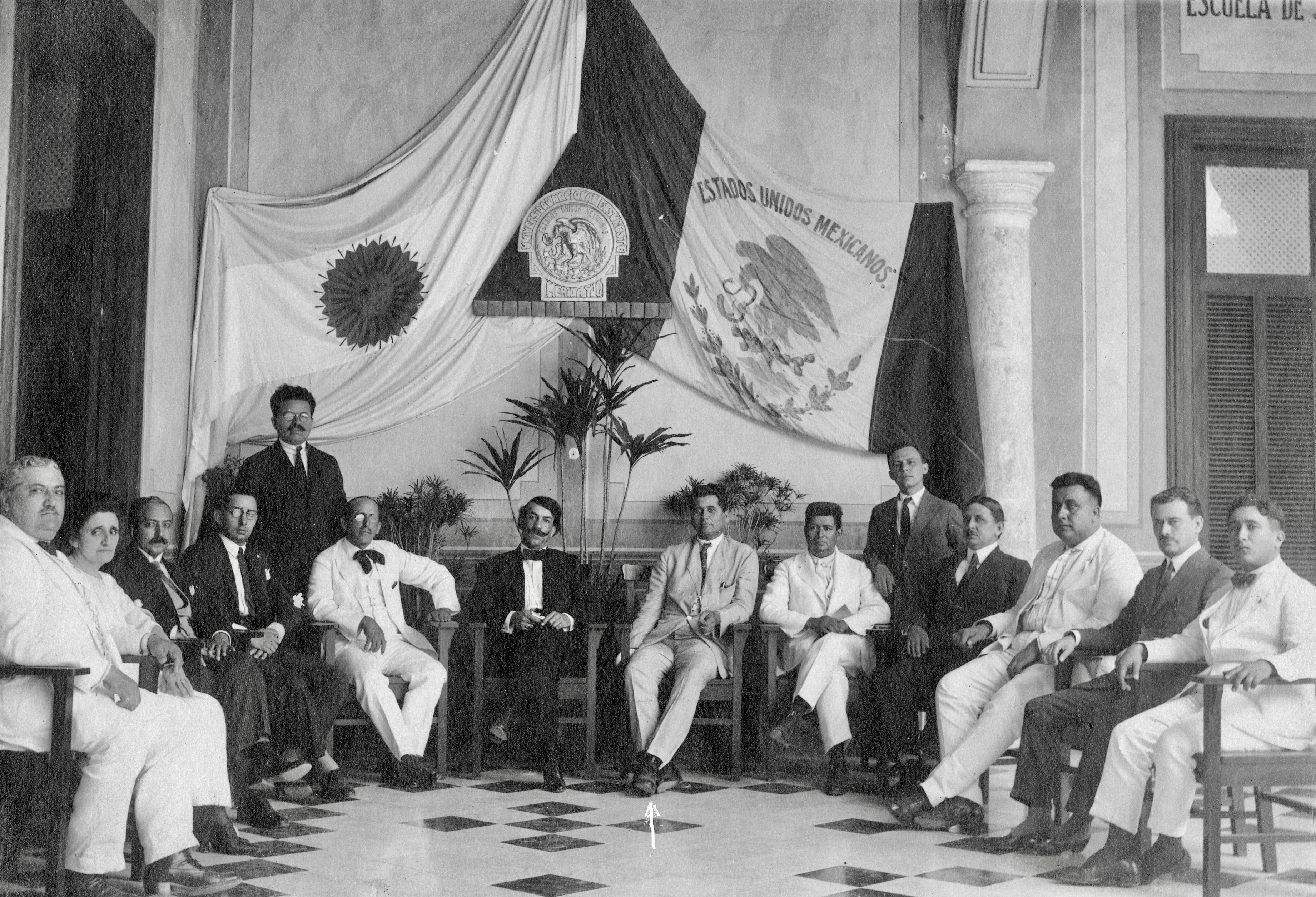
The union that hired Amábilis produced the next governor. Felipe Carrillo Puerto took office on February 1, 1922, at the head of what its historians call the first socialist government in the Americas. A shopkeeper’s son who never claimed Maya ancestry, he was fluent in Peninsular Maya and delivered his inaugural address in it.15 Then the land started moving. Every Thursday, land went out to Maya campesinos, taken from the henequen plantations that had enriched the Casta Divina: 311,241 hectares to 14,675 workers across 56 towns in the first seventeen months alone.16 His government paved the road from Mérida to Chichén Itzá, opening the ancient city to the people whose ancestors built it. He did not borrow the Maya past for spectacle. He was giving back the ground it stood on.
On January 3, 1924, a military faction aligned with the henequen oligarchy tried Carrillo Puerto before a court martial and shot him against a wall of Mérida’s cemetery, along with three of his brothers and eight associates.17 Carrillo Puerto’s government was brief. Its architecture outlived it.
The Address of the People
La Casa del Pueblo was completed in 1928, by which point the governorship had passed to Álvaro Torre Díaz, an Alvarado aide who had argued in 1918 that Yucatán’s Maya majority could not be trusted to hold office until properly educated.18 Amábilis had laid the theoretical groundwork, but the design fell to an Italian immigrant, Ángel Bachini. Its style came from the same Uxmal and Chichén Itzá iconography Stacy-Judd sketched for his California hotel. Its purpose was a union hall and community meeting place, the institutional body of the movement Carrillo Puerto had died for. The same rain-god masks of Chaac that appeared as commercial kitsch in Monrovia here presided over the working life of the people whose ancestors carved them.
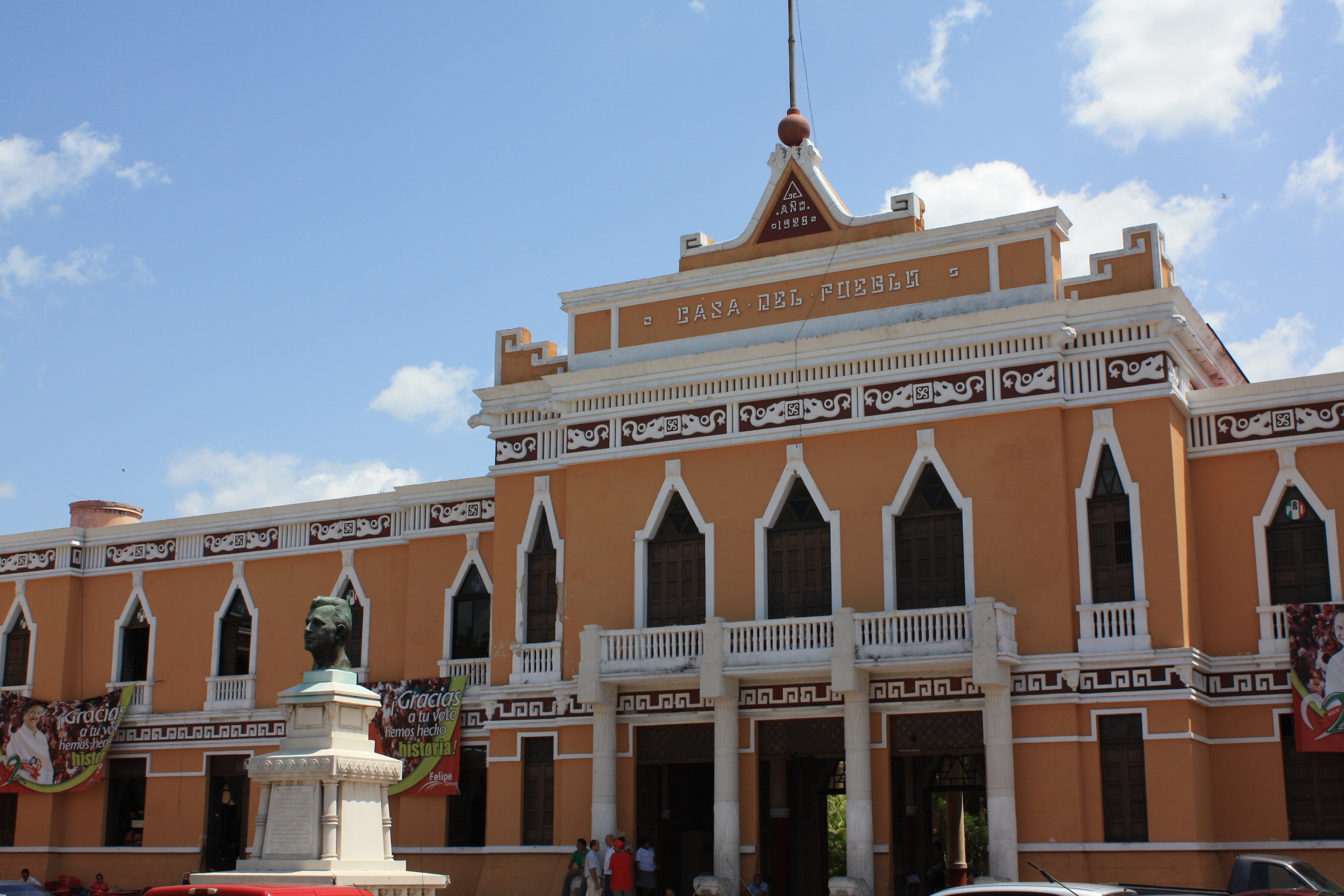
The building’s address is itself an argument. La Casa del Pueblo went up on Calle 65, south of the Paseo de Montejo. Mérida’s class geography ran then, and runs now, north-rich and south-poor.19 The People’s House and its massive Maya facade went up among the people the henequen fortunes were taken from.
The oligarchs looked to Madrid. The revolution looked to Uxmal.
La Casa del Pueblo still stands in southern Mérida, faded, and still in political hands: Carrillo Puerto’s Socialist Party of the Southeast was gradually folded into the national revolutionary party system that became the Partido Revolucionario Institucional, which holds the building today and has announced a restoration for the 2028 centenary.20 Monrovia’s Aztec Hotel closed within two years of opening and has been a revolving door of shutdowns since.21 In 2025 it went on the market for fifteen million dollars, still padlocked, and remains closed as of this writing.22
Each building became what it was made for. One was made to serve, and serves still. The other was made to sell, and waits to be sold yet again.
Vanessa Christman is an MA candidate in Archaeology and Heritage at the University of Leicester and a Principal Librarian at the California State Library, where she oversees the Witkin State Law Library and Government Publications. She is currently writing a dissertation on awe as an epistemic force in archaeological interpretation.
Notes
- “The Promotion,” The Studio, season 1, episode 1, aired March 26, 2025, on Apple TV+.
- Tom Ravenscroft, “How The Studio’s Production Team Created a Convincing Frank Lloyd Wright Building,” Dezeen, October 9, 2025, https://www.dezeen.com/2025/10/09/the-studio-frank-lloyd-wright/.
- John Lloyd Stephens, Incidents of Travel in Yucatan (New York: Harper & Brothers, 1843), 1:142–48.
- R. Tripp Evans, Romancing the Maya: Mexican Antiquity in the American Imagination, 1820–1915 (Austin: University of Texas Press, 2004), 74–79.
- Barbara Braun, Pre-Columbian Art and the Post-Columbian World: Ancient American Sources of Modern Art(New York: Harry N. Abrams, 1993), 137–79.
- Braun, Pre-Columbian Art, 137–79, quoting Wright at 138 and 139.
- Robert Stacy-Judd lecture series schedule, n.d., Box 2511, Robert Stacy-Judd Collection, circa 1923–1962, California History Section, California State Library, Sacramento; Marco Aurelio Díaz Güemez, review of Los mayas de la Atlántida: Una lectura crítica de las ideas de Robert Stacy-Judd y Manuel Amábilis, by Luciano Concheiro San Vicente and Alkisti Efthymiou, INTER DISCIPLINA 14, no. 38 (January–April 2026): 357–60.
- Robert B. Stacy-Judd, “The Autobiography of an Architect” (unpublished manuscript, Los Angeles, c. 1944), 10, quoted in David Gebhard, Robert Stacy-Judd: Maya Architecture and the Creation of a New Style (Santa Barbara, CA: Capra Press, 1993), 41.
- Cato Hernández, “As Monrovia’s Iconic Aztec Hotel Turns 100. Why This ‘Bad Luck’ Inn Is So Unusual,” LAist, September 20, 2025, https://laist.com/news/los-angeles-activities/monrovia-aztec-hotel-history-mayan-architecture.
- José Crisanto Franco Moo, “La experiencia socialista en la Península de Yucatán: génesis y eclosión de un proyecto político (1915–1930)” (PhD diss., CIESAS, 2017), 379.
- “The Henequén Mansions of Paseo de Montejo,” Yucatán Today, no. 452 (August 2025), published online July 28, 2025.
- Franco Moo, “La experiencia socialista,” 376–77; Esteban Cruz Obando, “Sanatorio Rendón Peniche, edificio revolucionario,” Punto Medio, May 4, 2019.
- Gilbert M. Joseph, Revolution from Without: Yucatán, Mexico, and the United States, 1880–1924 (Cambridge: Cambridge University Press, 1982).
- Manuel Amábilis, Los Atlantes en Yucatán (Mexico City: Editorial Orión, 1963). On the shared Atlantism of Stacy-Judd and Amábilis, and the contradiction of celebrating the ancient Maya while severing them from living Maya people through the Atlantis myth, see Luciano Concheiro San Vicente and Alkisti Efthymiou, Los mayas de la Atlántida: Una lectura crítica de las ideas de Robert Stacy-Judd y Manuel Amábilis (Mexico City: Universidad Nacional Autónoma de México / El Colegio de San Luis, 2024), 136–39.
- Ben Fallaw, “Imagining Socialisms in Southeastern Mexico: Felipe Carrillo Puerto, Bartolomé García Correa and Yucatán’s Maya Majority, 1915–1923,” Radical Americas 10, no. 1 (2025): 3, https://doi.org/10.14324/111.444.ra.2025.v10.1.003.
- Perla Patricia Valero Pacheco and Alejandro Fernando González Jiménez, “Felipe Carrillo Puerto contra el plantacionoceno: la revolución de la milpa en el Gran Caribe yucateco (1922–1924),” Historia Caribe 21, no. 49 (July–December 2026): 42–45.
- Valero Pacheco and González Jiménez, “Carrillo Puerto contra el plantacionoceno,” 52.
- Fallaw, “Imagining Socialisms,” 3.
- Adrián-Guillermo Aguilar, Miguel Flores-Espinosa, and Josefina Hernández, “Metropolización, dinámica inmobiliaria y segregación socio-territorial. El caso de Mérida, Yucatán,” EURE 51, no. 153 (May 2025).
- Justo Miguel Flores Escalante, “La libertad de prensa en la posrevolución. El amparo al Diario de Yucatán(1931–1933),” Tzintzun. Revista de Estudios Históricos, no. 61 (2015): 209–10; PRI Yucatán, Facebook post, May 2026.
- Hernández, “Aztec Hotel Turns 100.”
- Hugo Martín, “The Historic Aztec Hotel along Route 66 Is Said to Be Cursed. But My Tour Found No Ghosts or Spirits,” Los Angeles Times, May 30, 2026.
Featured image (at top): The lobby of the Aztec Hotel, Monrovia, California, from Robert Stacy-Judd’s own promotional portfolio, 1929. Robert Stacy-Judd Collection, Box 2511, California History Section, California State Library, Sacramento. Photo by the author.

