
This is the ninth post in our themed series, Cities at Play.
By Jason Collins
To this day, Eden Gardens is fondly remembered as one of the greatest cricket venues of the modern world, a reputation built on its scale, longevity, and atmosphere. The ICC lists its current seating capacity at around 68,000 and notes that the ground has hosted Tests, One Day Internationals, T20 Internationals, major domestic fixtures, and league cricket. It also describes Eden Gardens as famous for producing some of “the most passionate and vocal crowds in the game.”1 But its history began long before packed stands and international matches.
The site first took shape in the early nineteenth century as a landscaped pleasure ground on the edge of the Maidan, where colonial power, military planning, and urban leisure met in a single space. However, rather than treating that garden as a mere prehistory to cricket, it makes more sense to see it as the first stage in a longer urban history of organized play in Kolkata. Its early design as a managed promenade helps explain why Eden Gardens could later become a cricket ground without breaking from its older role in Kolkata’s public leisure culture.
By the mid-nineteenth century, Eden Gardens was a visually stunning garden associated with elite promenades and imperial display, a common feature of colonial urban planning in Calcutta. Eden Gardens sat on the western edge of the Maidan, near the Hooghly River and close to Fort William. In that setting, leisure unfolded inside the open military landscape around the fort rather than in a separate civic park. Thacker’s Guide to Calcutta later treated Eden Gardens as one of the city’s notable open-air sites within this Maidan landscape.2
The guidebook framing supports the idea that Eden Gardens was already understood as a place to be seen, visited, and folded into the city’s public life before cricket became its defining use. Its later development as a cricket ground, therefore, grew from an existing culture of organized leisure rather than replacing it outright.
Before Eden Gardens became a cricket ground in 1864, the sport was already being played on the Maidan.3 In Kolkata, the Maidan is a large open green space in the center of the city, near Fort William and the Hooghly River. Under British colonial rule, it functioned as open ground around the fort, but it also became a major public space for walking, recreation, military display, and later sport.4
The institutional history preserved by the Calcutta Cricket Club’s successor records that, in the absence of a permanent venue, the club first played between Government House and Fort William, obtained a Maidan plot in 1825, enclosed that ground in 1841, and then ran into objections from the Fort William garrison, which viewed the fenced cricket ground as an encroachment on open military land around the fort.5
That conflict sheds some light on what changed later in the century. The transition was not as simple as the grounds going from “garden” to “sport,” but from a precarious cricketing presence to a more secure one. Boria Majumdar argues that cricket in Bengal gained momentum in the late 1860s and 1870s as the sport became more closely connected to colonial clubs and organized institutions.6
At Eden Gardens, the club’s long effort to turn an uncertain Maidan presence into a settled cricket ground shows how that wider institutional growth took physical form.
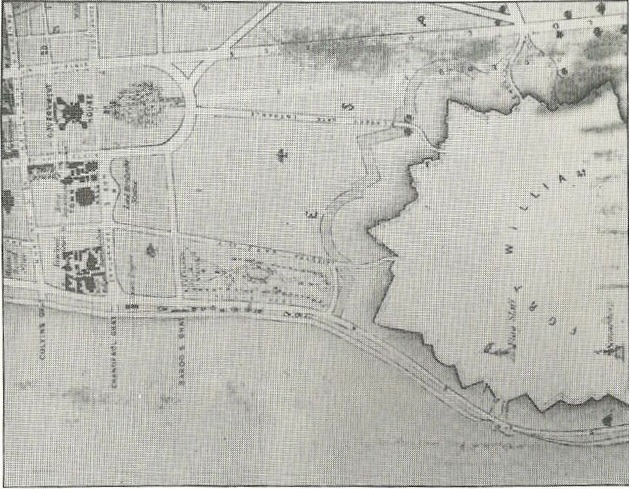
The decisive moment came in the 1860s. Club history records that a new road cut into an earlier ground, after which the club shifted to the eastern end of Eden Gardens, the site that later became an international cricket venue.7
By 1871, the government approved the construction of a permanent pavilion, replacing what the club itself had dismissed as a “wretched hut.”8 The pavilion gave cricket a fixed architectural presence at Eden Gardens long before the ground became known for Test cricket, the long-form version of the sport in which national teams play one another over several days.9
Cricket’s position in colonial Calcutta was therefore complicated. As a British sport, it carried social prestige and helped colonial clubs present themselves as orderly, civilized institutions. Yet the game still had to compete for space in a city where the Maidan served military needs as well as leisure. Fort William’s objection centered on the fenced ground itself. The enclosure interrupted the open land around the fort, even while cricket remained closely tied to British authority and elite sociability.10
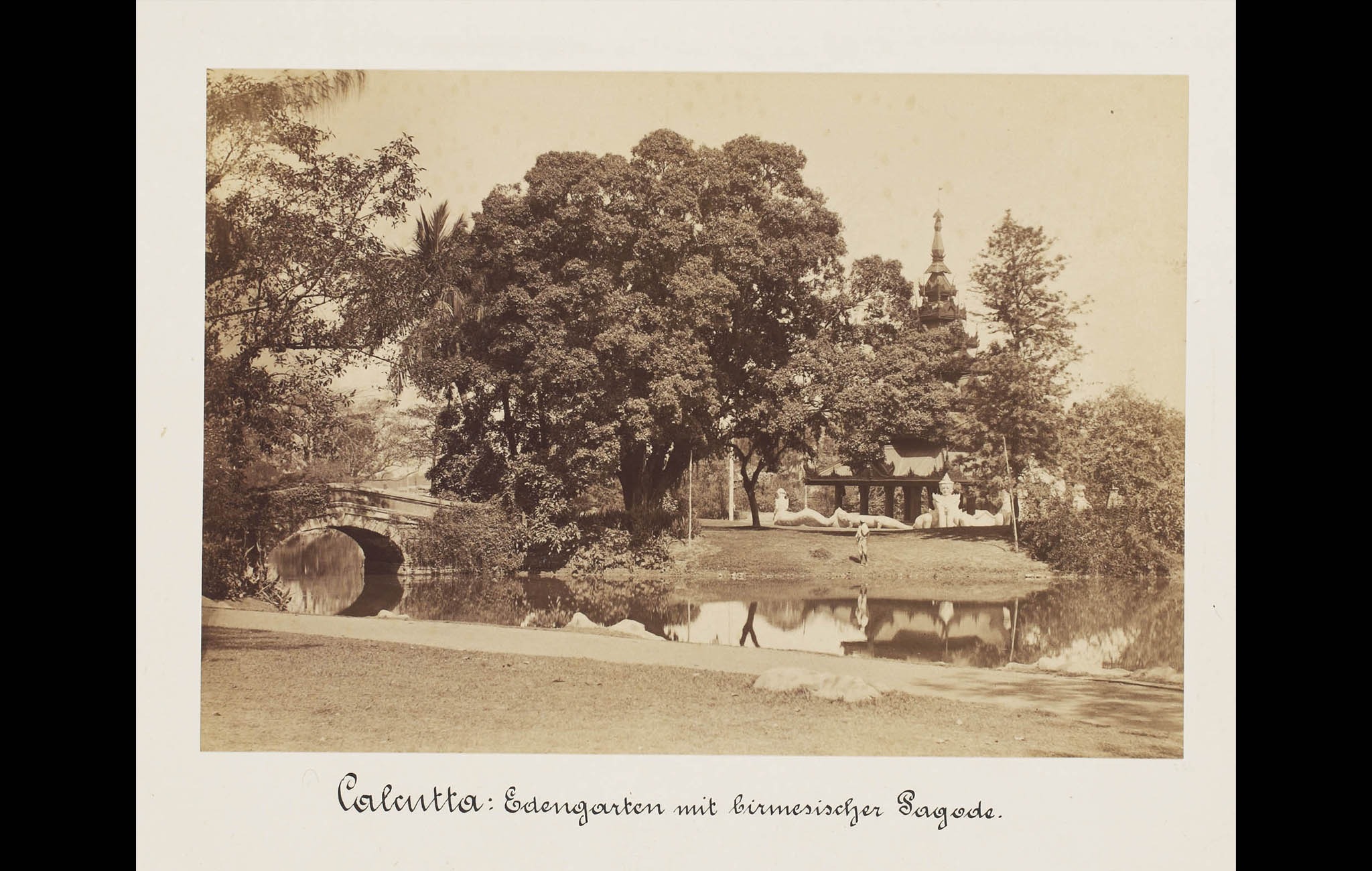
The garden setting continued to shape how Eden Gardens was experienced. Travel writing, guidebooks, and collection notes indicate that the bandstand, ornamental water, and Burmese Pagoda remained central features of the grounds, even as cricket became more established there.11 The pagoda in particular made imperial conquest visible within a space increasingly associated with recreation. It had been carried from Prome after the Second Anglo-Burmese War and erected in the gardens in the 1850s.12 Beside a manicured colonial garden and a formal cricket ground, the pagoda made conquest appear ornamental, even bucolic.
Cricket deepened that imperial reading because the sport brought British ideas about discipline, order, and civilized leisure into the same setting. Eden Gardens, therefore, presented play as more than recreation. It made sport part of a colonial public culture, with the captured pagoda and the cricket field reinforcing the same vision of empire. That coexistence is what makes Eden Gardens especially valuable for urban history. It was not a modern sports complex built on empty land, but a sporting venue built into an already symbolic colonial landscape.
The postcolonial history of Eden Gardens illustrates the cultural negotiation that occurred after British control ended. As Souvik Naha shows in Cricket, Public Culture and the Making of Postcolonial Calcutta, cricket did not remain a mere colonial holdover after independence. In Calcutta, spectators, clubs, journalists, and local institutions remade the game as part of the city’s own public culture, giving it new meanings tied to belonging, civic pride, and urban identity.13 When read against that longer history, Eden Gardens’ twentieth-century growth looks like the democratization, however incomplete, of a landscape once designed for colonial promenade and elite display.
In the modern era, Eden Gardens continues to be central to Indian sports culture and to Kolkata’s effort to draw cricket tourism. Redevelopment plans released in April 2026 would increase capacity from 68,000 to 85,000, expand hospitality, add a Sky Deck, and introduce heritage-focused spaces, including a museum and hall of fame.14 Populous, the design firm undertaking the redevelopment, frames the project as an attempt to keep Eden Gardens’ legacy visible while adapting the venue for modern cricket, with principal architect Siddharth Soni saying the design is “not just restoring Eden Gardens” but “enhancing an icon.”15
Cricket Association of Bengal president Sourav Ganguly used similar language, describing the work as “giving back to a place” shaped by the roar of Kolkata’s crowds.16 Kolkata-facing sports coverage has also presented the renovation as a post-IPL 2026 transformation built around heritage, atmosphere, and a larger match-day experience, rather than only a capacity increase.17 The designers also connect the project to the surrounding gardens and riverside setting, which shows how Eden Gardens’ redevelopment continues to draw on the older landscape that gave the venue its name.
Jason Collins is a Las Vegas-based writer with more than a decade of experience in digital writing. He holds a bachelor’s degree in English from Loyola Marymount University and has contributed to magazine publications. His interest in history ranges from the Timbuktu manuscripts of West Africa to Helike, the ancient Greek city lost for centuries.
- International Cricket Council, “Eden Gardens,” accessed May 1, 2026, https://www.icc-cricket.com/tournaments/mens-t20-world-cup-2026/venues/eden-gardens-x3603 ↩︎
- Walter K. Firminger, Thacker’s Guide to Calcutta (Calcutta: Thacker, Spink & Co., 1906), Internet Archive, https://archive.org/details/thackersguidetoc00firm. ↩︎
- International Cricket Council, “Eden Gardens.”
↩︎ - Firminger, Thacker’s Guide to Calcutta.
↩︎ - Calcutta Cricket and Football Club, “History,” accessed May 1, 2026, https://www.ccfc1792.com/history.
↩︎ - Boria Majumdar, “Cricket in Colonial Bengal, 1880–1947: A Lost History of Nationalism,” The International Journal of the History of Sport 23, no. 6 (2006): 960–990, https://www.tandfonline.com/doi/full/10.1080/09523360600802562. ↩︎
- Calcutta Cricket and Football Club, “History.” ↩︎
- Calcutta Cricket and Football Club, “History.”
↩︎ - International Cricket Council, “Eden Gardens.”
↩︎ - Calcutta Cricket and Football Club, “History.”
↩︎ - Firminger, Thacker’s Guide to Calcutta.
↩︎ - University of Notre Dame, “Burmese Pagoda at Eden Gardens: View from River,” accessed May 1, 2026, https://marble.nd.edu/item/deb09ec0-8f1a-4f19-bb84-b0225df10ed9.
↩︎ - Souvik Naha, Cricket, Public Culture and the Making of Postcolonial Calcutta (Cambridge: Cambridge University Press, 2022), https://doi.org/10.1017/9781108781190.
↩︎ - Populous, “Enhancing an Icon: Populous’ Fan-Focused Designs for Kolkata’s Famed Eden Gardens Will Create New History,” April 2026, https://populous.com/article/enhancing-an-icon-populous-fan-focused-designs-for-kolkatas-famed-eden-gardens-will-create-new-history. ↩︎
- Populous, “Enhancing an Icon.”
↩︎ - Populous, “Enhancing an Icon.”
↩︎ - Subhayan Chakraborty, “A New Dawn for a Cricketing Colosseum: Eden Gardens Set for Major Redevelopment, Know All Details,” RevSportz, April 3, 2026, https://revsportz.in/a-new-dawn-for-a-cricketing-colosseum-eden-gardens-set-for-major-redevelopment-know-all-details/. ↩︎
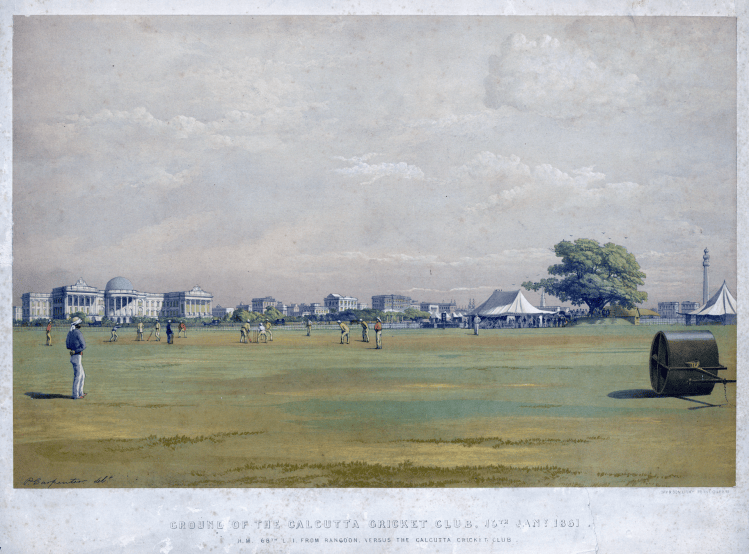
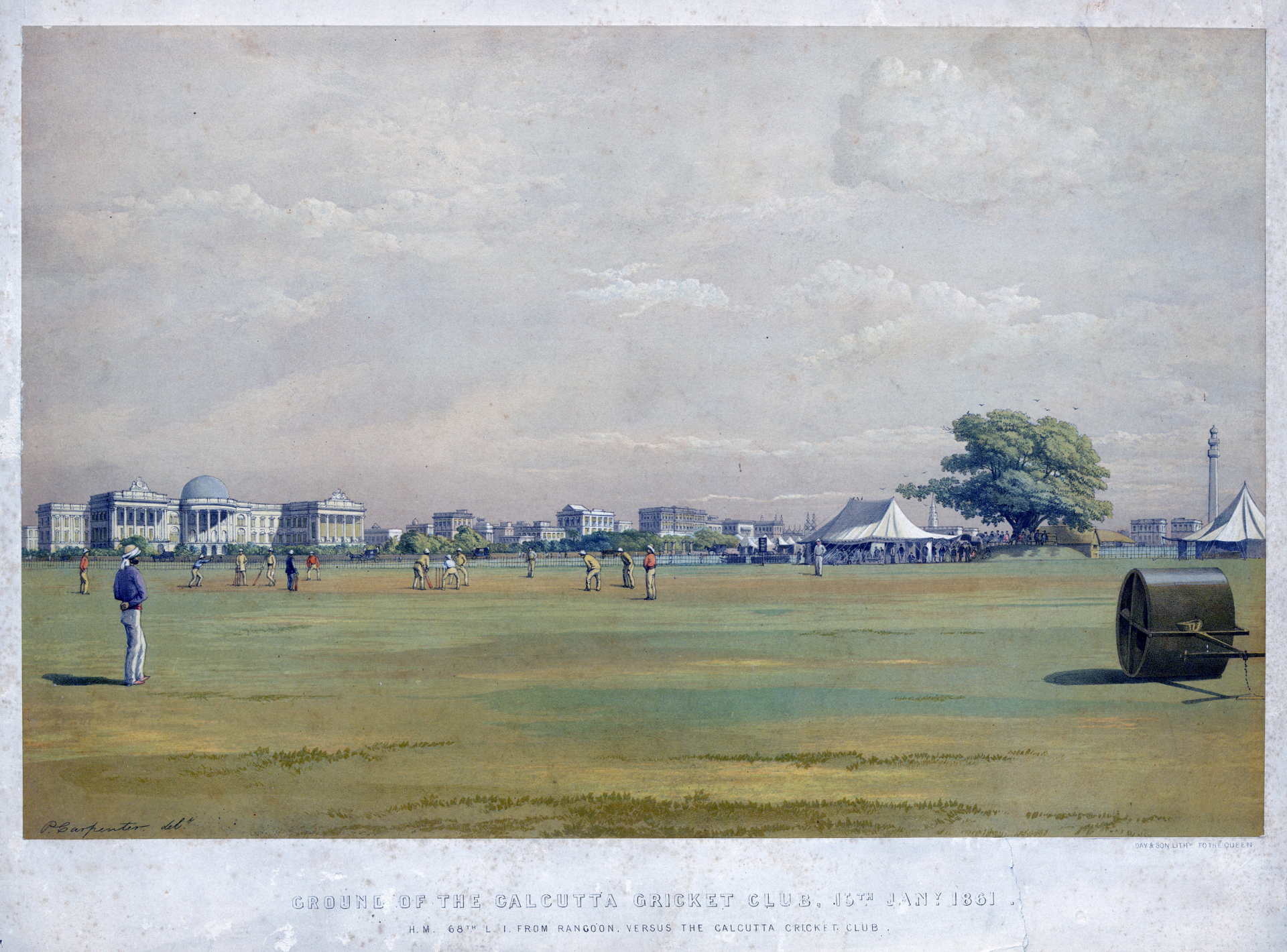
Featured image (at top): “Ground of the Calcutta Cricket Club, 15th Jan’y. 1861,” after Percy Carpenter, printed by Day & Son. The image shows a match between H.M. 68th Light Infantry from Rangoon and the Calcutta Cricket Club on the Maidan, with colonial buildings visible beyond the playing field. Source: SOAS Digital Collections, with the work held by the MCC Museum.

