
This is the eighth post in our themed series, Cities at Play.
By Sameer Chandavarkar
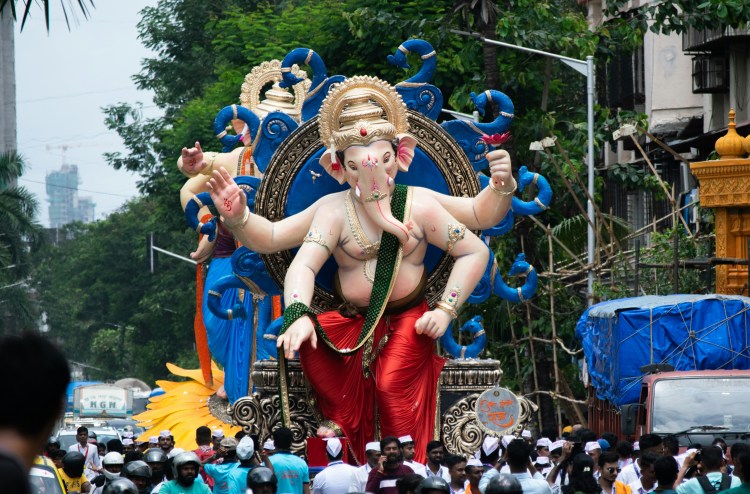
Every year, Mumbai changes its rhythm—deliberately. Roads that are usually choked with traffic slow down or shut entirely as temporary pandals (elaborate festival structures housing Ganesh idols) are set up across neighborhoods. Intersections turn into gathering points where residents participate in aartis (prayer rituals), cultural performances, and community events. Loudspeakers play devotional music, and streets fill with processions carrying idols for immersion (visarjan) at the end of the festival. Neighborhoods begin to revolve around these shared activities rather than routine. During Ganesh Utsav, the city isn’t just decorated—it is temporarily remade.
Ganesha is widely understood as a deity associated with beginnings and the removal of obstacles, which helps explain his central role in both private and public worship. That began to shift in 1893, when Bal Gangadhar Tilak actively encouraged people to celebrate Ganesh Utsav in public—as a sarvajanik (community-wide) festival—in cities like Bombay and Pune.1
This move was not accidental. At the time, British colonial authorities closely monitored public gatherings. As Richard I. Cashman argues, Bal Gangadhar Tilak and his colleagues deliberately gave the Ganapati festival a public character in order to encourage collective participation and strengthen nationalist consciousness in Maharashtra.2 Tilak viewed the festival as a way to bring people together across caste and class divisions through a shared cultural and religious form. Rather than directly confronting colonial authorities, the public celebration of Ganesh Utsav created a socially legitimate space in which political discussion, collective identity, and nationalist sentiment could gradually develop.3 What emerged was something more than a religious festival. Streets, courtyards, and local squares became places where devotion, community, and politics overlapped. The city itself became part of the performance.
One of the earliest examples of this shift can be seen in the Keshavji Naik Chawl mandal—a neighborhood-based community organization that plans and organizes Ganesh Utsav celebrations—established in 1893 in Girgaum.4 Located in a dense working-class neighborhood, this mandal illustrates how the festival became embedded in everyday urban life. As Richard I. Cashman notes, the transformation of Ganapati celebrations from private household rituals into public, community-based events enabled broader participation across social groups.5 In the case of Keshavji Naik Chawl, residents extended the festival beyond domestic space into shared courtyards and streets, organizing collective worship, decorations, and performances. The chawl, already a tightly knit social unit, thus expanded into the surrounding public space, blurring the boundary between private and public life. Private and public space blurred, allowing residents to collectively reshape their surroundings. In doing so, they created shared neighborhood spaces where residents could gather, interact, and participate collectively in public life.
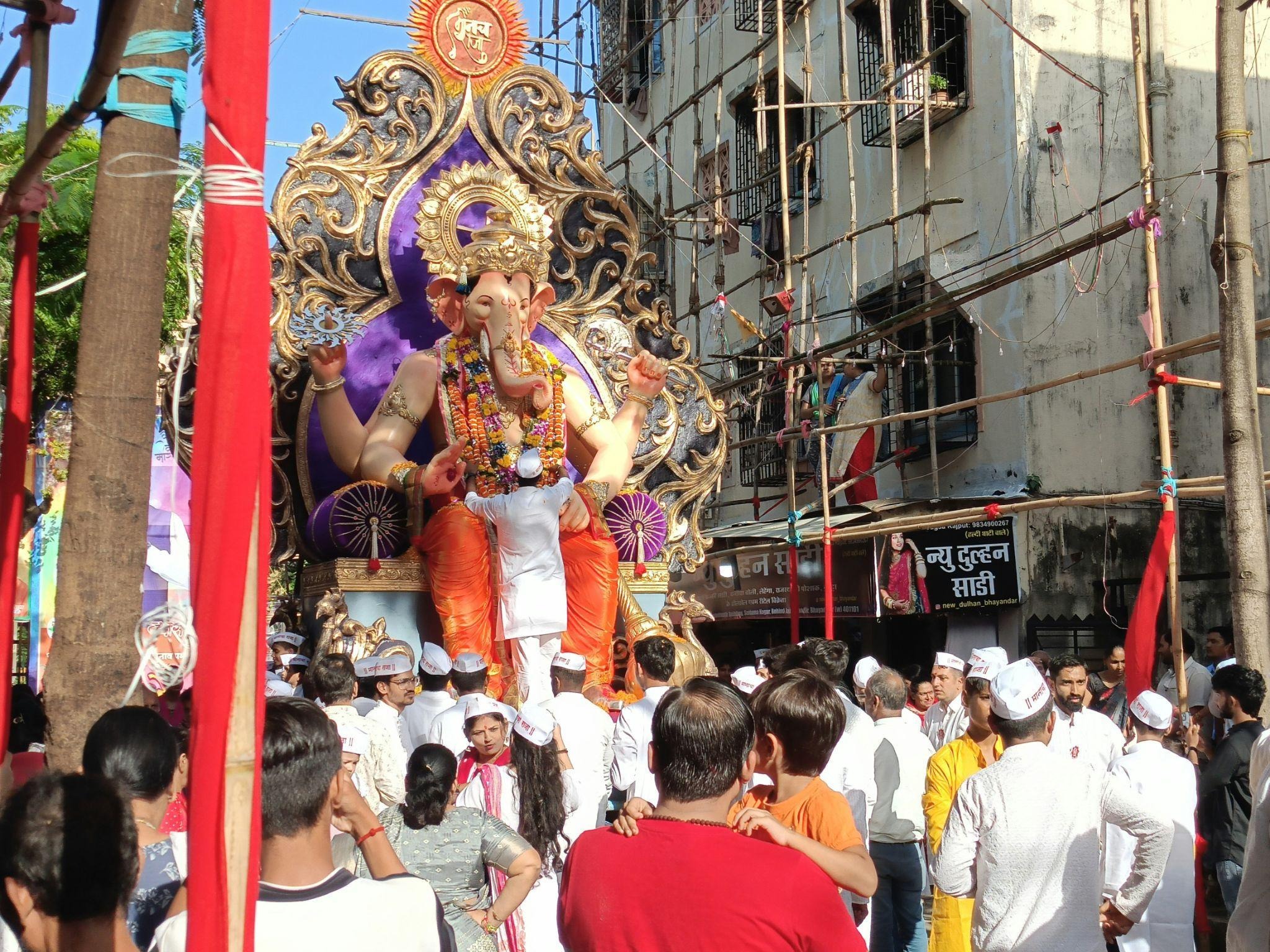
By the early twentieth century, Ganesh Utsav had become a regular part of the city’s social and spatial life. Its spread mirrored larger changes in Bombay—industrial growth, migration, and rising political awareness. The festival helped people anchor themselves in a rapidly expanding city. As Richard I. Cashman argues, the expansion of public Ganapati celebrations enabled broader participation across social groups and helped foster a sense of collective identity through shared religious and cultural activity.6 In this context, the festival became a way for residents of rapidly growing neighborhoods to form visible and recognizable communities within the urban landscape. It was not only a religious event, but also a means of establishing belonging and social presence in the city, allowing participants to publicly assert their presence through shared celebrations, collective rituals, and neighborhood-based organization.7
After independence, the role of the festival shifted again. While its nationalist edge softened, mandals began to take on more visible civic roles within their neighborhoods. Many organized community activities such as health camps, blood donation drives, educational programs, and local welfare initiatives alongside festival celebrations. In this way, the festival extended beyond its religious and cultural functions to become a platform for ongoing community engagement and neighborhood-level organization.
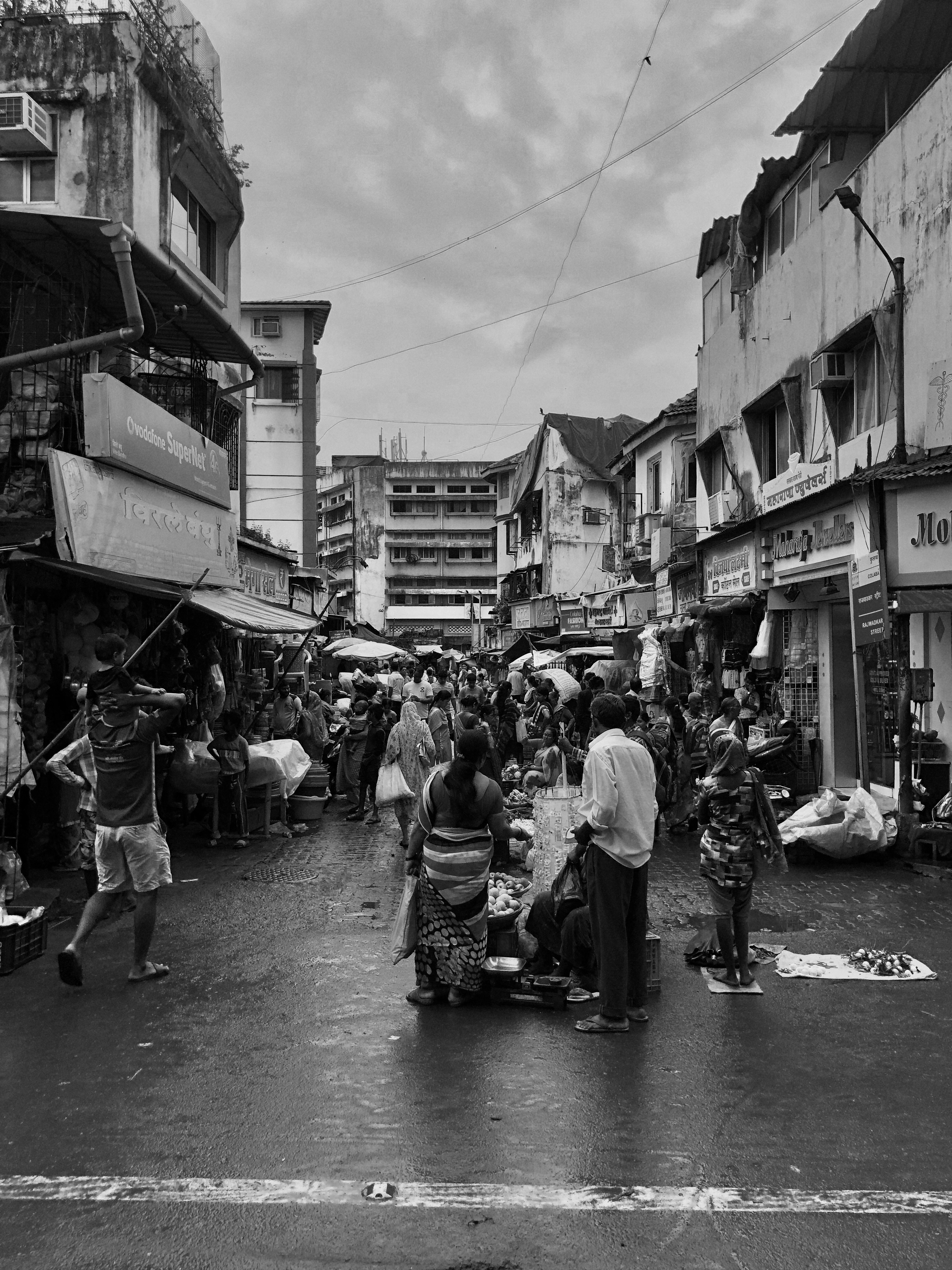
In present-day Mumbai, Ganesh Utsav continues to reshape the city in visible ways. Thousands of mandals set up temporary structures, ranging from small neighborhood shrines to massive themed installations based on mythological scenes, historical events, social issues, and contemporary topics.
This kind of transformation fits into what urban scholars describe as informal urbanism—the idea that cities are not shaped solely by official planning, but also by temporary, community-led interventions that reconfigure how space is used. As urban scholars have argued, urban life is often produced through everyday negotiations over space and infrastructure rather than through formal planning alone. Ganesh Utsav illustrates this clearly: neighborhood groups set up temporary pandals, organize events, and redirect movement through streets, effectively reshaping urban space for the duration of the festival. In this way, the festival does not exist outside the city’s structure but actively participates in producing it, as residents temporarily take control of their surroundings in ways that extend beyond everyday uses of planned space.
The immersion processions, or visarjan—the ritual carrying of Ganesh idols through the city for immersion in water—make this especially visible. Idols are carried through the city along pre-approved routes, often ending at places like Girgaum Chowpatty, a popular public beach in South Mumbai used for idol immersion. These processions draw huge crowds, slowing or stopping traffic altogether, and require coordination with city authorities. In this sense, formal planning does not simply restrict these activities but adapts to and accommodates them, allowing temporary transformations of urban space at a large scale.
At the same time, this transformation does not happen without oversight. While early public celebrations operated with relatively informal structures, increasing scale and participation over the twentieth century led to more systematic regulation by authorities such as the Brihanmumbai Municipal Corporation (BMC) and the Mumbai Police. Mandals are now required to obtain permissions, follow safety and noise guidelines, and coordinate procession routes with the state. These regulations have emerged not only to manage logistical challenges such as crowd control and traffic disruption, but also in response to periodic concerns over public order and, more recently, environmental impact. What results is not total freedom, but an ongoing negotiation over how public space can be used.
In recent years, these negotiations have increasingly focused on environmental and civic concerns. The use of plaster-of-Paris idols, for example, has raised questions about water pollution, leading to campaigns for eco-friendly alternatives.8 Noise regulations have also become a point of debate, with some viewing them as necessary for urban life, while others see them as limiting cultural expression. These tensions reflect a larger challenge: how to balance tradition with the realities of a modern, densely populated city.
The festival has also become a space for political visibility and, at times, competition. Local politicians and organizations often sponsor mandals, using them as platforms to connect with communities and signal influence. Different mandals frequently vie for attention through larger installations, more elaborate decorations, or high-profile performances, creating a competitive environment within the city. In some cases, this competition extends to the use of space and procession routes, requiring negotiation with authorities and coordination between groups. These dynamics add another layer to the festival’s role, linking it not only to community life but also to ongoing political and spatial negotiations within the city.
All of this challenges the idea that “play” is separate from serious social life. In Ganesh Utsav, play is not trivial but embedded in everyday forms of participation. Residents take part in organizing pandals, decorating public spaces, and performing in music, dance, and theatrical programs. Children and youth participate in games and cultural competitions, while local groups stage performances and community events. Processions, drumming, and collective chanting during visarjan further transform the streets into spaces of shared activity. These practices involve a wide range of participants—from neighborhood residents and volunteers to performers and local organizers—and allow people to engage with the city by temporarily reshaping how space is used, experienced, and shared.
Looking at the festival historically makes this even clearer. From its transformation in the 1890s to its present-day form, Ganesh Utsav shows that urban space is not fixed. It is constantly shaped and reshaped through collective action. The festival makes these processes visible, even if only for a short time each year.
It also pushes us to think beyond Western examples of urban theory. Cities like Mumbai offer their own ways of understanding how public space works—ways that are rooted in local history, culture, and practice. Ganesh Utsav is one such example, showing how celebration can intersect with power, identity, and space.
In the end, the festival reminds us that cities are not only built through infrastructure or governed through policy. They are also created through shared experiences—through moments when people come together and temporarily change how the city works. During Ganesh Utsav, Mumbai is not just celebrating—it is, in a very real sense, reimagining itself.
Sameer Ramesh Chandavarkar is a freelance writer based in Navi Mumbai, India. His work explores culture, urban life, history, and sport, with a particular interest in how public spaces shape community identity.
- Richard I. Cashman, The Myth of the Lokamanya: Tilak and Mass Politics in Maharashtra (University of California Press, 1975) ↩︎
- Cashman, 48. ↩︎
- Sandria Freitag, “Collective Action and Community,” Modern Asian Studies (1989). ↩︎
- Eshenpriya MS, “Five of the oldest Ganesh mandals in Mumbai,” Indian Express, Sept. 9, 2022. ↩︎
- Cashman, 181. ↩︎
- Cashman, 48. ↩︎
- Jim Masselos, The City in Action: Bombay Struggles for Power (Oxford University Press, 2007). ↩︎
- Alok Deshpande, “Maharashtra issues guidelines ahead of Ganesh Festival: All POP idols to carry red dot for identification” Indian Express, August 1, 2025. ↩︎
Featured Image (at top): A Ganesh Utsav procession moves through Mumbai streets, illustrating how the festival temporarily transforms urban space into a site of collective participation and public celebration. Photo by Vishal Panchal via Pexels.

