
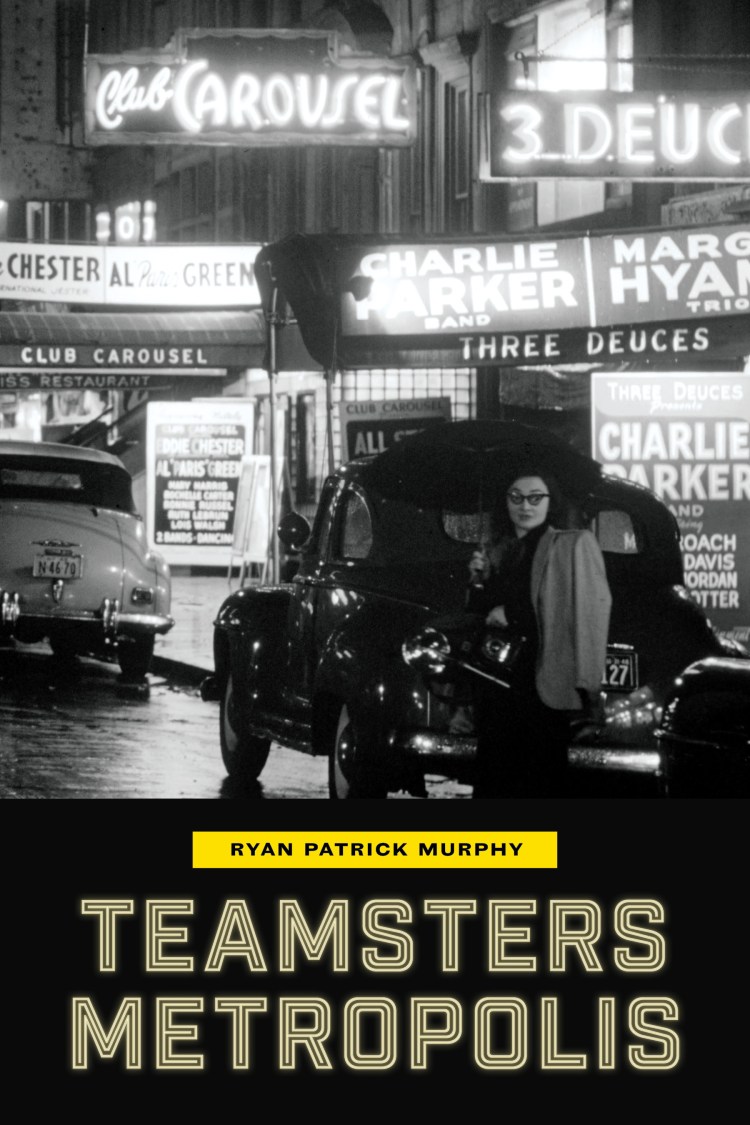
Murphy, Ryan Patrick. Teamsters Metropolis . University of Michigan Press, 2025.
Reviewed by Gracie Anderson
Gender history and queer history have long been concerned with the city’s role in structuring norms and identity.1 Ryan Patrick Murphy’s Teamsters Metropolis applies the lenses of queer and gender history to an unexpected urban subject: the million-worker boom in Teamster union membership over the course of the 1950s. The Teamsters began in the early 1900s as a union of horse-drawn wagon drivers who delivered supplies to small businesses in the Midwest, and by the 1950s, it had rapidly expanded to cities across the United States and picked up new members from the diversifying service industry. As horse-drawn wagons gave way to gas-powered trucking, the Teamsters kept pace, scooping up the long-haul truckers who put some of the first miles on the nation’s new interstate highways. Murphy seeks to uncover the secret to the Teamsters’ remarkable organizing success at this time, even as they embraced the unconventional in both presentation (Teamsters were “Big, loud, unyielding, flamboyant, and bejeweled”) and association (they readily formed alliances with crime syndicates).2 Teamsters were known for tossing dynamite into non-union small businesses, and preferring to shout “at full volume in the native language of the small business owner” rather than trying to embody the polite style of liberal bargaining sanctioned by the Wagner Act.3 In turn, Murphy shows, they were embraced by blue-collar workers across the country, especially southern and eastern European immigrants, who saw the union as their ticket to middle-class suburban life, its unorthodox tactics notwithstanding – in fact, these tactics created space for the values and traditions they brought with them from their countries of origin, such as non-nuclear living arrangements. Ultimately, Murphy argues that “The Teamsters union was popular with workers precisely because it gave…a million rank-and-file members a space to push the boundaries of domesticity and heterosexuality while reaping the full privileges those categories endowed.”4
Murphy departs from narratives of the Teamsters’ midcentury conservatism by showing how the union offered its members a middle-class way of life that bucked the standards of the white Protestant nuclear family.5 With its emphasis on kinship and indulgence, Murphy claims, “workers saw the Teamsters union as a place to forge an alternative to the bourgeois cultural values that workers were supposed to embrace as they became middle class, values that included self-denial, deferred gratification, the avoidance of pleasure, and personal responsibility.”6 Between their new residences in the suburbs and traditional commercial districts downtown, these union members created a “Teamsters metropolis” that successfully linked workers from vastly different industries, cities, and backgrounds.
In tracing the expansion of the Teamsters metropolis, Murphy offers an important addition to urban history by showing how the process of suburbanization at midcentury was contested, messy, and “unruly” for many immigrant workers. His first chapter looks at the coin-operated vending machine business in New York City, whose Catholic and Jewish family business owners formed a key base for Teamsters organizing. These immigrant families were drawn to the union because it allowed them to evade the pressures of suburbanization and heterosexual domesticity, Murphy argues. In the following chapter, Murphy zooms out from life in the city to explore the federal government’s mounting concern over Teamster activity, culminating in the McClellan Committee hearings. Rather than rehashing the political undercurrents of the hearings (already explored by historians like David Witwer and Thaddeus Russell), Murphy argues that they were fundamentally concerned with the place of working-class culture in the city and driven by a desire to move the very immigrant families at the heart of Teamsters’ organizing to the suburbs. Further, Murphy contends, the hearings reveal a “working-class metropolitan world that rejected the bourgeois culture of the 1950s.”7 This world is the subject of his subsequent chapters, as he examines case studies related to leisure, segregation, and alternative kinship models throughout the Teamsters metropolis.
The Teamsters adopted a particularly creative approach to leisure when their president Jimmy Hoffa decided to fund a Miami oceanfront development for their members. Here, Murphy explores another use the Teamsters found for the urban world: pleasure. Drawing on gender and queer histories of work and leisure, like Kathy Peiss’ classic Cheap Amusements and Julio Capó’s Welcome to Fairyland, Murphy explores how this real estate venture simultaneously acted as an organizing strategy to garner support in the South and as a part of Hoffa’s vision for the Teamsters metropolis which inculcated an unrestrained, unruly investment in pleasure. Murphy points out, however, that this vision was limited to white workers alone, as Jim Crow laws kept Black members from enjoying the fruits of their labor in Miami Beach. This kind of racist exclusion informs Murphy’s following chapter on workers of color in New York. Workers of color were barred from the Teamsters metropolis by discrimination and violence, and in the Civil Rights era, Hoffa failed to organize this generation of service workers as effectively as in years past. Murphy attributes this failure to Hoffa’s allegiance to his support base of European immigrants and his overall inability to capture a “nuanced understanding of the full spectrum of workers’ desires.”8 In his final chapter, Murphy profiles Sylvia Pagano, an oft-mentioned background character in Teamsters history who, Murphy argues, represents the unruly nature of Teamsters organizing in this period. Her relative absence from historical narratives and the archive belies her important strategic role in the Teamsters and reflects her ability to evade attention as a woman unencumbered by the nuclear family model. Therefore, Murphy argues that Pagano encapsulates the “cultural complexity” of the Teamsters in this period – she is both representative of a new generation of independent women and a child of the very immigrants forming the base of the union’s strategy, operating from the Teamsters’ hub of Detroit.
In the epilogue, Murphy features the overlapping worlds of Teamsters, the Mafia, and queer life, as he traces the history of a few New York City bathhouses. These Mafia-supported bathhouses flourished in midcentury as a site for gay public sex; Murphy suggests that the behind-the-scenes Teamster/Mafia alliance was “critical to the production of queer public space” like the bathhouses, as “some small business owners were willing to [risk their business licenses] because the institutions of the Teamsters metropolis had their backs.”9 Though this is the book’s first mention of “queer” as an identity category, Murphy draws on queer historiography throughout the text to characterize the unruly, unlikely, and unabashed counter-culture of the Teamsters in the 1950s.10 In this way, Murphy applies the lenses of queer and gender history to reveal the countervailing forces operating within the Teamsters beyond the normative. Throughout the text, Murphy invokes queer historians to tease out the unexpected facets of Teamsters’ organizing and Hoffa’s vision that rejected middle-class, heteronormative respectability. For example, Murphy uses Lauren Gutterman’s history of postwar affairs between married women and Stephen Vider’s work on queer kinship to characterize both evidence of non-normativity in suburban life and the possibilities of alternative familial and romantic relationships for Teamsters like Sylvia Pagano.11 Murphy’s analytic reveals both the ambivalent attitudes working-class people held towards suburbanization and the union’s pathbreaking strategy to grow its power. Importantly, these developments take place in the urban context on which queer history built its foundation; Murphy’s epilogue shows how the worlds of queer history and the Teamsters collide in the city. Envisioned in the Teamsters metropolis was “space for embodied pleasure and freedom,” an “unruly endeavor” which Murphy seeks to uphold as the “most enduring contribution of the International Brotherhood of Teamsters to the US labor movement.”12
Gracie Anderson is a PhD student in History at Columbia University, researching queer activism and politics in the 20th century United States.
- As explored in Regina Kunzel, “The Power of Queer History,” The American Historical Review 123, no. 5 (2018): 1560–82. ↩︎
- Murphy, 14. ↩︎
- Murphy, 14.
↩︎ - Murphy, 17.
↩︎ - Murphy invites readers to depart from “the story we sometimes tell about the mid-twentieth century… that narrative frames Jimmy Hoffa’s Teamsters as the paragon of conservative business unionism” (Murphy, 156). He traces this “story” back to works including Nelson Lichtenstein’s State of the Union: A Century of American Labor (Princeton University Press, 2002), Dan Labotz’s Rank-and-File Rebellion: Teamsters for a Democratic Union (Verso, 1991) and Jefferson Cowie’s Stayin’ Alive: The 1970s and the Last Days of the Working Class (The New Press, 2010). ↩︎
- Murphy, 16.
↩︎ - Murphy, 84.
↩︎ - Murphy, 151.
↩︎ - Murphy, 183.
↩︎ - Murphy’s first book, Deregulating Desire: Flight Attendant Activism, Family Politics, and Workplace Justice (Temple University Press, 2016), similarly intersects labor and queer history, by focusing on queer and feminist activism within the flight attendant union movement.
↩︎ - Lauren Gutterman, Her Neighbor’s Wife: A History of Lesbian Desire Within Marriage (University of Pennsylvania Press, 2019); Stephen Vider, The Queerness of Home: Gender, Sexuality, and the Politics of Domesticity After World War II (University of Chicago Press, 2021).
↩︎ - Murphy, 198.
↩︎


A compelling take on urban labor history, thanks for the review!
LikeLike