
This is the seventh post in our series, Cities at Play.
By Sandra Coffey
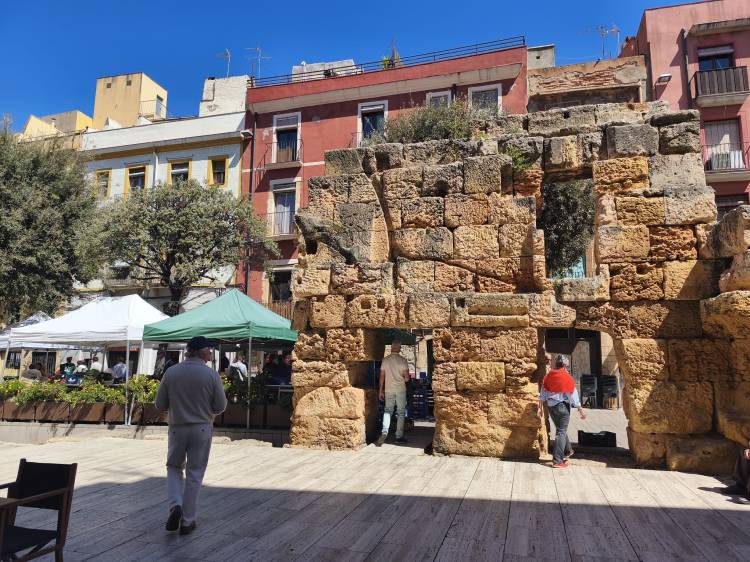
In Tarragona, a coastal city in Catalunya, Spain, the past sits so casually in the Plaça del Fòrum that many first-time visitors stop in disbelief. Here, 1st century Roman ruins, the surviving remnants of the Provincial Forum of Roman Tarraco, lie open to the elements and to the public. There are no ropes around them, no glass partition and no signs telling you not to touch them. Instead, they serve as an open invitation for public interaction and recreation.
To understand how this placa has evolved into what it looks like today, it’s essential to look at how urban play sits within the Tarragona’s context. It’s part of the city’s civic way of making heritage a part of everyday life. Here, play is the spontaneous, uncurated use of public heritage space to fulfill the leisure, socialization, and imaginative needs of the city’s people, where possible and safe to do so.1 In the Plaça del Fòrum, which is in the city’s Part Alta area, this idea can be seen daily. Children use the Roman ruins as a space for hide and seek and tag. One afternoon, this author observed a group of local boys use the 2,000-year-old Roman wall fragment as one side of a makeshift goalpost for a spontaneous game of football. The ancient wall was effortlessly incorporated into their game with no hesitation.
This combination of everyday leisure and heritage preserved in situ represents how history is an active, durable habitat. When Tarragona was designated a UNESCO World Heritage Site in 2000, officials decided it was time to cement this concept.2 They stated that the city’s ancient Roman architecture and its citizens form an inseparable urban ecosystem. This forms the basis for an urban model defined by convivència – the art of living and playing alongside history.3
Contemporary Scenes
To have a coffee in one of the cafes close to the ruins is to witness how seamlessly the local community lives amongst them. The café tables are placed right beside it, which is one of the first visible signs of how the remains are integrated in the daily life of the city. Every week, a local market takes place. The open-air stalls of the Mercat Setmanal del Fòrum are placed beside the Roman wall remains and the stalls sell fruits, vegetables, and crafts. Local vendors talk about the ruins to customers in a natural way and encourage people to go over to look at it and touch them. These interactions ground academic theory in the realities of daily life. These ruins are familiar and form part of a weekly backdrop to trade.
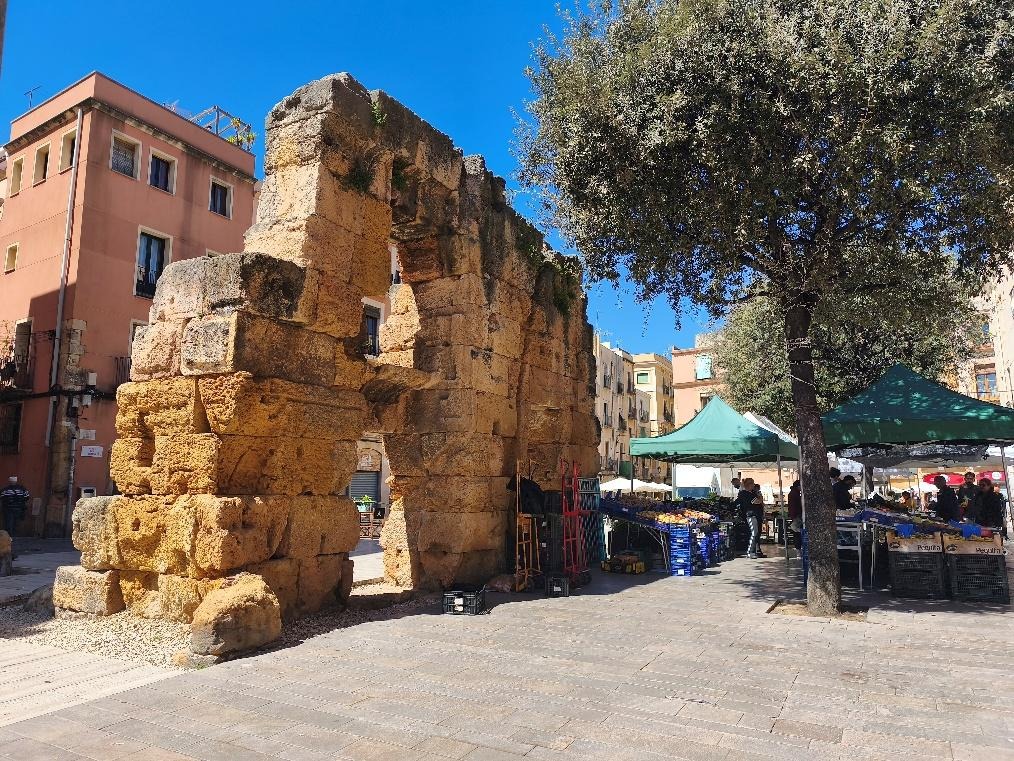
As the market stalls pack away in the afternoon, the space at times plays host to children’s games. Local children run under the arched recesses on their way home from school. On a separate afternoon, this author witnessed a man sitting completely at ease directly on top of the ancient ruins, using it as a place to take a rest like you would a bench.
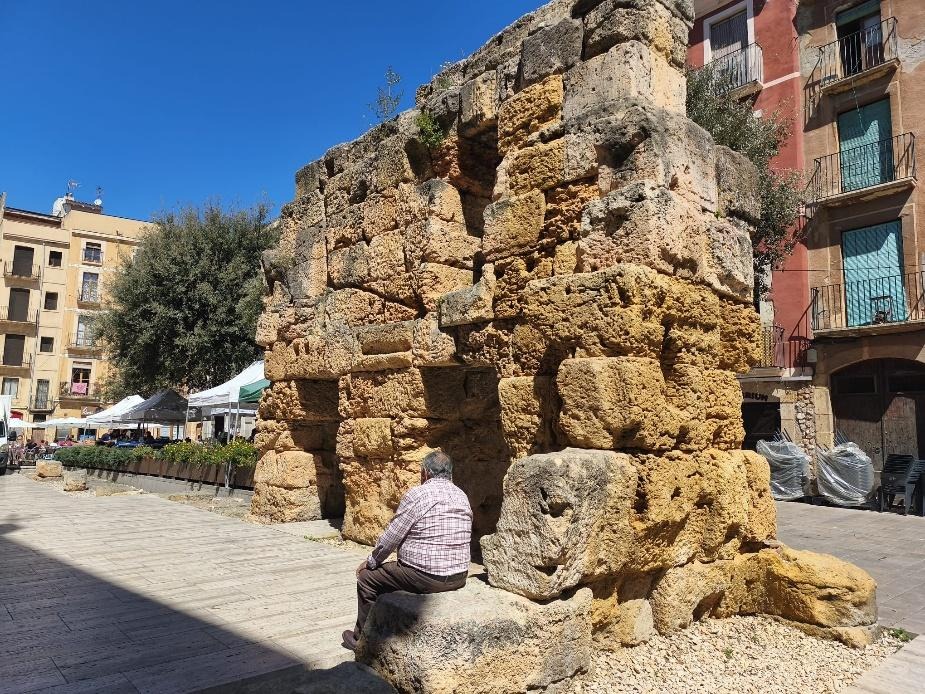
For tourists, arriving at this scene often provokes a moment of cultural tension. Having just walked a mere seven minutes from Tarragona’s Roman Amphitheatre, a traditional curated heritage site complete with ticket booths, opening hours, and barriers, visiting parents often pause upon entering the Plaça del Fòrum. They assume that playing around it or touching the wall must be forbidden. However, as they sit at a café and watch the locals, their hesitation eases. They watch other children play games; they see adults casually leaning their backs against Roman masonry while chatting. Gradually, they too begin to inhabit the space around the monument with ease.
Throughout the calendar year, this area plays host to the city’s festival activities and rituals. During the Santa Tecla festivities in September (Tarragona’s main festival), the plaça becomes an active space for people to gather before and after attending an event. During winter, the market also sells the Catalan tradition of the Tió de Nadal. During Easter’s Holy Week, the city’s Via Crucis (Stations of the Cross), a religious procession goes from the nearby Cathedral, its participants robed and carrying the heavy floats as they parade close by the ruins.4
How the Ruins Have Evolved
For centuries, this plaça was not an open square, but a tightly packed network of houses and narrow alleys. The Roman wall was used for domestic life, serving as the interior walls of homes. Human interaction with the stone was intimate but entirely utilitarian. As well as cooking and sleeping among the walls, they also housed livestock.
The physical appearance of the Plaça del Fòrum changed dramatically during the Spanish Civil War (1936-1939), when heavy aerial bombardment destroyed several of the multi-story residential buildings on the site.5 In the post-war reconstruction era, municipal planners made a critical and visionary decision. Instead of rebuilding the lost housing, they cleared the rubble to create an open public square, allowing the Roman ruins to emerge into daylight.6
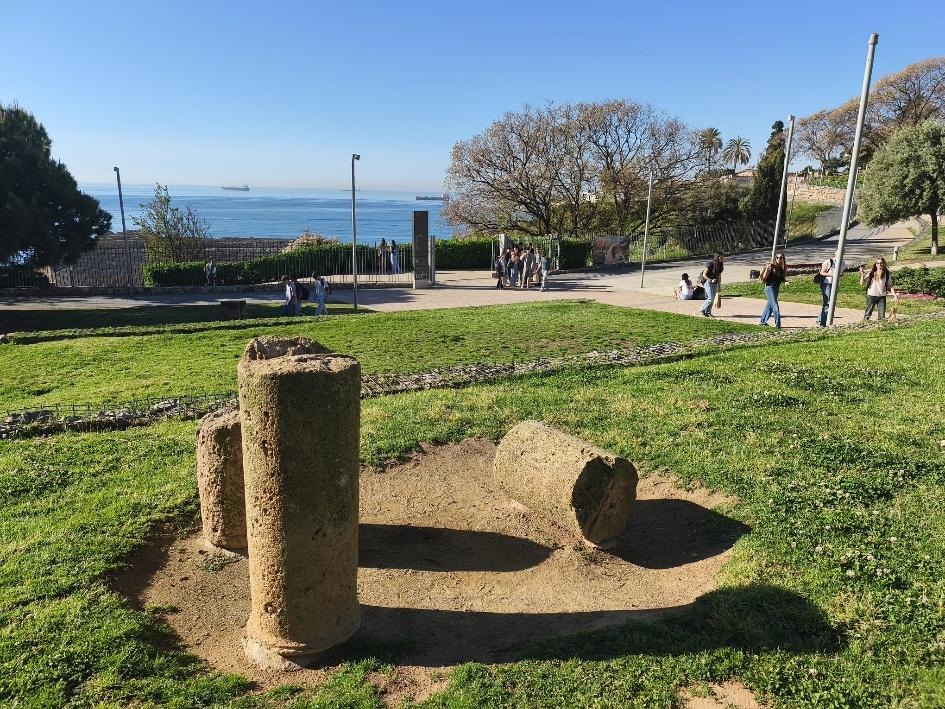
While this example in the Plaça del Fòrum is one of the more remarkable examples, the concept of convivència is also evident in other parts of the city. Just outside the gates of the iconic Roman Amphitheatre, in an open public green space, lie three Roman column bases. They likely belonged to an ancient secondary structure, adjacent to the amphitheatre’s entrance. Left in situ, they receive no special lighting or fencing. People walk past and some sit close by and enjoy the view out to the Mediterranean Sea.
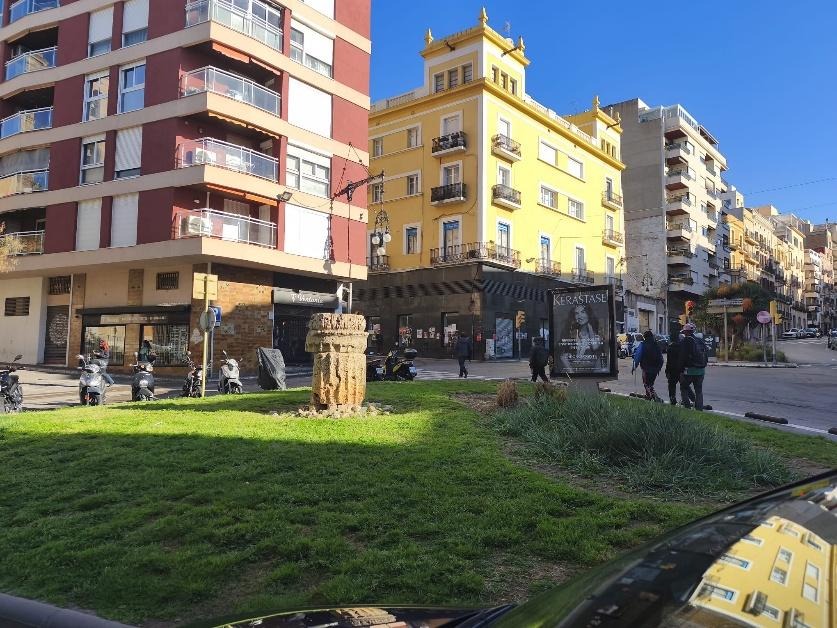
In another part of the city, at the traffic lights at Plaça de Prim, the remains of an ancient Roman column drum sit within a space used as a roundabout. This juxtaposition is most unusual as pedestrians and cars go around the ruins and their presence has been completely normalized and part of their everyday lives.
How Tarragona’s monuments were viewed during Franco’s time shaped how curated and uncurated sites sit side by side in the city today. During the Franco era, Tarragona’s major Roman monuments, like the Amphitheatre, were selected as symbols of a glorious imperial past. Sites like this were homed in on for their Roman past and for their association with early Christian martyrdom.7 Both messages aligned with the regime’s nationalist-Catholic ideology. Smaller, embedded ruins such as those in the Plaça del Fòrum, lacked this value and were left untouched.8 By the time UNESCO declared Tarragona a World Heritage City, the local community had already established a decades-long tradition of living with these ruins in the open plaza, so much so that the city formalized a philosophy of leaving the ruins open for play and interaction.
The Importance of Geology in Making this Possible
Crucially, one of the final factors that makes this open interaction possible comes down to the geological makeup of the stones themselves. Their physical resilience can absorb the force of a bouncing ball. It can withstand the weight of a person sitting on it. It’s safe for people to walk under. This is made possible because the ruins were made from a locally sourced, dense, low-porosity limestone.9 This stone naturally develops a hard, protective surface over centuries that locks out moisture and resists environmental erosion.10 Because engineers have verified that these wall fragments are structurally self-sustaining, municipal planners have deemed them safe to live amongst.11
Analyzing the Play Landscape Through Environmental Psychology
The unique dynamic in Tarragona provides a case study for examining the tension between familiarity and historical significance. When an extraordinary ancient monument becomes a goalpost for an impromptu football match, does its significance slip into the realm of the familiar, causing its historical importance to be forgotten?
Dr. Linda Hirsch, a Postdoctoral Researcher in Computational Media at the University of California, Santa Cruz, conducted an environmental psychological study analyzing how everyday, non-touristic routines interact with historical versus modern sites. Her findings revealed that direct interaction with the built environment increases users’ understanding of and relationship with its history, even in uncurated settings.12 Her case study, which took place in Munich, mirrors Tarragona’s lived-heritage dynamic, where everyday routines deepen civic connection to ancient spaces.
Crucially, Dr. Hirsch’s study discovered a distinct behavioral shift when people move through historical spaces. She said, “Because of the historical significance, students seemed to automatically walk through the historical building with more pride and upright postures. So, there is also value in having everyday exposure to historically significant buildings. It makes you feel more like being part of something great and significant.”13 Applying this insight to the boys playing football or the man sitting on the ruins reveals that their apparent nonchalance is not indifference. Instead, it represents a deep, subliminal “place attachment.” As Dr. Hirsch notes, place attachment thrives when an environment simultaneously fulfills practical contemporary needs.14
This uncurated landscape allows for what heritage scholars describe as a “re-enchantment of the ordinary,” linking the smallest personal story to the grandest part of historical urban transformation.15 If a ticketed, curated monument teaches a visitor through academic instruction, Tarragona’s open ruins teach through an intuitive, physical play that normalizes history. It transforms the past from a distant, cold narrative into a living, tactile reality.
A Look to Future Plans in the City
As Tarragona looks toward the future, it’s moving to further cement this progressive model of open heritage management. Marking the 25th anniversary of its UNESCO World Heritage status, the city announced the official formation of the Roman Consortium of Tarraco, an administrative body designed to streamline preventive conservation while protecting the open, barrier-free civic accessibility of some of its ruins.16
At present, the city is undergoing a major rehabilitation project for the Fòrum de la Colònia, a separate set of Roman ruins. This is backed by a €3 million investment from European Union Next Generation funds.17 Rather than pulling the ruins back behind protective barriers, this initiative will prioritize the reintegration of the Roman remains into the surrounding urban landscape.
Dr. Hirsch adds that there’s a balance in how to use and maintain cultural heritage sites: “It is a very complex challenge that has to be decided on an individual level. Experts have a much greater understanding of what and why sites are historical and what their significance is in relation to the overarching developments of a city or even a country.”18 And yet, “At the same time, vernacular heritage is more relatable and, in many ways, more relevant for contemporary needs. And we need to find a balance between the two, ideally even synergies. This is a process that takes time, but it is extremely important.”19
In Tarragona, play is not a distraction from the serious work of historical preservation. It is one of its driving forces. While the city has numerous curated monuments, it’s the uncurated ones that can often exert the most wonder and are the driver in terms of engagement and preservation. It is these sites that will continue to shape the everyday lives of the city, keeping its history alive not through distance but through one morning market, one cortado, and one childhood game at a time.
Sandra Coffey is a senior news and features journalist from Ireland with over fifteen years’ experience writing for Irish and UK titles. She has a Masters in Arts Policy & Practice from the University of Galway, Ireland. Her thesis reported on the heritage tourism potential of mausoleums in the west of Ireland and she was invited to present her findings at the annual national heritage conference held in Galway.
- Generalitat de Catalunya. “Tarraco | Cultural Heritage.” Patrimoni Cultural de Catalunya, 2024. https://patrimoni.gencat.cat/en/collection/tarraco ↩︎
- UNESCO World Heritage Centre. “Decision – 24 COM X.C.1: Archaeological Ensemble of Tarraco (Spain).” Report of the Twenty‑Fourth Session of the World Heritage Committee, Cairns, Australia, 27 Nov – 2 Dec 2000. https://whc.unesco.org/en/decisions/875 ↩︎
- Ajuntament de Tarragona. “Convivència i Patrimoni: Viure amb la Història.” Tarragona Cultura i Patrimoni, 2023. https://www.tarragona.cat/cultura/patrimoni ↩︎
- Ajuntament de Tarragona. “Setmana Santa 2024: Via Crucis de la Catedral.” Tarragona Cultura i Festes, 2024. https://www.tarragona.cat/cultura/festes/setmana-santa
↩︎ - Generalitat de Catalunya. “Plaça del Fòrum – Mur Romà (IPAC 42344).” Inventari del Patrimoni Arquitectònic de Catalunya, 2024. https://invarquit.cultura.gencat.cat/card/42344
↩︎ - Museu d’Història de Tarragona. “Plaça del Fòrum – Mur Romà.” Patrimoni Històric de Tarragona, 2024. https://museuhistoria.tarragona.cat/patrimoni/placa-del-forum ↩︎
- Macías Solé, Josep Maria. “La gestión del patrimonio arqueológico en Tarragona durante el siglo XX.” *Butlletí Arqueològic*, Reial Societat Arqueològica Tarraconense, 2000. ↩︎
- Macías Solé, Josep Maria. “La gestión del patrimonio arqueológico en Tarragona durante el siglo XX.” *Butlletí Arqueològic*, Reial Societat Arqueològica Tarraconense, 2000.
↩︎ - Generalitat de Catalunya. “Muralles de Tarragona – Geologia i Materials.” Patrimoni Cultural de Catalunya, 2024. https://patrimoni.gencat.cat/en/collection/muralles-de-tarragona
↩︎ - Institut Geològic de Catalunya. “Litologia de Tarragona: Calcàries Miocenes i Conservació Patrimonial.” Servei Geològic de Catalunya, 2024. https://geologia.gencat.cat
↩︎ - Ajuntament de Tarragona. “Mur Romà de la Plaça del Fòrum – Conservació Estructural.” Patrimoni Històric de Tarragona, 2024. https://museuhistoria.tarragona.cat/patrimoni/placa-del-forum
↩︎ - Hirsch, L., Buschek, D., Einwächter, E., Bekker, L., & Butz, A. (2023). “An Empirical Study to Design Interactions with Historical Buildings Used for Everyday Activities.” Proceedings of the 20th International Conference on Culture and Computer Science (ACM), Berlin, 2023. ↩︎
- Hirsch, Linda. Email interview with Sandra Coffey, April 2026.
↩︎ - Hirsch, Linda. Email interview with Sandra Coffey, April 2026.
↩︎ - Hirsch, L., Buschek, D., Einwächter, E., Bekker, L., & Butz, A. (2023).
An empirical study to design interactions with historical buildings used for everyday activities.
In Proceedings of the 20th International Conference on Culture and Computer Science: Code and Materiality (pp. 1–10).
Association for Computing Machinery (ACM). https://doi.org/10.1145/3623462.3624635
↩︎ - Ajuntament de Tarragona. “El Pla de Gestió per garantir els valors del conjunt arqueològic de Tàrraco es presenta en el 25è aniversari de la declaració UNESCO.”
Patrimoni Històric de Tarragona, 2025.
↩︎ - Ajuntament de Tarragona. “Tarragona inicia la rehabilitació del Fòrum de la Colònia amb una inversió de 3 MEUR dels fons Next Generation.”
↩︎ - Hirsch, Linda. Email interview with Sandra Coffey, April 2026.
↩︎ - Hirsch, Linda. Email interview with Sandra Coffey, April 2026.
↩︎

