
This is the third entry in our May series, Cities at Play.
By Dr. Ellery Weil
In 2005, the London skyline faced a threat to one of its iconic features, in the form of an eviction notice. The target? The London Eye. The Ferris wheel, which had been constructed in honor of the new millennium, had found itself caught up in a rent dispute with the owners of the land on which it stood.1
Public outcry was immediate, and fierce. Kate Hoey, an MP for London’s Vauxhall district, told the BBC that the landowners were “being very, very greedy,” and introduced a Parliamentary motion stating that serving the Eye an eviction notice was “against the public interest and should be withdrawn immediately.”2 The motion was tabled; days after the initial backlash, the land company denied it had ever planned any action against the Eye.
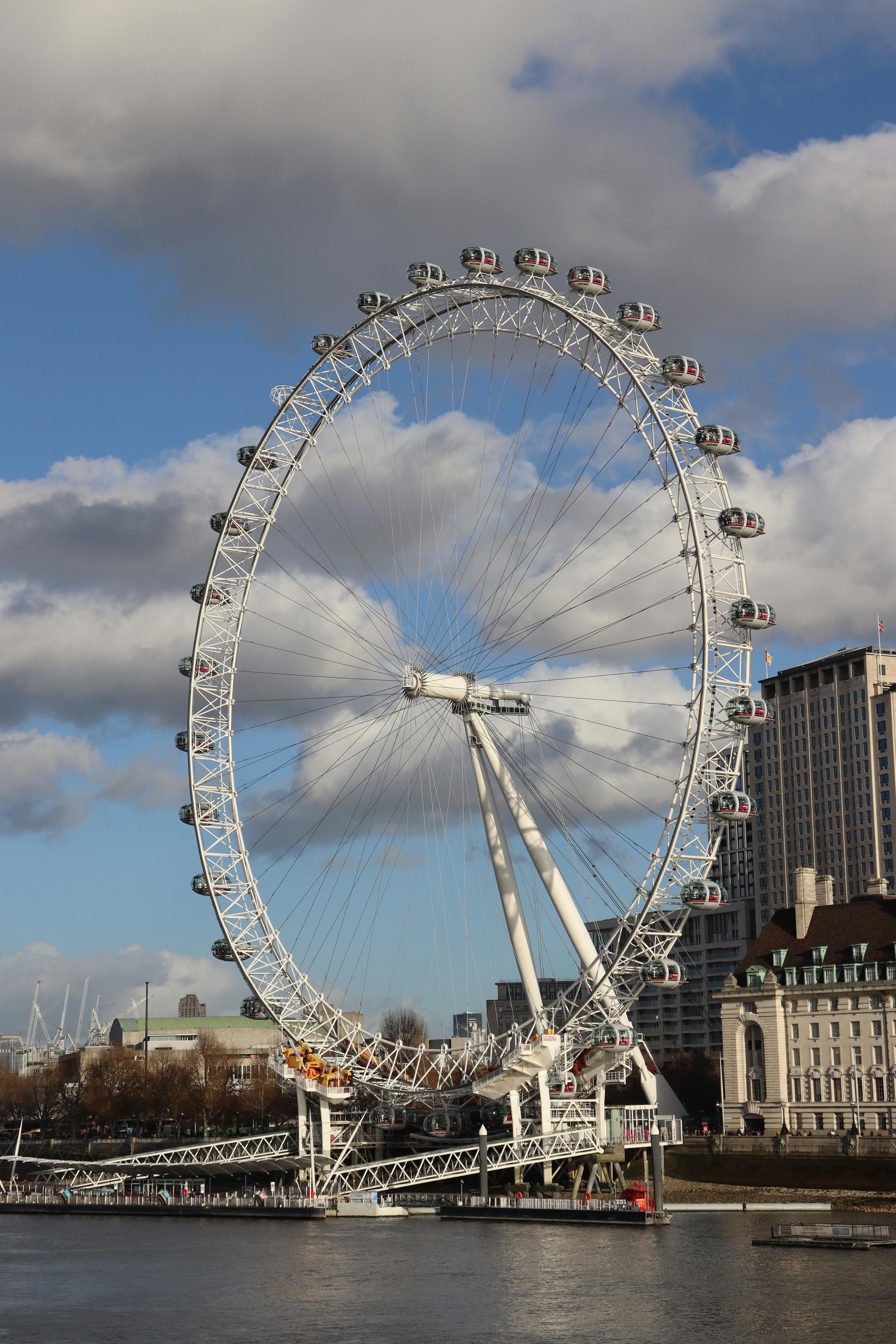
Only a decade earlier, the incident would have seemed unlikely. The London Eye was never supposed to be built; a competition to propose architectural feats marking the new millennium had left judges underwhelmed and unenthusiastic. It was only thanks to a public campaign launched by the Evening Standard that the wheel received funding and building permission. “Once it had appeared in the Evening Standard,” said Eye architect Julia Barfield, “everything changed,” and financial backers as well as the city government started taking the wheel seriously.3
Barfield and her husband and business partner, architect David Marks, had initially developed their proposal for the Eye as London’s millennium project together because they “agreed it shouldn’t be a landmark that people just look at, it should be a landmark that is celebratory, that people can participate in.”4 In short, the team chose a wheel because they thought it would be a place for Londoners and guests alike to mark a new millennium with play.
London wasn’t the first city to fight hard to build its Ferris wheel. That honor famously goes to Chicago, where the world’s first Ferris wheel was constructed as part of the 1893 World’s Fair, as the city’s answer to the Paris Exposition’s Eiffel Tower. That wheel, which opened after months of delay and shocked, delighted, and in some cases terrified fairgoers brave enough to ride it, was an engineering feat, a statement of American ingenuity, and also a statement of something else: the wheel, both during and after the fair, was a testament to Chicago’s prosperity. And within all of that, the wheel was something playful. The 1880s and 1890s were the beginning of leisure being fused with business and engineering, and the Ferris Wheel was an icon of that triumvirate—and a symbol that underscored the message of the exposition itself, the “message” of throwing a World’s Fair at all: that prosperity, in both a city and a nation, fueled recreation and leisure.
The Wheel wasn’t the only display of the “business of play” at the fair. Today, every carnival and amusement park has a midway with games and attractions; the 1893 Fair’s Midway Plaisance, where international exhibits were held, originated the term. But the wheel’s visual shorthand was part of its appeal. Years before the Fair, the consensus was that “the Eiffel Tower…awakened the pride of nations,” and a centerpiece of equal magnificence would be key to an American event.5
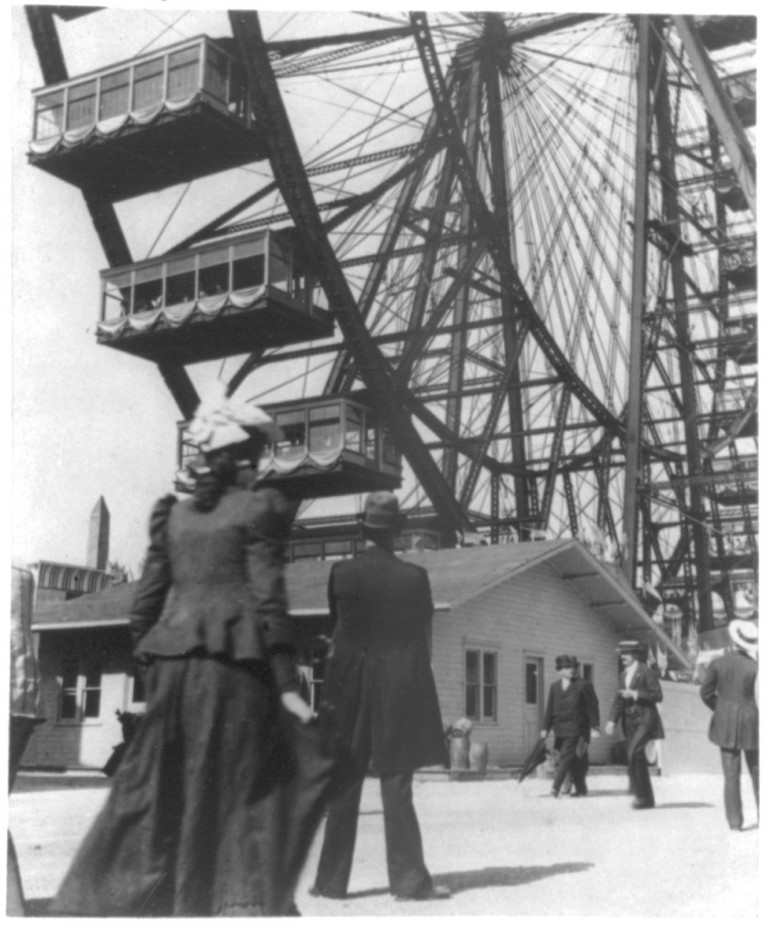
Beyond the obvious comparisons to the Eiffel Tower as a World’s Fair centerpiece, the Ferris wheel at the 1893 Fair had something else in common with that structure: it was a physically massive, and enormously expensive, structure with purely recreational uses.6 Unlike zoos and botanical gardens, which could hold educational missions, or beaches, which are inherently the product of a natural landscape, the Wheel and the Tower were undeniably man-made marvels, meant only to give people a novel view, especially desired as air-based travel, such as hot air ballooning, was increasingly drawing public interest.7 While the Tower, where the trip to the top was straightforward, successfully became the symbol of Paris, the Wheel, where the journey is so much of the appeal, became something else: a symbol of leisure.
After the fair, Chicago’s Ferris wheel was disassembled, removed from the fairgrounds, and reassembled elsewhere in the city. But it would not be a permanent fixture of Chicago, or of any city—Chicago’s fairgrounds had always been intended as temporary structures, the Wheel included.8 Jackson Park would revert to traditional parkland, which it remains today.
Years later, New York City’s Coney Island would become home to the Wonder Wheel, towering over the amusement areas at 150 feet. While this was more than 100 feet shorter than the 1893 Chicago wheel, the height still made the wheel one of the most distinctive features of the park.9 Moreover, the Wonder Wheel was (and still is) an “eccentric” Ferris wheel, with cabins that move on tracks as the wheel turns. The first of its kind, and opened as Coney Island “reached its zenith as America’s amusement park capital,” the Wonder Wheel took the idea of play from the original Chicago wheel, and upped the ante with motion being as big a part of the attraction as the view.10 The moving cabins would prove inspirational to a Ferris wheel at America’s future “amusement park capital,” Disneyland.11
There are multiple reasons that the Ferris wheel succeeded as, and continues to succeed as, such a powerful symbol of a city thriving. The first is, of course, that it’s both inherently unnecessary (no city needs a Ferris wheel in the way that they need a hospital, a school, or even a shopping district), and costly to build. The London Eye cost over £70 million to build at the time of its construction. 12You can’t put up a long-lasting Ferris wheel if you’re short on cash, or if you think that you’re not likely to recoup your investment through ticket sales. Much of the money to build the Eye came from British Airways, who were only persuaded to invest after the “Back the Wheel” campaign took off, which the company took as a signal of high demand.13
Those tickets can get expensive in their own right. A standard ticket for the London Eye in 2026 stands at £33, more than two and a half times Britain’s national minimum wage. And yet, the tickets sell, to the point that the website where they can be purchased warns visitors about the risk of tickets selling out at “peak times.”14 This, in spite of the fact that Londoners and tourists alike can enjoy an even higher view for free at Sky Garden, the city’s only public garden to be housed at the top of a skyscraper, or a more detailed one, if they’re willing to pay a hefty fee, from a private helicopter tour.15
But the elevator that takes visitors to Sky Garden is windowless, and the helicopter tours take place in tiny vehicles, which are inherently temporary features in the skyline. By contrast, not only does a ride on a Ferris wheel provide you with views going up, at the wheel’s apex, and on the way down, it also positions you inside a view of the city—a famous, iconic one at that. As you watch London from your carriage on the wheel, London is watching you, and the city becomes your partner in play.
Ferris wheels represent a confidence in modern engineering and a confidence in the view one is presenting. No one rides a Ferris wheel to gaze at clouds of industrial smog, or a city that’s blighted and ugly. A Ferris wheel only makes sense in the presence of a view worth seeing. Chicago built its Ferris wheel on the hope of novelty appeal; Daniel Burnham, one of the architects of the 1893 Fair, who had been involved in approving the wheel, had championed a signature structure that “something novel, unique, original, and daring must be built if American engineers are to retain prestige and standing,” marking his view of the wheel chiefly as proof-of-concept and technological marvel.16 Burnham said in 1909 that Chicago “will be lovely,” one day, but wasn’t yet—more than a decade after the wheel’s first turn.17 He would have been sympathetic to anyone whose interest in the 1893 wheel didn’t go past a single ride for the sake of novelty.
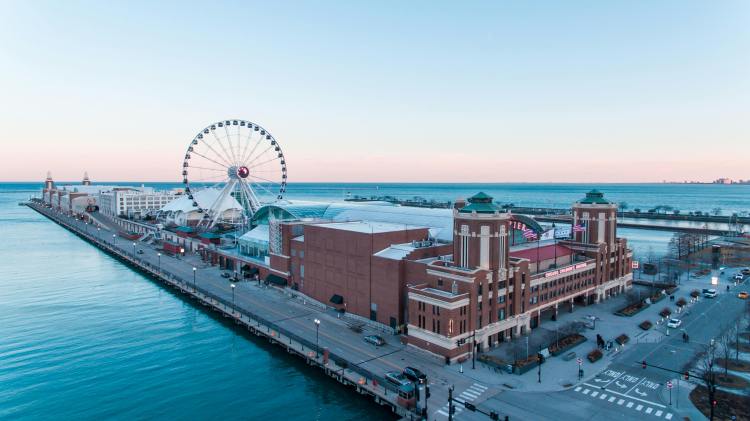
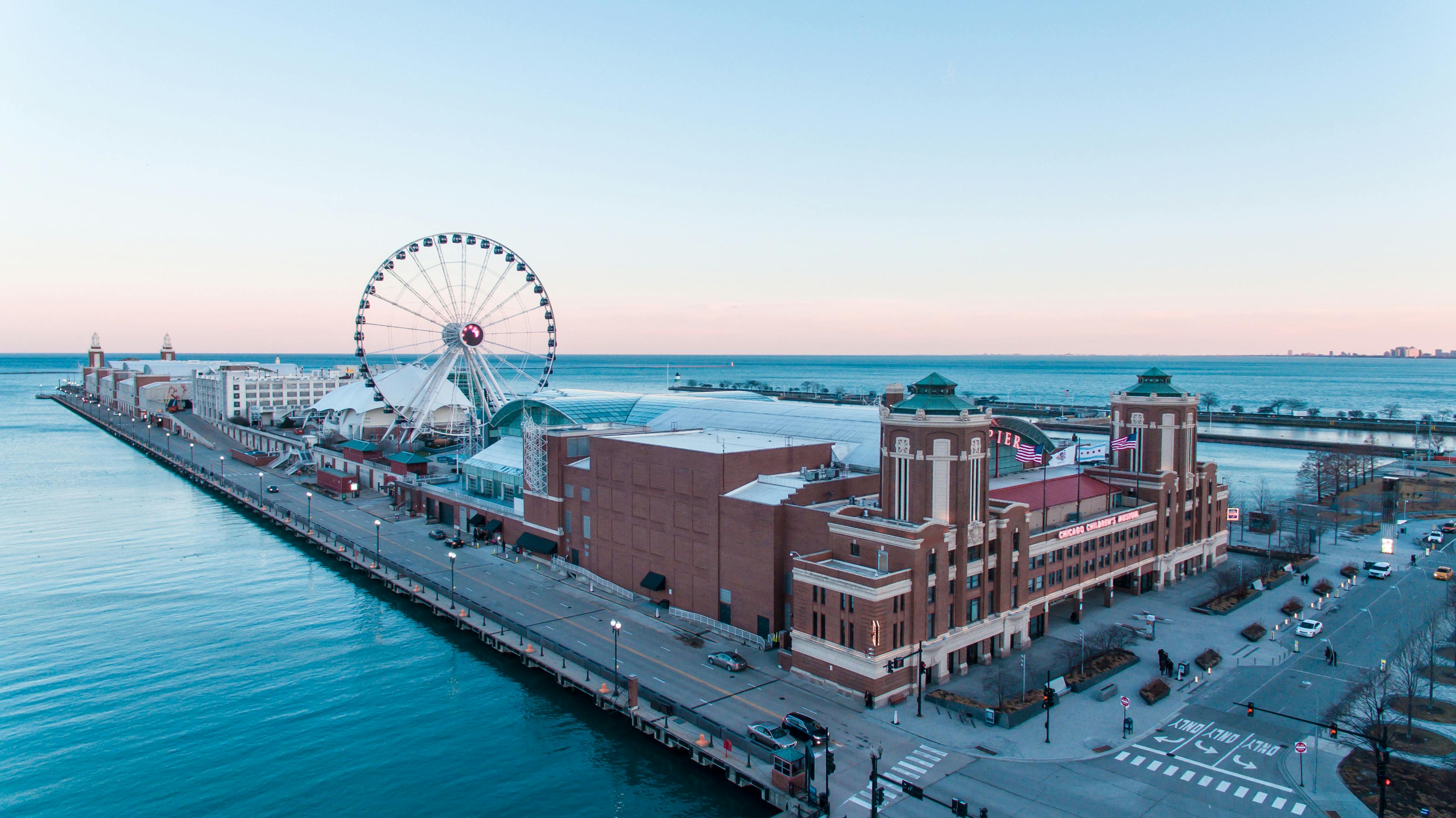
The original Ferris wheel had been demolished three years before Burnham made that statement. It hadn’t even spun its last turns in Chicago—it had been moved to St. Louis in 1903 for another World’s Fair, this time celebrating the Louisiana Purchase.18 But in 2016, 110 years after the 1906 demolition of the original Ferris wheel, Chicago’s Navy Pier marked a century of operation with the creation of the Centennial Wheel, a new permanent Ferris wheel for Chicago. Today, if you ride the Centennial Wheel, you can see two views, both part of Chicago’s history: the Chicago skyline, home to the Willis Tower, which is one of the Western Hemisphere’s tallest buildings, on one side, and on the other, the expanse of Lake Michigan, whose use in trade helped make Chicago a major city.19
Meanwhile, in London, business continues to meet playtime. In the city, both business travelers and tourists will almost certainly ride the London Underground. They might not pay particularly close attention to the upholstery on their seats there, but if they did, they’ll note that Tube seats on most major lines are covered in the same patterned fabric. The pattern depicts an abstract rendering of the London skyline. Among its most distinctive features, seen below ground as above, is the outline of the London Eye.
Ellery Weil is a historian and writer living in London. She holds a PhD in History from University College London, where she completed her thesis on Jewish women’s activism at the turn of the twentieth century, as well as a Bachelor’s in Political Science from the University of Michigan, and has written for academic and professional publications including Atlas Obscura, Saveur, Lilith, the Jewish Women’s Archives, and many more.
- “London Eye Given Eviction Notice,” BBC News. May 20, 2005. Published online at http://news.bbc.co.uk/1/hi/england/london/4564115.stm. ↩︎
- Ibid.; LONDON EYE, EDM 165, Tabled on 23 May, 2005. See: https://edm.parliament.uk/early-day-motion/28359/london-eye ↩︎
- Julia Barfield. “I Designed the London Eye — But Without This Sharp-Eyed Journalist It Wouldn’t Have Been Built.” The Standard March 5, 2025. https://www.standard.co.uk/comment/london-eye-anniversary-twenty-five-years-julia-barfield-b1215167.html ↩︎
- Ibid. ↩︎
- “M. Palacio’s Design for a Colossal Monument in Memory of Christopher Columbus.” Scientific American, Volume 63, Issue 17. (October 1890), 260. ↩︎
- The 1893 wheel was built at an estimated cost of $380,000, or close to $14 million in today’s currency. Notably, this was not the most expensive proposal for a fair centerpiece; a “sphere” proposed by Spanish architect Alberto de Palacio, had an estimated cost of $6 million, or over $200 million today. See “M. Palacio’s Design for a Colossal Monument in Memory of Christopher Columbus.” Scientific American. ↩︎
- Tethered hot-air balloon rides were one of the signature attractions of the 1889 Paris Exposition; the Ferris wheel can be viewed in part as an attempt to outdo the experience. See: https://airandspace.si.edu/collection-objects/lexposition-de-paris-supplement-au-no-18-le-grand-ballon-captif-de-m-giffard/nasm_A20140656000 ↩︎
- Rebecca S. Graf, “The City Beyond the White City.” Society of Architectural Historians & Charnley-Persky House Museum Foundation, 2022. https://www.beyondthewhitecity.org/worlds-columbian-exposition
↩︎ - Swaim, Ginalie. “Iowans at the 1893 World’s Columbian Exposition: What They Took to the Fair, What They Did There, and What They Brought Back Home.” The Palimpsest 74, no. 4 (1993). ↩︎
- Landmarks Preservation Commission May 23, 1989; Designation List 215 LP-1708; https://s-media.nyc.gov/agencies/lpc/lp/1708.pdf ↩︎
- “History–Deno’s Wonder Wheel” accessed at https://www.denoswonderwheel.com/history ↩︎
- “History and Facts.” https://www.londoneye.com/about-us/history/#how-much-did-it-cost-to-build-the-london-eye ↩︎
- Barfield. “I Designed the London Eye — But Without This Sharp-Eyed Journalist It Wouldn’t Have Been Built.” ↩︎
- “General Admission Tickets.” https://www.londoneye.com/tickets-and-prices/entry-tickets/
↩︎ - “Book Your Free Sky Garden Ticket.” https://tickets.skygarden.london/WebStore/shop/viewitems.aspx?cg=SkyGarden&c=Tickets ; “Helicopter Sightseeing Flight of London for Two.” https://www.virginexperiencedays.co.uk/product/helicopter-flight-london-for-two ↩︎
- Untitled typescript, Ferris Papers, 1. ↩︎
- Undated biography, Burnham Archives, Box 28, File 2.
↩︎ - WHEEL, FERRIS. The Mythical West: An Encyclopedia of Legend, Lore, and Popular Culture (2001): 139. ↩︎
- Navy Pier, “Centennial Wheel.” Accessed at https://navypier.org/pier-locations/centennial-wheel/
↩︎


A beautiful tribute to urban landmarks; your point about the Ferris wheel making the city a “partner in play” is truly insightful.
LikeLike