
This is the second post in our May theme month, Cities at Play.
By Maggie McNulty
On November 30, 2022 at a ribbon cutting ceremony for the Interstate 70 (I-70) Cover Park in Denver’s Elyria-Swansea neighborhood, Governor Jared Polis stated, “This is really a model of innovative solutions, green infrastructure, state of the art technology and community involvement from the ground up.” Former Councilwoman At-Large Debbie Ortega observed the project’s “unprecedented commitment” to the community. Stephanie Pollack, Acting Federal Highway Administrator, lauded the I-70 Cover Park as a national example for reconnecting communities impacted by highway construction across the country.1 These public sentiments from government officials, however, obscure that for many local residents the cover park has always been a controversial decision, filled with concerns about community health and displacement. This piece explores urban renewal, pollution mitigation, and whether the creation of such a greenspace is reparative or deceptive through the lens of play and recreation on top of the I-70 Cover Park in Elyria-Swansea.
In 1964, I-70 was constructed in Denver, Colorado bisecting the Globeville and Elyria-Swansea neighborhoods, demolishing thirty-one homes, and isolating these communities from the rest of the city.2 By 2008, one of the highway’s viaducts in Elyria-Swansea was crumbling, and the city was left to decide whether to rebuild, relocate, or remove the elevated freeway.3 Other US cities including San Francisco, Milwaukee, Boston, and Seattle replaced elevated freeways with surface-level boulevards in the 1990s and 2000s prioritizing public transit, cycling, and pedestrian opportunities to increase connectivity.4
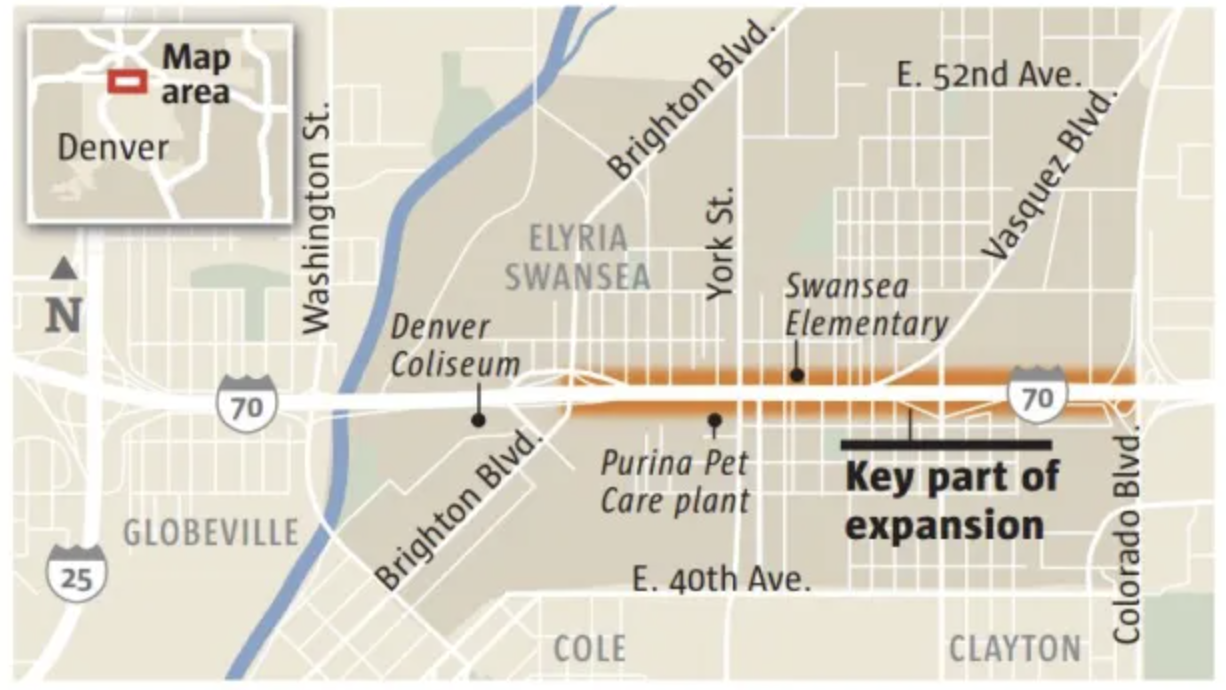
Many stakeholders came forth with proposals for I-70 including expansion, removal and replacement with a boulevard, and decking. In 2008, the Colorado Department of Transportation (CDOT) initially proposed two options for the aging I-70 viaduct, neither of which involved removal of the freeway. The first was to reroute the highway north, which would demolish forty-seven homes and Swansea Elementary School. The second option was to reroute south, which would take out fifty-four homes and the Nestle Purina plant in Elyria-Swansea.5 The city quickly ruled out relocating Purina to avoid losing the tax revenue.6 Both options for I-70 involved displacing approximately fifty households in Elyria-Swansea, subsequently wiping out one-third of the neighborhood, which consisted of 150 homes within a fourteen-block radius just north of 46th Avenue between Brighton Boulevard and York Street. Although residents were compensated for their property values, CDOT’s plans again dispersed a tight-knit group of residents, friends, and families in Elyria-Swansea like they did in the 1960s.
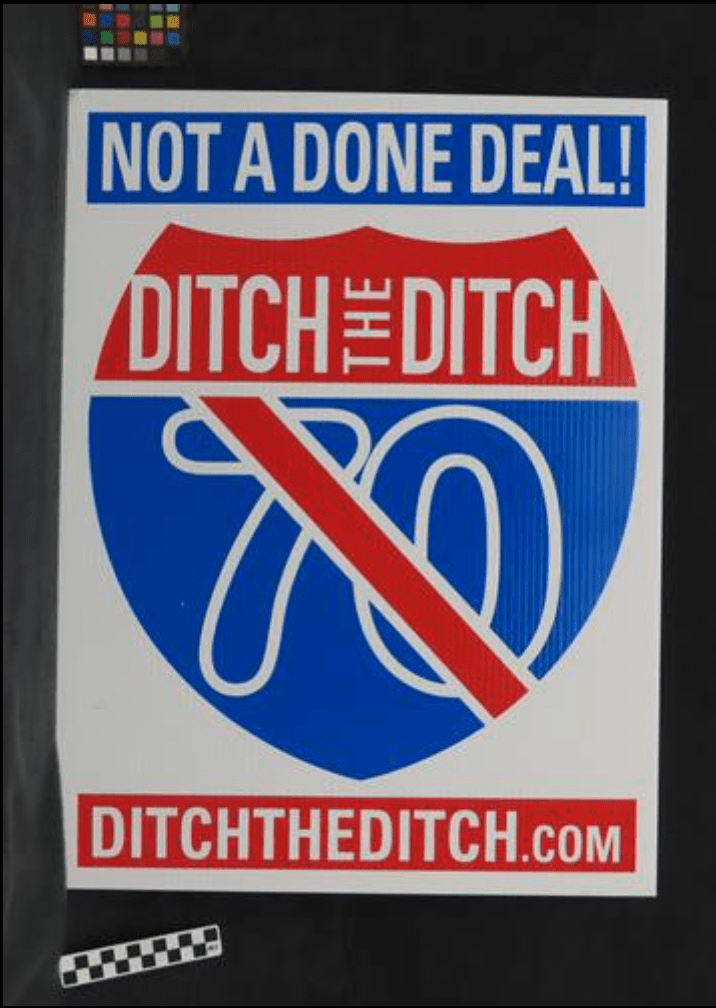
The proposal to expand I-70, however, did not come without opposition. Earth First!, a radical environmental group, dedicated to wilderness and biodiversity advocacy protested the expansion of I-70 in May 2009 by hanging a banner that read “Stop I-70 Expansion” during rush-hour traffic.7 In 2010, residents, led by local artist and entrepreneur Brad Evans, started the “Ditch the Ditch” campaign (see figure 2); initially a Facebook group with over 2,900 members, the group opposed the expansion and lowering the viaduct and advocated for rerouting I-70 outside of the city.8 Numerous faith-based organizations including the congregation of Denver’s oldest African American church supported the Ditch the Ditch campaign. More than 400 members of the interfaith and interdenominational community in metropolitan Denver wrote letters to CDOT and the United States Department of Transportation (USDOT) expressing concerns about the public health effects and pollution exposure on the community, especially for children at Swansea Elementary School. The Denver Department of Public Health and Environment (DDPHE) found that children living in close proximity to I-70 experienced a 40% greater rate of severe asthma related events, including urgent care visits, than in other parts of Denver.9 The interfaith groups called the highway expansion “immoral” for disproportionately impacting an already disenfranchised community of color.10
The I-70 expansion proposal was one of six projects that were part of Mayor Michael Hancock’s 2013 North Denver Cornerstone Collaborative, known as the Corridor of Opportunity program.11 The Corridor of Opportunity projects were designed to revitalize North Denver. The proposed Corridor of Opportunity included turning Denver’s National Western Stock Show, in Elyria-Swansea, into a year-round entertainment center and doubling its size, redeveloping the River North (RiNo) Arts District, and adding Regional Transportation District (RTD) commuter rail lines.12 A twenty-three-mile stretch between the Denver International Airport and Union Station in downtown Denver, the expansion of the highway and addition of new rail lines was designed to create a gateway from the airport to the National Western Complex and downtown.13 As part of the Corridor of Opportunity, in August 2014, CDOT announced that the “Central 70” project, later named “I-70 East,” would not only replace the aging viaduct, but also would expand eleven miles of I-70 in North Denver, adding two additional lanes in each direction. Subsequently, the highway would be expanded from six lanes to ten lanes, with two new toll lanes, and widened from 115 to 315 feet.14 The I-70 expansion was in part justified because it was the “front door” to the National Western and is central to its success as it provides convenient access for tourists and visitors.15
However, many residents, urban planners, architects, and engineers argued that their ideal scenario for I-70 would be to have the highway rerouted out of the city entirely and to construct a boulevard in its place. Opponents of the expansion argued this would displace the fewest number of residents and businesses, create more neighborhood connectivity, increase property values, and have the least negative impact on Swansea Elementary School, which sits right next to the highway.16 Unite North Metro Denver, one of the most vocal local groups against the expansion, advocated for an urban, tree-lined boulevard with native trees in the median to improve air quality, decrease the urban heat island effect, and retain stormwater runoff. The tree-lined boulevard would also open access to the nearby South Platte River and opportunities for pedestrians and bikers instead of vehicles.17 A significant component of the highway removal and boulevard replacement proposal was the potential revenue and economic benefits of converting I-70 from urban renewal transit infrastructure into recreational infrastructure.
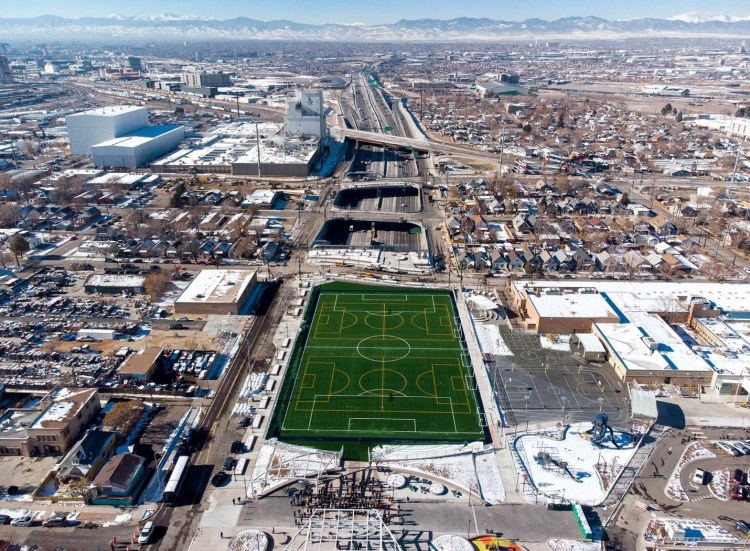
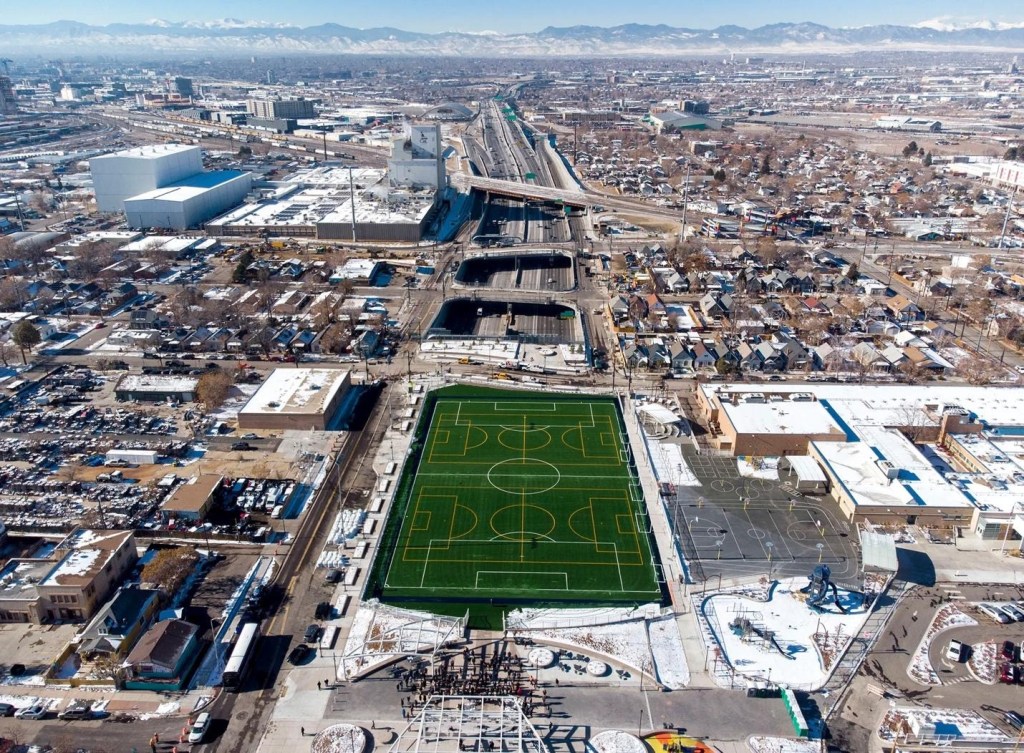
Despite resistance from residents, environmental organizations, interfaith groups, urban planners, architects, civil engineers, and others, CDOT elected to depress the crumbling portion of the viaduct and construct a four-acre landscaped “lid” on top, as a means of reestablishing connectivity between these neighborhoods that was once diminished when the highway was initially constructed in the 1960s. Today, the I-70 Cover Park, which sits on top of the lowered highway in this predominantly low-income community of color, contains an amphitheater, two soccer fields, and splash pads and cost $125 million of the highway construction’s $1.2 billion project.18 On the surface this may appear to be an inviting space for families to engage in recreation; however, this project remains highly controversial among locals. Residents are concerned that this project will contribute to rising housing costs, exacerbate childhood asthma rates, and there are safety concerns about children playing on top of a highway. Residents have called the I-70 Cover Park “lipstick on a pig” and assert that the city “wouldn’t [put] that in a white, wealthy neighborhood.”19
Longtime Globeville resident and parent Armando Payan further expressed “Why would you want to bring your kids next to a highway so they can go to school and breathe all that contaminated air?”20 Some parents in Elyria-Swansea find the playground to be “limiting” due to the astroturf grass, rubbery bark chips, and small trees that provide no shade or respite from the heat in the summer and assert that “putting a park on top of a highway in the most polluted zip code in America feels a little offensive.”21 While there has not yet been a comprehensive study of the air quality on the I-70 Cover Park, preliminary findings from a scientist at the University of Colorado Boulder demonstrate that pollutants from traffic emissions tend to concentrate at the edges of the park but are no higher in the center of the park, where children play, than in the surrounding neighborhoods.22
Residents have also reported that there was minimal input from community members about what they wanted the cover park to look like, an example of the city excluding equal participation in the decision-making process and design of the highway. While CDOT hoped the I-70 lid would lessen the pollution burden, the deck is often described as “not what the community itself would have wanted.”23 Ana Varela, a resident of Elyria-Swansea, stated in an interview with Rocky Mountain PBS, “my thoughts on the park over the freeway are that it is a perfect example of one community that isn’t really heard. The neighbors wanted green space, not Astroturf. The neighbors wanted access to active areas, not a locked gate [referring to the soccer field here that is locked unless you have a permit to play].”24 On the contrary, Denver’s Governor Jared Polis and former Mayor Michael Hancock celebrated the I-70 Cover Park as an “innovative mitigation” project.
The lack of community input and agency in the planning of the I-70 lid has influenced how some residents use this green space and their sense of belonging here. Some view the cover park as a material marker that represents the demolition of fifty-six homes and seventeen businesses in their community for the construction of new express lanes. Overall, residents have mixed feelings about the cover park; some resent the project and see it as a form of greenwashing and consolation for the highway’s adverse impact on the neighborhood, but others do enjoy “using this amazing soccer field and having families enjoy the events lawn and other spaces this park provide[s].” Today, the park is largely used and enjoyed by children and parents at Swansea Elementary School who have described the cover park as “a major asset to both the school and the community.”25 The I-70 Cover Park remains a contested symbol in North Denver and reveals the limits of infrastructural solutions that attempt to solve mitigation while largely ignoring meaningful community engagement. While advertised by the city as a means of connectivity, recreation, and play, for some residents the I-70 Cover Park is a reminder of community displacement, increased health concerns, and exclusion within the decision-making process.
Maggie McNulty is a PhD candidate in History at the University of Colorado Boulder with a focus on environmental and urban history. McNulty’s dissertation explores the history of environmental justice and activism in Denver’s Globeville and Elyria-Swansea neighborhoods. @maggiemcnulty.bsky.social
- Rebecca Tauber, “That park above I-70 in Elyria-Swansea is finally open,” Denverite, November 30, 3022, https://denverite.com/2022/11/30/i-70-park-opening-elyria-swansea/. ↩︎
- Daniel Doeppers, “The Globeville Neighborhood in Denver,” Geographical Review 57 (1967); Larry Betz, “Globeville: Part of Colorado’s History,” (Denver, 1972).
↩︎ - Robert Sanchez, “I-70’s neighbors torn over its fate” The Denver Post, November 1, 2004, 1A, 12A.
↩︎ - Kathleen McCormick, “Deconstruction Ahead: How Urban Highway Removal is Changing Our Cities,” Land Lines (April 2020). https://www.lincolninst.edu/publications/articles/2020-03-deconstruction-ahead-urban-highway-removal-changing-cities/. For a similar example, see New York’s Riverbank State Park, a park built on top of a sewage treatment plant in Harlem, https://www.dattner.com/projects/view/riverbank-state-park/. ↩︎
- Tina Greigo, “Dividing neighbors—I-70 viaduct expansion comes with price for Swansea, Elyria,” The Denver Post, March 11, 2012. ↩︎
- “I-70 Widening Proposal Reveal Flawed Values,” in the author’s possession gift from Rocky Piro.
↩︎ - Jared Jacang Maher, “Earth First! Enviro-radicals emerge from the trees to protest I-70 overhaul,” Westword, June 22, 2009; Jezzaboo, Nettle, and Sasha, eds., Earth First! 29, no. 5 (1 July 2009) republished by the Environment & Society Portal, Multimedia Library, https://www.environmentandsociety.org/sites/default/files/key_docs/ef_29_5_1.pdf. ↩︎
- Kevin J. Beaty, “CDOT Hearing on I-70 Plan Draws Opponents, Pleas to ‘Ditch the Ditch,’” Westword, April 25, 2016; Carol McKinley, “Colorado Interstate 70 project keeps driving forward despite opposition from neighborhood,” The Denver Gazette, January 10, 2021. ↩︎
- Natalya Savka, “No, This Latino Neighborhood in Denver Doesn’t Want Your 21-Lane Highway,” Sierra: The Magazine of the Sierra Club, December 8, 2016, https://www.sierraclub.org/sierra/green-life/no-latino-neighborhood-denver-doesn-t-want-your-21-lane-highway. ↩︎
- Tom McGhee, “Denver’s oldest African American church supports residents opposed to plans for I-70 expansion,” The Denver Post, August 6, 2017. ↩︎
- Monte Whaley, “A grand design—I-70 remake at heart of plan to revive Denver neighborhoods,” The Denver Post, December 17, 2013; Gabe Fine, “Big Projects Are Home Wreckers for Longtime Residents of North Denver,” Westword, August 15, 2017. ↩︎
- Monte Whaley, “A grand design—I-70 remake at heart of plan to revive Denver neighborhoods,” The Denver Post, December 17, 2013; Natasha Gardner, “For more than a century, Denver has mistreated, maligned, or misused the Globeville neighborhood,” 5280 Magazine, September 16, 2019. ↩︎
- National Western Center Master Plan, March 9, 2015, Denver Public Library: Valdez-Perry Branch Library.
↩︎ - Monte Whaley, “A grand design—I-70 remake at heart of plan to revive Denver neighborhoods,” The Denver Post, December 17, 2013; Jon Murray, “Activism, lawsuits could delay or derail the massive I-70 expansion in Denver—but are they long shots? CDOT has won federal approval for project but still faces nimble opponents with several efforts underway,” The Denver Post, April 17, 2017; Caroline Tracey, “Redlining Returns to Denver but with a Neoliberal Twist,” The Nation, July 31, 2017; Alan Prendergast, “CDOT’s ‘Push Poll’ On I-70 Expansion Draws Pushback,” Westword, August 24, 2017; Jon Murray, “Judge greenlights I-70 project-Neighbors’ health concerns still will be argued in court while construction kicks off,” The Denver Post, April 4, 2018.
↩︎ - National Western Center Master Plan, March 9, 2015, Denver Public Library: Valdez-Perry Branch Library.
↩︎ - “Unite Metro North Denver: The I-270/I-76 Reroute Alternative for I-70,” in A Better Option for I-70 East, in the author’s possession gift from Rocky Piro. ↩︎
- Unite North Metro Denver “Channel 56- I-70 Expansion Discussion” October 28, 2014, https://www.youtube.com/watch?v=2LZzbV_kaE4. ↩︎
- Raksha Vasudevan, “North Denver’s green space paradox,” High Country News, December 1, 2023. For a breakdown of the costs see, “Central 70 Project,” Colorado Department of Transportation, https://www.codot.gov/projects/archives/i70east. And the project’s managed lanes were financed through a public-private partnership.
↩︎ - Carol McKinley, “Colorado Interstate 70 project keeps driving forward despite opposition from neighborhood,” The Denver Gazette, January 10, 2021; Rebecca Tauber, “It’s finally time to put that park on top of I-70,” Denverite, September 12, 2022. ↩︎
- Armando Payan, interview by Marissa Volpe, 2018, Globeville-Elyria-Swansea Memory Project, History Colorado. ↩︎
- Rocky Mountain PBS, “The Most Polluted Zip Code Part 2,” https://www.rmpbs.org/shows/beecff7d-20c0-48bb-9866-b02159a2dc1d/episodes/the-most-polluted-zip-code-part-2-talsnj. ↩︎
- Sam Brasch, “Colorado built a park over I-70 to contain pollution. Is the air safe to breathe?” Colorado Public Radio (CPR) News, October 30, 2023, https://www.cpr.org/2023/10/30/colorado-built-a-park-over-i-70-to-contain-pollution-is-the-air-safe-to-breathe/. ↩︎
- Rocky Mountain PBS, “The Most Polluted Zip Code Part 2,” https://www.rmpbs.org/shows/beecff7d-20c0-48bb-9866-b02159a2dc1d/episodes/the-most-polluted-zip-code-part-2-talsnj. ↩︎
- Amanda Horvath and Alexis Kikoen, “First-hand air-quality awareness for residents in the most polluted zip code,” Rocky Mountain PBS, November 16, 2023, https://www.rmpbs.org/news/rocky-mountain-pbs/social-justice-and-environmental-quality-study-denver. ↩︎
- Jon Murray, “New cover park is the I-70 expansion project’s crown jewel. Will it change a Denver neighborhood for the better?” The Denver Post, December 1, 2022, https://www.denverpost.com/2022/12/01/central-70-project-final-milestone-cover-park/. ↩︎

