
This is the fifth post in our themed series, “Selling the City.“
By Grace Gillies
Augustus, Rome’s first emperor, styled himself as the savior of Rome. Despite the fact that he destroyed the Republic when he seized sole power, he depicted himself as the man who would restore its traditions while raising Rome to new heights of glory. He spent the four decades of his rule investing in large-scale public works in the city, through repairs and new construction, to the point that he is said to have claimed that he “found Rome a city of brick and left it a city of marble.”1 The Ars Amatoria, a work of poetry on how to attract lovers by the poet Ovid, would challenge this landscape of propaganda in a conflict that intersects with modern discussions of urban branding.
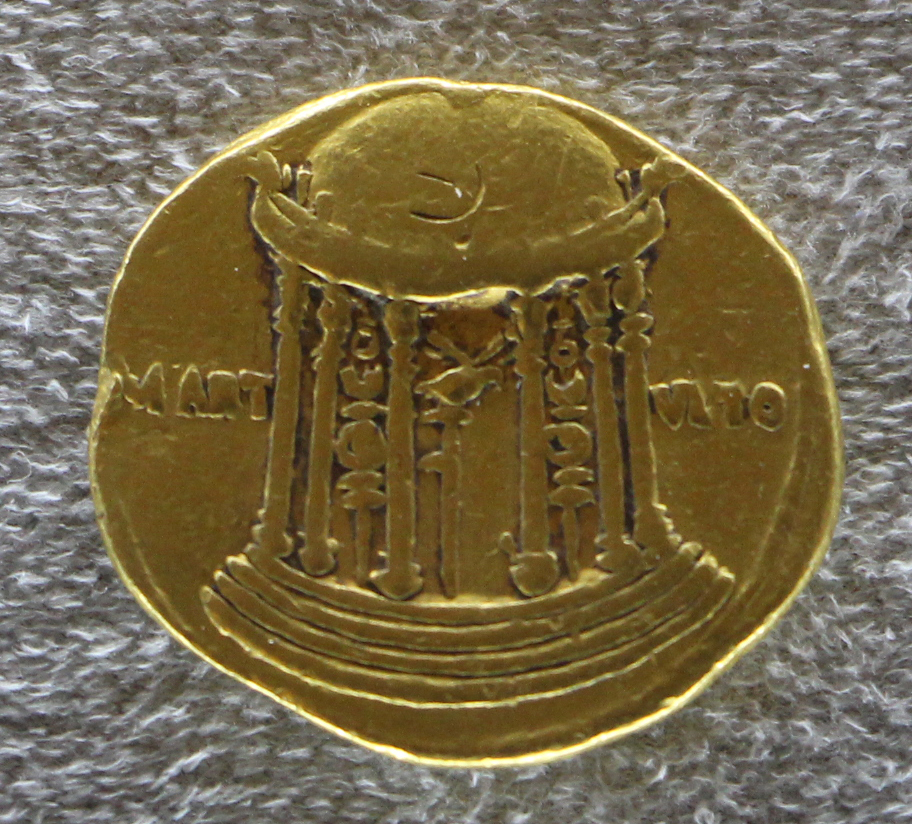
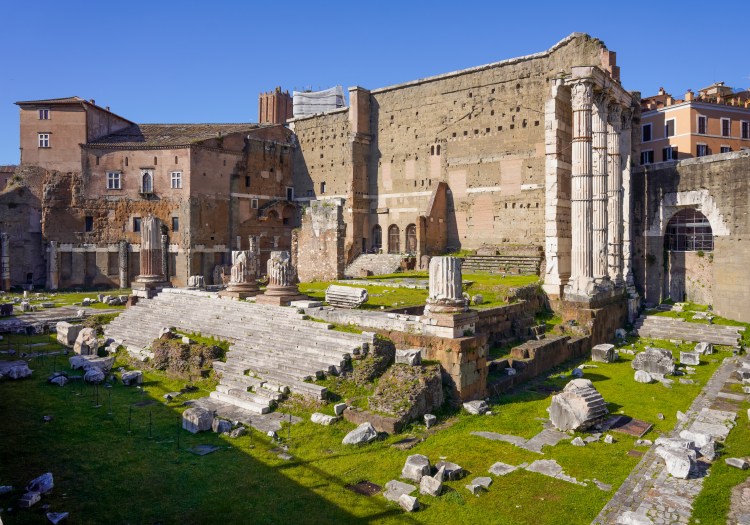
Augustus reshaped Rome with an extensive building program meant to glorify himself and characterize his rule as a moralizing force. The centerpiece was the Forum of Augustus (fig. 1), a hulking public space dominated by a temple to Mars Ultor (Mars the God of Vengeance), the deity supposedly responsible for Augustus’s victory in the civil war. A statue of Augustus stood in front of the temple, at the center of the forum, visually connecting Augustus to the god who had ordained his victory. The temple also depicted Venus, the goddess of love, whom Augustus’ family, the Julians, claimed descendance from by way of her son Aeneas, a heroic founding figure of Rome. The forum also linked Augustus to the most revered men in Rome’s history. Its sides were lined with statues and descriptions of Rome’s founders and heroes of the Republic, which framed the statue of Augustus at the center. Thus, Augustus suggested that he was another founder and Roman hero, a man who would exemplify Rome’s traditional values.
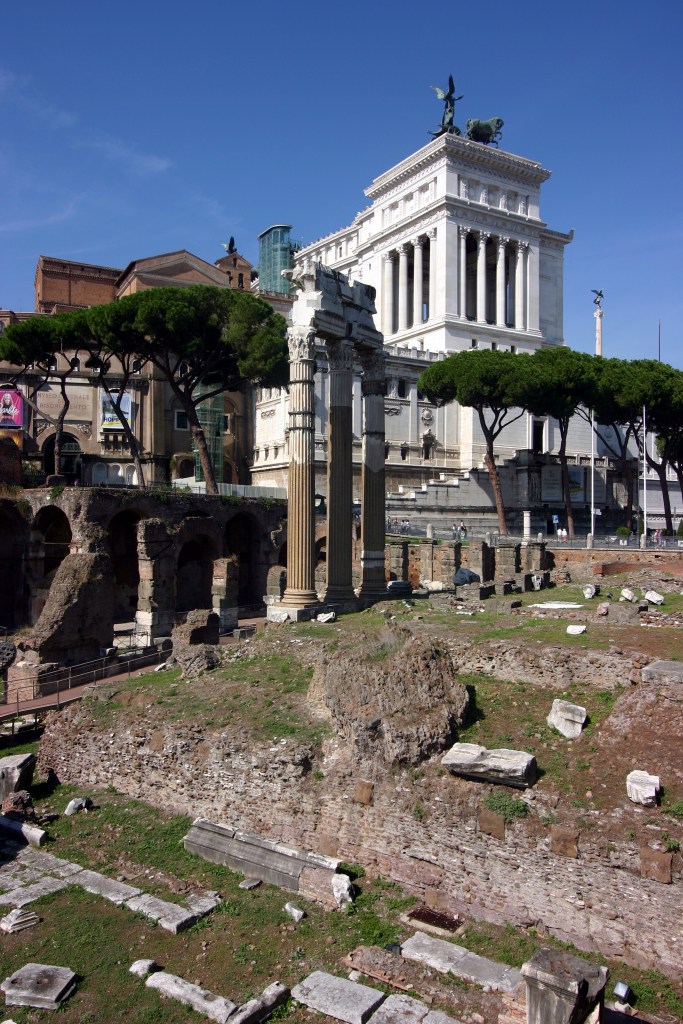
This messaging was reinforced by the rest of Augustus’s extensive building program. Augustus finished, for instance, the Forum of Caesar (fig. 2), which had been begun by Julius Caesar but left unfinished after his assassination. This forum had a temple to Venus Genetrix (Venus the Mother), which similarly stressed the Julian family’s connection to this goddess. In addition were numerous public works created either under his name or close allies or family, such as the Portico of Livia, named after his wife. The portico replaced a wealthy private house that had been built on that site, and so the portico offered several different propagandizing messages. As a public space, it emphasized Augustus’s commitment to the people. As a replacement for a wealthy private house, it contrasted the home’s decadence with Augustus’s humble taste. Lastly, its connection with Livia reinforced Augustus’s image as a man devoted to Roman family values, which he reinforced with moralizing legislation, including laws regulating and encouraging marriage (lex Julia de maritandis ordinibus) and increased the criminal penalties for adultery (the lex Iulia de adulteriis coercendis). These sites were the physical representation of Augustus’s messaging and social control. Anyone engaging with the city was forced to experience it through Augustus’s lens, a lens whose focus was tightly controlled.
It was in this context that the Roman poet Ovid published The Art of Love, three books of poetry that parodied the didactic genre by instructing readers on how to find, attract, and hold on to lovers. The poems were published at the beginning of the first century AD, thirty years after Augustus first rose to power. Ovid would go on to claim it was this work that led Augustus to exile him.2 The poetry seems to have been objectionable because, despite an introductory warning that the text was not meant for married women, it was understood to encourage adultery.3 Perhaps even more damningly, the first book famously praises the Rome Augustus had rebuilt as a wonderful place to cruise for girls:
Rome will give you such smokeshow girls—and so many— 55
that you’ll say, ‘Whatever you could get anywhere in the world, She’s got it!’
However much wheat Gargara has, or grapes Methymna,
or fish in the sea, or birds covered by branches,
or stars in the sky, that’s how many girls your Rome has:
[Venus, the goddess of love and sex,] the mother of [Rome’s founder] Aeneas, resides in her own city. 60
If you’re turned on by girls in their early, still-growing years,
a genuine girl will pass before your eyes:
or if you want a young one, a thousand will suit your taste.
You’ll be forced to confess you don’t know which you’d choose!
Or if by chance an older and wiser age appeals to you, 65
there will be an even fuller parade of these women, believe me.4
By the time of Ovid’s writing, Rome was a booming capital with a population usually estimated at one million. Ovid turns that population into evidence of Rome’s sexiness, to the point that Rome itself becomes yet another woman to enjoy, like wheat or grapes, through the pun on “She.” Even Rome’s origin story becomes evidence of the city’s suitability for lovers: its divine origins mean that the goddess of love and sex herself resides there. This narrative is at odds with Augustan messaging: Venus, the mother of the Julian line, becomes the authority confirming Rome as a site for a (potentially extramarital) fling.
Ovid’s narrator goes on to tour the city’s sites for sexually available women, suggesting they can be found and flirted with at a number of locations that were closely associated with the Augustan regime, including sites like the Forum of Augustus, the Forum of Caesar, and the Portico of Livia.5 The references to these places are superficial and desultory; they are not sites in which to meditate on Augustus’s message, but places to stroll through in the search for love. Ovid even casts the public shows Augustus recently supplied, to celebrate the completion of the Temple of Mars the God of Vengeance, as a great place to find foreign girls:
What about when Augustus recently set Persian ships
Against Athenian ones in a mock naval battle?
Truly from every sea came young people and girls
And the whole world was in Rome.6
The power of the spectacle is inverted. The marvel of the event is not the feat of engineering that is a mock naval battle—and certainly not the heavy-handed subtext praising Augustus’s own victory in the civil war—but that the spectacle draws a crowd. That is the real spectacle, because it will have exotic attractive people in it. The narrator goes even further in this playful subversion of Augustus’s agenda as he heaps praise on the emperor’s upcoming campaign against the Parthians. It will surely culminate in a military parade through Rome, complete with the display of captive leaders and other symbols of victory, a wonderful spectacle—wonderful, of course, because it will be a great place to pick up girls:
Happy youths will watch right next to the girls,
And that day will be exhilarating to everyone’s spirits.
And when some girl from the crowd asks the names of the kings,
What places, what mountains, or what rivers are displayed, 220
Tell her everything, even if she doesn’t ask;
And what you don’t know, pretend to know.7
The propaganda of the military parade—the people and images intended to tell the story of Augustus’s victory—becomes meaningless. Whether one knows the names of the captive kings or not does not matter. The point of the parade’s displays is not to understand Augustus’s greatness, but to vaunt one’s own importance in the pursuit of a girl.
This vision of the city, though playful and satirical, was glaringly at odds with the emperor’s urban agenda. The Art of Love and its backlash is a case study in the difficulty of creating art under an authoritarian regime, and, in the emperor’s response, the frailty of authoritarian propaganda. It is also, however, an ancient predecessor to the process of the urban imaginary and its relationship with urban branding. Miriam Greenberg has described the urban imaginary as a multi-faceted vision of the city arising from competing images of it:
Alongside and in dialectical relation with the ‘real’ built city exists what may be called the ‘urban imaginary’: a coherent, historically based ensemble of representations drawn from the architecture and street plans of the city, the art produced by its residents, and the images of and discourse on the city as seen, heard, or read in movies, on television, in magazines, and other forms of mass media.8
Through this capitalistic process, with its inherent differences of power, the urban imaginary becomes consolidated by dominant voices into “a monolithic, consumer-oriented version,” what Greenberg calls “the branding of the city.”8
Greenberg identifies this process as modeled on changes in the branding of goods in the latter half of the twentieth century. There are points of contact, however, between this framework and Ovid’s work. The Art of Love, as a work of art produced by a resident of Rome, is a facet of the urban imaginary. Moreover, it is striking how Ovid’s work attempts a “monolithic, consumer-oriented version” of the city. All of Rome is reduced to an experience of shopping for girls and women, who are imagined as goods from around the globe, plentiful as wheat and grapes, available in every variety of ethnicity and age. The fetishization is so complete that Rome herself becomes another commodity, one of leisurely pursuit and enjoyment.
Ovid frames the pursuit of girls—and through it, the experience of Rome—as a leisure activity. It is compared consistently to hunting, a pastime enjoyed by the wealthy in their rural estates.9 Picking up girls in the theater involves a pleasant walk: “You just take a leisurely stroll in the shade of the portico of Pompey.”10 Other traditional leisure activities—going to the theater or a parade or a chariot race or enjoying a mock naval battle—are subsumed into the pursuit of women. Even sites associated with sober business—temples, forums, court—are reimagined as sites for love.11 Again and again, Ovid rejects the resonance of these urban sites that were intended by Augustus, subtexts that oriented the city-dweller towards his authority, and instead depicts a Rome in which the consumer is king. The poem allows for no other meaning of the city beyond that consumer-oriented vision. Functionally, Ovid attempts to brand the city, and the brand is not in alignment with Augustan priorities.
This framework offers an additional lens on what made The Art of Love so objectionable to Augustus. Beyond the flippancy towards the Augustan meaning of Rome and the subject matter at odds with the regime’s puritanical rhetoric, the poem was a puckish statement about who the city was for. Ovid pitches the city to consumers; he reduces it to a narrow experience of leisurely consumption, and subsumes all other versions of the urban imaginary into this monolith. This branding also, by definition, establishes Ovid as the dominant voice controlling the urban imaginary—the ultimate authority on Rome. An emperor would not take kindly to it.
Grace Gillies is an Adjunct Lecturer, CUNY Queens College. Their research focuses on the culture of the city in urban literature, as well as Roman representations of gender and sexuality.

- Suetonius, The Life of Augustus, 28. All translations are my own. ↩︎
- This is the rationale for the exile put forth by Ovid in Book 2 of Sorrows, poems published while in exile. This interpretation, however, is not without controversy. For an overview of Ovid’s exile, see Gareth Williams, “Worlds Apart: Ovid’s Exilic Poetry” in Brill’s Companion to Ovid (Brill 2001): 337-381.
↩︎ - Ovid, The Art of Love, 1.31-34. ↩︎
- Ovid, The Art of Love, 1.55-66.
↩︎ - The forum of Augustus (170, 180-181), the Forum of Caesar (81-82), and the Portico of Livia (71-72). In addition, Ovid mentions the Portico of Pompey (1.67), the Portico of Octavia (69-70), the Theater of Marcellus (70), the Temple of Palatine Apollo (73-4), the Temple of Isis (77), the Theater of Pompey (103), the Palatine Hill (105), the Roman Forum (164), and the Circus Maximus (136, 163, 408). ↩︎
- Ovid, The Art of Love, 1.171-174. ↩︎
- Ibid, 217-222. ↩︎
- Ibid, 229. ↩︎
- Ibid, 45-50, 89, 114, 254. ↩︎
- Ibid, 67. The complex to which this portico belonged is one of the sites Augustus claims to have repaired, “at great expense and without putting my name on it,” in The Deeds of Divine Augustus, 20. ↩︎
- Ibid, 73-88. ↩︎
Featured image (at top): An image of the remains of the Forum of Augustus, including the steps to the temple of Mars the God of Vengeance, as well as the wall that separated the forum from the residential neighborhood behind it. Wikimedia Commons. Accessed July 31, 2026.


