
This is the fourth post in our themed series, “Selling the City.”
By Colin J. Wood
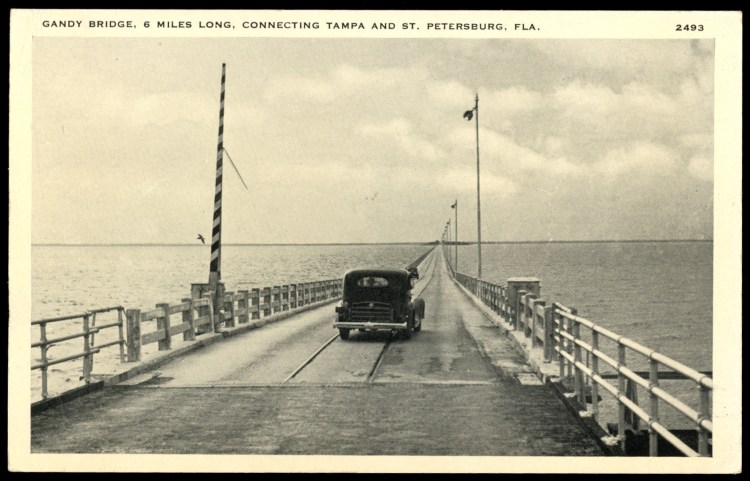
Philadelphian financier George Gandy arrived in the Tampa Bay region in 1915 to establish a development company to build a bridge connecting the cities of St. Petersburg and Tampa. He refused to bootstrap the bridge’s construction cost, opting instead to build public support and capital and pursue “stockholders” who poured funds into the infrastructure project “before construction was commenced.”1 Gandy’s bridge, like all his infrastructure projects in Florida, was funded by northern financiers persuaded by eloquent letters from the Philadelphian in which he claimed their investments “may surpass their fondest expectations.”2 The project remarkably attracted over $1.9 million in investments, and construction was completed in 1924.3 But the engineering marvel came with a twist: It required a toll to cross. Although the bridge was vital for the development of the Tampa Bay region, Gandy and his financiers saw it as nothing more than a speculative commodity. As he wrote in an undated paper, sometime in the 1920s, “So large are figures that one cannot guess at the enormous profits created in real estate along the route of the bridge traffic.”4
Tensions between infrastructural development and financial commodification, like those that arose around Gandy’s 1920s bridge project, were ubiquitous in interwar St. Petersburg. The city was incorporated in 1892, and by the turn of the century, its elite class was set on turning it into a tourist boomtown contingent upon services and real estate. By 1906, officials had begun acquiring waterfront land as a public amenity. That move set a precedent for St. Petersburg’s political economy. Land was rarely developed; rather, it was intricately manufactured and marketed as a speculative capital asset.
Speculation is the investment in a high-risk capital asset with the expectation that it will accrue substantial profit within a brief period. Scholars of American capitalism, notably after the Great Recession, have recentered the role speculation played in American history, focusing on financial capital markets.5 They follow in the footsteps of an older group of historians and economists, beginning in the 1920s and declining in the 1970s, that tethered speculation specifically to real estate and land development.6 In 1920, economist Richard Ely argued that land speculation “ceases” when buildings are erected on a plot of land, viewing speculation and development as two separate phenomena.7 This article uses Ely’s distinction to explain St. Petersburg’s political economy of land speculation in the 1910s and 1920s.
The developmental trajectory of St. Petersburg in the 1910s and 1920s was bifurcated between facilitating speculation and progressive urban planning. In 1913, an editor of the St. Petersburg Times argued that nothing mattered more to the city’s future than adopting the principles of the “City Beautiful movement”—a Progressive-era city planning movement that advocated for slum clearance and the establishment of decadent, upper-middle-class urban landscapes as a solution to late nineteenth-century social ills. The editor also went further, calling for public ownership of utilities, regulated development, and beautified parks and waterfronts. 8That same year, the City Beautiful movement’s most prestigious firm set its eyes on the Sunshine City. The Olmsted Brothers’ Brookline office had recently designed significant parts of Chicago, Seattle, and New York. It also drew up the “Pinellas County Park Plan” for the St. Petersburg area. That plan outlined a network of public “pleasure grounds” designed to gradually raise property values while preserving the city’s botanical charm.9
The Pinellas County Board of Trade unanimously adopted the Olmsted plan in April 1914, and locals celebrated the move. But Frederick Law Olmsted Jr., head of the Olmsted firm and a nationally acclaimed urban planner, warned that adoption alone could not bring the plan to life. It would require legislative action by local and state governments, which had far more authority and were more connected with the city’s elite class than the local board of trade.10 These more influential actors congregated in the city’s most powerful civic organization—the Chamber of Commerce—and had the influence needed to enact the Pinellas County Park Plan.
Unfortunately for the locals who had cheered the plan, St. Petersburg’s speculative elite stalled it. Fiercely competitive and disproportionately wealthy in land, the city’s capitalists treated the Olmsted plan as a direct threat to their wallets because higher taxes and more land-use restrictions made financial wealth harder to extract. “We are very anxious,” a sympathetic Chamber of Commerce member admitted in a letter to the Olmsted firm in 1921, noting that most commissioners favored the plan but that a vocal opposition “must be overcome.”11 It never was. Under sustained pressure, the plan died quietly in committee, and the coalition of speculators who killed it hardened St. Petersburg’s speculative political-economic path.
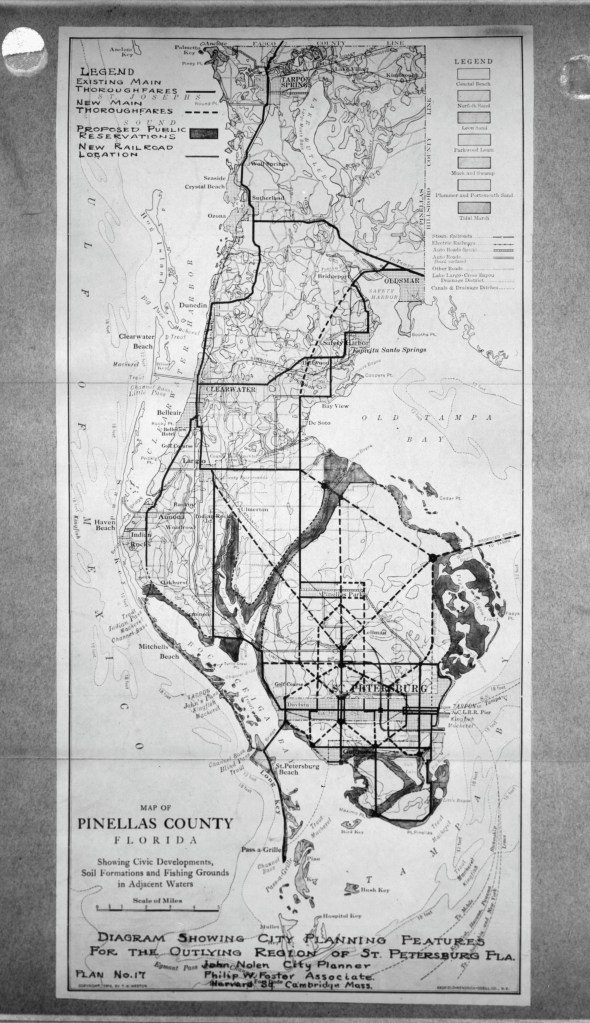
Though the Olmsted plan was blocked in the early 1920s, John Nolen, an enthusiastic and experienced landscape architect who had trained under Olmsted Jr. and recently begun working in Florida, still had hope that orderly city planning could be achieved in St. Petersburg. He believed the city could become “a great laboratory of town and city planning,” an American prototype of the English Garden City instead of a cesspool of speculation.12 In 1922 he signed a $6,500 contract to draft a comprehensive plan for the city (see below), confident that the commission offered “an unusual opportunity… to exercise a good influence on city planning legislation.”13 In 1922, Nolen’s partner, Frank Williams, drafted an accompanying zoning ordinance that if implemented, Nolan said would give the city power to “properly regulate” real estate development for the “best impulses” of the citizenry.14
The city commission passed the plan, then refused to pay Nolen or publish his paper. Determined to see the plan survive, Nolen simply forgave the debt.15 It was pointless. The same minority of city elites who blocked the Olmsted plan repeated the process with Nolen’s proposal. The planning board’s chairman confessed to Nolen several years later that enforcing the plan in full would have meant betraying the speculative ethic of the area’s political economy and would have made him “a traitor to both city and state.”16 Nolen scathingly predicted the future of St. Petersburg in the introduction to the final draft of his plan in 1923: “Man is the only animal who desecrates the surroundings of his habitation.”17
Nolen’s plan died out by the mid-1920s, as St. Petersburg entered its land boom era in earnest. According to a local historian, residents later remembered the period as “one long glorious party.”18 A 1926 travel guide described the city so thronged with newcomers that a “stranger from some quiet place like Chicago” felt overwhelmed navigating its crowded sidewalks, packed parks, and gridlocked streets.19 St. Petersburg joined a stateside real estate mania that a 1926 article in The Accounting Review called an “orgy of buying and selling.”20 It was, in short, a climate inimical to Nolen’s vision of orderly and well-moderated city development.
St. Petersburg’s 1920s land boom made speculation sacrosanct. Boosters wrapped real estate in the language of opportunity and even virtue, promising fortune to anyone willing to buy. One advertisement published in the St. Petersburg Times in 1923 claimed that “the touch of the magic wand of capitalism and enterprise” guaranteed riches.21 “Resales occurred hourly,” said former speculator Walter Fuller decades later, before adding, “the 1925 Florida land boom didn’t just happen. It was the logical, final explosion” of the city’s speculative elite.22 One journalist described speculators as believing that the boom “w[ould] last forever, for there can be no let-up to the development of a state which offers so much to so many classes of people.”23
By the middle of the 1920s, investors had begun seeing through the veneer. Northern financial institutions, which provided most of the capital for St. Petersburg’s era of speculation, grew wary of the inflated empty plots of land that still covered much of the city’s landscape. Florida’s own boosters admitted, albeit grudgingly, that outside banks had begun griping about the state’s speculative bubble. By 1925 Ohio had even barred firms from selling Florida land to its residents altogether.24 That same year, a Chicago investment bank publicly cautioned against “wildcat land speculation” in the Sunshine State and a Massachusetts savings bank suggested to avoid the state entirely.25 By 1926, northern capital had pulled back, decimating the foundation of St. Petersburg’s economy.
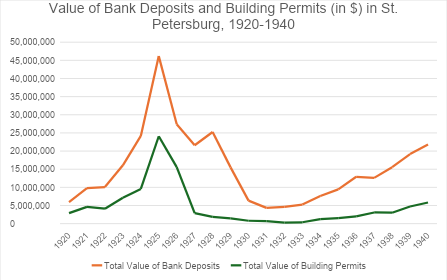
The collapse was violent and total. In 1926, in an article about Florida’s real estate market, a journalist for The Nation declared that “the world’s greatest poker game, played with building lots instead of chips, is over.”26 Walter Fuller put it even more bluntly years later. After years of promotion, he wrote, speculators “became the suckers.”27 Banks failed across the state, land trusts folded, and the tax base that both the Olmsted Brother’s and Nolen’s plans and Williams’s zoning law had once promised would stabilize the economy disintegrated. St. Petersburg — and the state of Florida writ large — slid into a localized depression four years before the financial crash in 1929, which caused the Great Depression.
St. Petersburg’s speculative elite were defeated by their own hubris. Built within a system of chaos and unsustainability, speculative capitalism was the bedrock from which the city arose. But that bedrock proved to be quicksand as soon as real development put pressure on it. This form of capital accumulation, driven by a capital-heavy financialization of land, had catastrophic implications for the city’s working class, as wages and infrastructure plummeted. The city lost its reputation as a botanical paradise. By the late 1920s, value in building permits sank from over $24 million in 1925 to just under $1.5 million in 1928 (see chart above). The situation only worsened during the Great Depression as city officials and businessmen struggled and failed to revitalize the Sunshine City’s economy. With the real estate market at a standstill and tourism virtually nonexistent, St. Petersburg was brought to its knees. Men like George Gandy, who led the charge to capitalize urban space in St. Petersburg, channeled their grievances through the same avenue that had facilitated their failures. The city’s political economy, which constructed the scaffolding for land speculation, inevitably destroyed itself.
——–
Colin J. Wood is a recent graduate of the University of Chicago and a prospective PhD student. He is interested in the history of capitalism, religion, and metropolitan development in modern America. His work has been featured in the Journal of the American Revolution, Anglican and Episcopal History, and the Journal of Church and State.
Featured image (at top): Hampton Dunn, “Gandy Bridge, 6 Miles Long, Connecting Tampa and St. Petersburg, A,” 1920, Hampton Dunn Collection of Florida Postcards, box 6, folder “Hillsborough,” image 2756, University of South Florida Library.
- “History of Gandy Bridge Promotion and Financing,” n.d., box 1, folder 21, George S. Gandy Papers, University of South Florida Archives and Special Collection, Tampa FL.
↩︎ - Florida West Coast Development Company to Associates, May 9, 1927, box 1, folder 14, Gandy Papers.
↩︎ - “George Gandy Sr. Made $1,932,000 Span Possible,” Saint Petersburg Times, April 18, 1956.
↩︎ - Grandy, miscellaneous writings, n.d. (circa 1920s) box 1, folder 21, Gandy Papers; C.W. Barron, “Florida by the Air: Land Booms at Tampa and St. Petersburg,” Barron’s (March 9, 1925), 11.
↩︎ - Julia Kathleen Ott, When Wall Street Met Main Street: The Quest for an Investors’ Democracy (Cambridge, MA: Harvard University Press, 2011); Greta Krippner, Capitalizing on Crisis: The Political Origins of the Rise of Finance (Cambridge, MA: Harvard University Press, 2011); Jonathan Levy, Ages of American Capitalism: A History of the United States (New York, NY: Random House, 2021); Giovanni Arrighi, The Long Twentieth Century: Money, Power, and the Origins of Our Times (New York, NY: Verso, 2010); Robert Brenner, The Boom and the Bubble: The U.S. and the World Economy (New York, NY: Verso, 2003); Ian Baucom, Specters of the Atlantic: Finance Capital, Slavery, and the Philosophy of History (Durham, NC: Duke University Press, 2005); Bench Ansfield, Born in Flames: The Business of Arson and the Remaking of the American City (New York, NY: W.W. Norton, 2025); Dylan Gottlieb, Yuppies: The Bankers, Lawyers, Joggers and Gourmands who Conquered New York (Cambridge, MA: Harvard University Press, 2025).
↩︎ - Robert P. Swierenga, “Land Speculation and Its Impact on American Economic Growth and Welfare: A Historiographical Review,” Western Historical Quarterly 8 no. 3 (July 1977), 302. Recently land speculation historiography has been revived by Michael A. Blaakman’s Speculation Nation: Land Mania in the Revolutionary American Republic (Philadelphia, PA: University of Pennsylvania Press, 2023) which won the Frederick Jackson Turner Award from the Organization of American Historians.
↩︎ - Richard Ely, “Land Speculation,” Journal of Farm Economics 2, no. 3 (July 1920), 124.
↩︎ - Editorial, St. Petersburg Times, July 13, 1913.
↩︎ - Olmsted Brothers, Pinellas County Park Plan (Boston, MA: Olmsted Brothers Firm, 1913); Charles E. Beveridge, “Frederick Law Olmsted’s Theory of Landscape Design,” Nineteenth Century 3 (Summer 1977), 38-43.
↩︎ - L. A. Whitney to James F. Dawson, April 15, 1914; Frederick Law Olmsted Jr., to J. Horace McFarland, April 17, 1914, container 5989, Olmsted Associates Records: Job Files, 1863-1971; Files; 5980 Olmsted Associate Records, Library of Congress, Washington DC. “The County Beautiful Plan Recommended By World Famous Landscape Architects, Olmsted Brothers, And Adopted By The County Board of Trade,” St. Petersburg Times, April 12, 1914.
↩︎ - A.F. Bartlett to the Olmsted Brothers Firm, March 3, 1921, container 5989, Olmsted Associates Records, LOC.
↩︎ - John Nolen, “City Planning in Florida,” 1925, box 56, John Nolen Papers, Carl A. Kroch Library Division of Rare and Manuscript Collections, Cornell University, Ithaca, NY.
↩︎ - Nolen to Frank Williams, March 22, 1922, box 34, folder 3, John Nolen Papers.
↩︎ - “Nolen Guest Of Rotarians: Local Club to Bid for District Convention Next Year,” St. Petersburg Times, March 4, 1922.
↩︎ - Nolen to Williams, June 26, 1923, box 34, folder 3, John Nolen Papers, Cornell University.
↩︎ - Frank Jonsberg to Nolen, January 24, 1928, box 34, folder 3, John Nolen Papers, Cornell University.
↩︎ - Nolen, “St. Petersburg Today, St. Petersburg Tomorrow,” 1923, box 34, folder 8, John Nolen Papers, Cornell University.
↩︎ - Raymond Arsenault, St. Petersburg and the Florida Dream, 1888-1950 ([1992] Gainesville, FL: University of Florida Press, 2017), 205.
↩︎ - Ralph Henry Babour, Let’s Go to Florida! (New York, NY: Dodd, Mead, and Company, 1926), 205.
↩︎ - Orton W. Boyd, “Accounting Problems of the Florida Real Estate Boom,” The Accounting Review 1, no. 3 (September 1926), 65.
↩︎ - Eve Alsman, “Realtors In Review Say Better Type Of Property Selling,” St. Petersburg Times, March 18, 1923.
↩︎ - Walter Fuller, untitled manuscript, n.d. box 27, folder 12, Walter Fuller Papers, University of South Florida Archives and Special Collections.
↩︎ - Charles D. Fox, Florida in the Making (New York: Simon & Schuster, 1926), 12.
↩︎ - “Editorial—Not All Going to Florida,” Suniland 3, no. 1 (October 1925), 80.
↩︎ - George B. Tindall, “The Bubble In The Sun,” American Heritage 16 no. 5 (August 1965).
↩︎ - Stella Crosley, “Florida Cashes In Her Chips,” The Nation (July 1926), 11.
↩︎ - Fuller, This Was Florida’s Boom (St. Petersburg, FL: Times Publishing, 1954), 62.
↩︎

