
This is the sixth entry in our 10th Annual Graduate Student Blogging Contest, “Revolution.”
By Sara Naghibizadeh
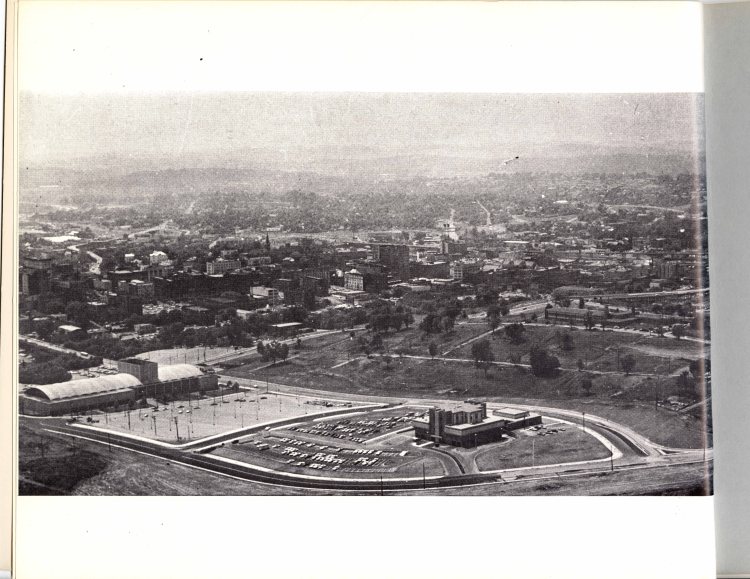
In the summer of 2026, Knoxville’s Mountain View neighborhood feels emptied of life. Walking through, I had the Knoxville Auditorium & Coliseum on my right and, on my left, a parking lot stretching the length of two city blocks. To the south stood a former Hyatt hotel. The pavement is cracked and shadeless, offering no shelter from the sun, though hardly anyone passes — barely even a car. It feels as though no one was ever meant to live here; just a scatter of large, modern complexes and a few utility plants, each isolated from the next and from any street life around them. Only further east did signs of residential life return — the same broken pavement, the same overgrown bushes, the same relentless sun.
What now looks scattered or vacant was no accident. It is hard to believe that this ground once was home to at least seventy-two families, nine businesses, and two churches, and harder still to believe that this fractured landscape was meant to be revolutionary, the deliberate outcome of the Mountain View urban renewal project, carried out in the 1960s in a bid to make urban life better. Comparing the present map against the one from before renewal makes it clear: houses that were once someone’s home are simply gone now.
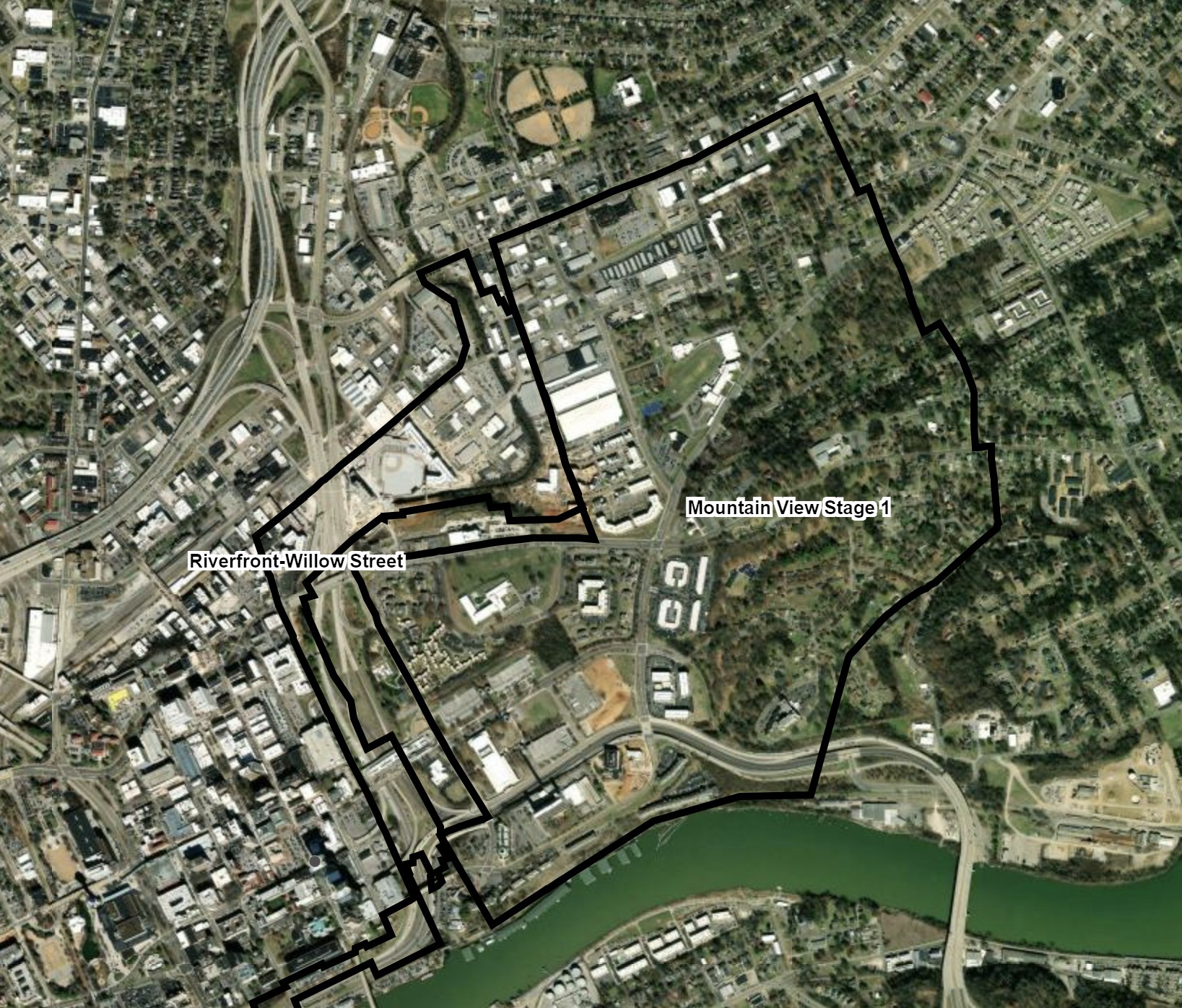
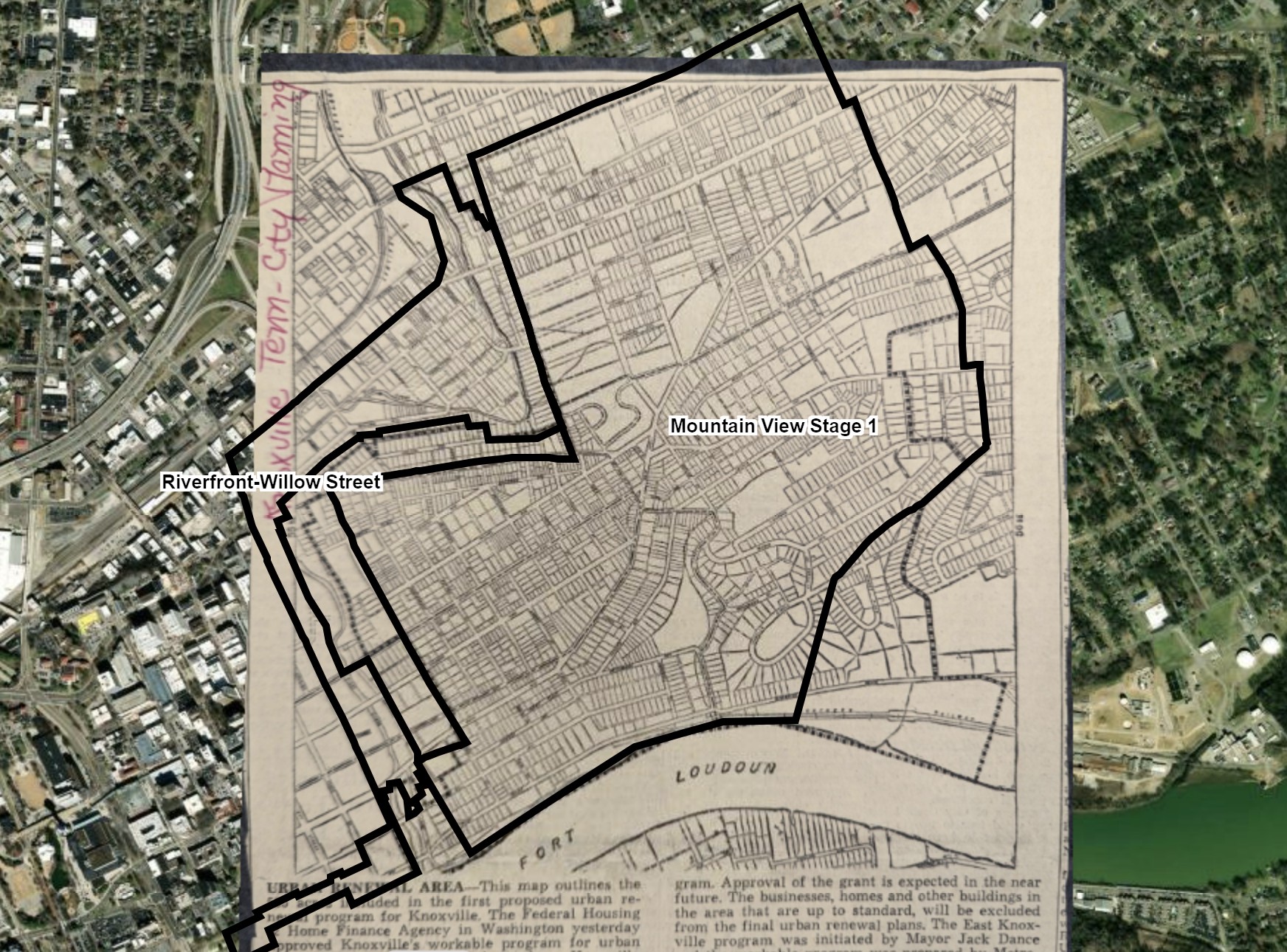
Proposed area for urban renewal-Knox News Sentinel Urban Renewal Map, Chris DeRolph, “Interactive Map: pre-Urban Renewal Knoxville, Tennessee, c. 1958,” Knox County Public Library, https://www.knoxcountylibrary.org/resources/interactive-map-pre-urban-renewal-knoxville-tennessee-c-1953.
Urban renewal swept across the United States in the decades following World War II, and Knoxville was not an exception. During this era, planners and the public increasingly viewed older industrial centers as chaotic and “unplanned,” while suburbanization, fueled by the rise of the automobile, redefined “the good life” as a life outside the urban center.1 The resulting downtown decay was, planners believed, a crisis that could only be defeated by a revolutionary intervention: urban renewal. Thus, a network of federal housing legislation, urban planners, and bureaucrats emerged to reshape American cities. Urban renewal promised a revolution in the urban landscape — to save the present and secure a better future. In practice, it reshaped the past.
Understanding its destructive legacy requires more than examining the physical destruction of the city. It also requires examining the ideological frameworks that made that destruction seem reasonable, even necessary, to the people who carried it out. Seeing the devastation done to the lived experience of residents, who were predominantly Black, it becomes essential to ask what motivated this erasure, how it was justified, and through what mechanisms it was carried out.
To rationalize their interventions, planners and policymakers relied on a powerful fixation on a very different kind of past, expressing a longing for a prosperous era that had never actually existed in the way they imagined. Svetlana Boym calls this “restorative nostalgia,” which might initially suggest a simple sentimental feeling, but is a structural tool of development: a yearning for a home that no longer exists, or one that never existed at all.2 This restorative nostalgia was not neutral when it came to urban redevelopment. The mythical urban past it sought to recover was implicitly coded as white, middle-class, and free of social friction. Consequently, the vibrant, predominantly Black neighborhoods that actually existed in the urban center were framed as a “blight” that interrupted the desired restoration rather than as part of the city’s legitimate history. Embedded in this logic was the idea of a so-called “original,” authentic Knoxville that renewal was meant to restore.
Knoxville’s actual history undercuts this fantasy of a stable, “original” city. By 1900, manufacturing had defined Knoxville’s economy, but this prosperity did not last.3 By the 1920s, the city’s industrial boom had begun to decline, and it experienced population loss as wealth fled to the suburbs. Knoxville was a struggling landscape, watching economic growth take shape elsewhere while its own industrial base weakened. For example, nearby Oak Ridge — the secret federal facility built to enrich uranium for the first atomic bomb — thrived, and Knoxville felt itself falling behind. As William Bruce Wheeler observes, “Consciously or unconsciously, Knoxvillians sensed that Oak Ridge represented a future that would be denied their own city.”4 Yet, this anxiety had nothing to do with Mountain View or its residents, who paid the price for authorities’ ambition.
The nostalgia of the Mountain View renewal project is apparent in the opening directive of its development plan: “restore the original Mountain View.”5 This raises an obvious question: What was the “original” Mountain View, and what did it mean for planners to restore it? As the plan states: “The most significant proposal is to restore the original function of Mountain View as a desirable residential neighborhood.” The renewal plan’s language — restore, recover, bring back — presumed the neighborhood a failure waiting to be improved. But what the plan erased was not a failure. Across Mountain View, the Bottom, and Morningside, urban renewal destroyed at least 107 Black-owned businesses, fifteen Black churches, and more than 2,500 family homes — over 70 percent of them belonging to Black residents. 6
Many testimonies attest to the life that once filled these streets. One family who lived near the Coliseum site watched bulldozers take down their neighborhood YMCA; harder still, they said, was losing their church, which had stood on the same street for nearly a century.7 This was a neighborhood with its own civic history long before renewal ever reached it. Dr. Henry Morgan Green, who served as Knoxville’s city physician for seventeen years, is one figure whose legacy is tied to this community.
The Mountain View renewal was the result of many actors. Amid this context, one actor stood out: Victor Gruen’s architecture and urban planning firm, which had an international reputation. But was the Mountain View plan Gruen’s own vision imported from his history, or had Knoxville’s desires simply found the right architect to give them form? To answer that, we need to understand where Gruen’s ideas came from.8
Victor Gruen’s Theories of Urban Development
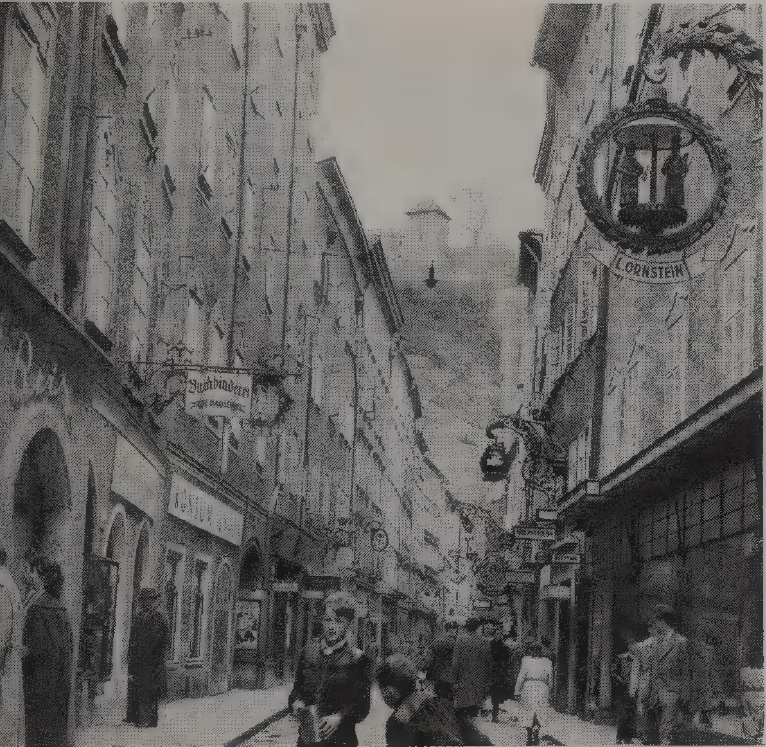
Born Victor David Grünbaum in 1903 into a middle-class Jewish family, Gruen’s foundational understanding of urbanity was shaped by Vienna’s historic center.9 In 1938, fleeing the Nazi annexation of Austria, he arrived in New York with little more than an architect’s degree. While he found joy and success in America, he simultaneously felt a deep longing. The dense, walkable, and socially vibrant European civic plazas of his youth shaped his vision of what a city was supposed to be.10 As he put it, defining urban life itself: “The weather is no better in Paris than in many a city of the United States, yet the desire to participate in ‘urban life’ is so overpowering that thousands fill the sidewalk cafés and sidewalk bistros from morning to night, year in and year out.”
While his blueprints ultimately facilitated mass displacement, it is important to recognize Gruen’s role in this history beyond that of an antagonist. He was attempting to cure a crisis of community. Gruen argued that “humanity today is using the power of its vast numbers, its scientific and technological ‘progress,’ to convert its cities and metropolitan regions into hell on earth.”11 By the end of his life, observing the desolate sprawl his ideas helped spawn, he famously denounced his own creations as “bastard developments.”12 As Boym argues, nostalgia is inherently prospective, where “fantasies of the past determined by the needs of the present have a direct impact on realities of the future.” In that sense, some urban development efforts like urban renewal promise something radical, something revolutionary — but what they deliver is simply a new fantasy of the past.
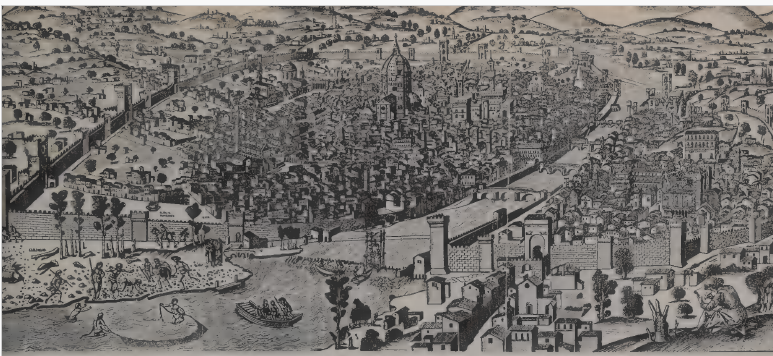
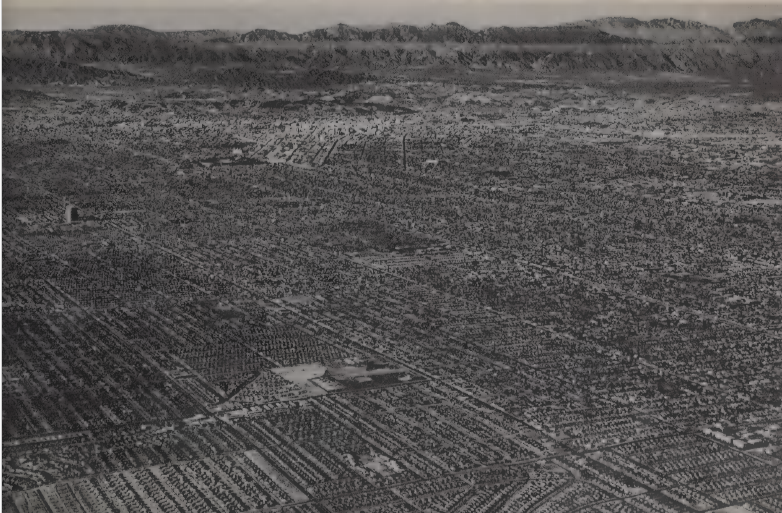
Gruen’s own work offers a telling illustration of how nostalgia and fantasy became intertwined in his thinking. In his book, where he set out to show how American cities were in crisis, he presents several revealing examples. Florence, his model of the compact, humane city, appears as a drawing — idealized and frozen in an imagined past — while the sprawling American city is rendered as an actual photograph. What is extraordinary is that he treats both images as equally real, when the Florence image is plainly a drawing — a fantasy. He presents them, nonetheless, as two views of two cities.
Whose Nostalgia?
Ultimately, the Mountain View urban renewal led to displacement, causing a multi-generational loss of economic wealth, spatial memory, and cultural heritage, as the image below shows.13
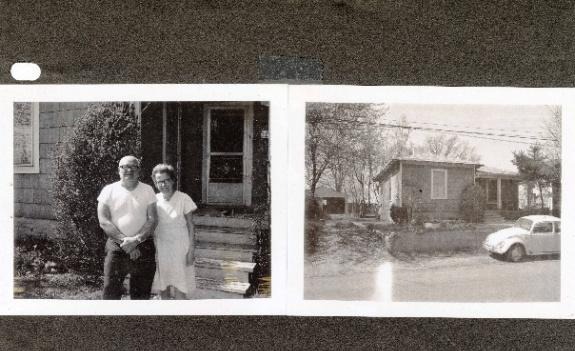
The profound trauma of this rupture is captured by poet Nikki Giovanni, whose grandparents lived at 400 Mulvaney Street, Mountain View neighborhood. Reflecting on the aftermath of urban renewal, she writes of the deep loss caused by the destruction: “Without it, I would have no guide to my Grandparents’ home.”14 This urban renewal did not cure the city through a nostalgic vision of originality; instead, it left a permanent, intergenerational wound in the memory of the residents who actually called Mountain View home. Mountain View was remade in the name of revolutionizing Knoxville, but what was actually rebuilt was a fantasy of the past that never included the people displaced to make room for it.
Sara Naghibzadeh is a PhD student in ASPECT (Alliance for Social, Political, Ethical, and Cultural Thought) at Virginia Tech. With a background in urban planning, her research interests center on urban studies and urban history. She is currently focusing her dissertation on the circulation of urban policies in the post-World War II era.
Featured image (at top): View Across the Mountain View Urban Renewal District, and the citation is: Gruen Associates, Inc., and Design Collective, Inc., “Mountain View Redevelopment Plan: Knoxville, Tennessee. Prepared for the Knoxville Housing Authority. Knoxville, TN,” 1969.
- For this idea of how “the good life” in America came to be, the same as living in the suburbs, see Kenneth T. Jackson, Crabgrass Frontier: The Suburbanization of the United States (New York: Oxford University Press, 1987).
↩︎ - Svetlana Boym, The Future of Nostalgia (New York: Basic Books, 2002), xiii. Boym explains, rather than acknowledging it as a longing, restorative nostalgia presents itself as absolute truth and tradition, used to justify present actions and interventions.
↩︎ - William Bruce Wheeler, Knoxville, Tennessee: A Mountain City in the New South (The University of Tennessee Press, 2005), 5, https://doi.org/10.2307/jj.28697732.
↩︎ - Wheeler, Knoxville, Tennessee, 83.
↩︎ - Gruen Associates, Inc., and Design Collective, Inc., “Mountain View Redevelopment Plan: Knoxville, Tennessee. Prepared for the Knoxville Housing Authority. Knoxville, TN,” 1969.
↩︎ - “Urban Renewal,” accessed July 9, 2026, https://www.beckcenter.net/urban-renewal.
↩︎ - WUOT, “Losing Home: Memories,” 91.9 FM WUOT, Your Public Radio Station, May 20, 2021, https://www.wuot.org/news/2021-05-20/losing-home-memories.
↩︎ - The Knoxville Housing Authority (KHA) was in charge of urban renewal in Knoxville and retained Gruen Associates as consultants for the Mountain View project.
↩︎ - Alex Wall, “Victor Gruen: From Urban Shop to New City.,” (Barcelona: Actar., 2005), 24, https://find.slv.vic.gov.au/discovery/fulldisplay/alma9913052943607636/61SLV_INST:SLV.
↩︎ - Wall, “Victor Gruen.” 24.
↩︎ - Gruen, “The Heart of Our Cities,” 34.
↩︎ - Wall, “Victor Gruen,” 110.
↩︎ - For more details on the psychological, economic, and generational devastation inflicted upon Black communities by urban renewal policies, see Mindy Fullilove, Root Shock: How Tearing Up City Neighborhoods Hurts America, and What We Can Do About It (New York: New Village Press, 2016).
↩︎ - “Quilting the Black-Eyed Pea: Poems and Not Quite Poems / Nikki Giovanni. – Vanderbilt University,” accessed April 27, 2026, https://catalog.library.vanderbilt.edu/discovery/fulldisplay/alma991032574089703276/01VAN_INST:vanui.
↩︎

