
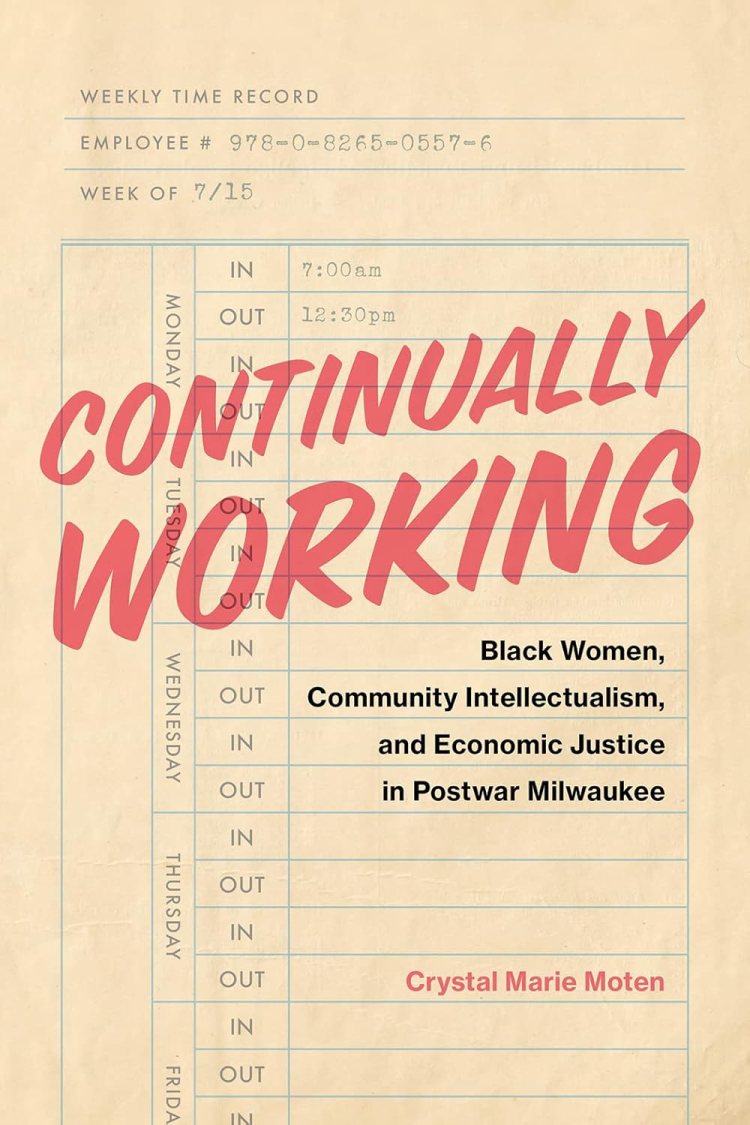
Moten, Crystal Marie. Continually Working: Black Women, Community Intellectualism, and Economic Justice in Postwar Milwaukee. Vanderbilt University Press, 2023.
Reviewed by Hannah Bruno
“Of course, this is/was/has always been hard work.”1 So said Black feminist historian Crystal Moten writing about intellectual work in the midst of the 2020 uprisings; so she demonstrates in her 2023 history of postwar Milwaukee’s Black working women, Continually Working: Black Women, Community Intellectualism, and Economic Justice in Postwar Milwaukee (Vanderbilt University Press, 2023). In Continually Working, Moten—a twentieth century historian and curator––examines the “day-to-day intellectual practices” (6) and collective activism of Milwaukee’s Black working women in the 1940s through 1970s in their struggles for economic justice. Building on conversations in African American intellectual history, Black women’s history, labor history, and Black freedom studies, Moten scours meeting minutes, departmental correspondences, alongside a broader archive of newspaper articles, oral histories, and more, to reveal the intellectual labor culture that Black Milwaukee’s working women cultivated in their pursuit of fair employment opportunities, job security, welfare rights, and equal employment opportunity accountability for discriminatory firms. From the midcentury fight for community-based programming and wage equality at Milwaukee Young Women’s Christian Association (MYWCA) through local and regional battles for welfare rights in the 1970s by Milwaukee County Welfare Rights Organization (MCWRO), Moten sheds new light on Black women’s diverse critiques of a racialized and gendered “Jim Crow job system” (2) and changing urban political economy in highly segregated Cream City.
Organized into five main chapters, Moten balances institutional histories with biographical methods to show how Black women navigated a stratified labor market, challenged the bureaucratic racism of the postwar state, and advanced ideas of economic justice in their communities. Following worker-activists like the MYWCA’s Bernice Copeland or Milwaukee Citizens for Equal Opportunity’s (MCEO) Helen Barnhill, Pressley School of Beauty Culture owner Mattie DeWese, and model of “militant motherhood” (113) welfare rights activist Betty Niedzwiecki, Moten surveys a wide range of intellectual-activist practices from Bronzeville’s Walnut Street to the state capitol: context-specific, perpetually-in-motion acts of storytelling, marching, “raising critiques, testifying multiple narratives, and publicly refusing employment injustice” (82). In doing so, Moten unveils previously hidden contributions of Black working women to twentieth century Black freedom struggles and radical thought within and beyond the Civil Rights and welfare rights movements.
Written in the tradition of Joe Trotter Jr.’s Black Milwaukee and Tera Hunter’s To ‘Joy My Freedom, Continually Working models new directions for coming generations of Black urban labor historians.2 In a retrospective essay twenty years after Black Milwaukee’s publication, Rhonda Williams noted that Trotter’s “proletarianization model tended, in many ways, to marginalize black women—or at least limit them to the already discussed ‘snapshot’ moments in the historical narrative.”3 Almost twenty years later, Moten’s monograph answers this corrective call to meaningfully integrate Black women into historical analysis of Milwaukee’s twentieth century proletariat. Alongside studies by Lisa Levenstein, Keona Ervin, Williams herself, among others, Moten’s Continually Working is part of a fruitful wave of literature centering Black working women, their diverse political practices, and encounters with the state.4 While recent works like Anne Gray Fischer’s The Streets Belong to Us: Sex, Race, and Police Power from Segregation to Gentrification focus on women’s bodies as sites of sexualized violence in the development of the postwar carceral city, Continually Working offers an analysis, from the perspective of Black working women themselves, of their labor as a site of extraction in an evolving urban economy and racialized labor market.5
Additionally, over a decade after Samuel Zipp and Michael Carriere’s JUH Special Section “Thinking Through Urban Renewal,” Moten raises new questions about the possibilities for intellectual history in African American urban labor history—how did Black working women understand and negotiate their relationships to a predatory urban labor market?6 How did these negotiations shape their communities on a day-to-day basis, and how did it shape their cities and freedom dreams long-term? What might such perspectives yield in bringing to light different dynamics of racial capitalism? Or highlighting Black women’s place-making or community-building practices by, for example, “drawing from a rich heritage and resilient culture that they continually reconstituted to meet the exigencies of urban life”?7 Of interest to undergraduate and graduate students, historians of African American life, labor, and intellectual traditions, Moten’s excellent book raises new questions and perspectives urban historians would be remiss to ignore.
Hannah Bruno is a PhD student in History at Columbia University.
- Crystal Moten, “Writing for/with the Revolution,” Crystal M. Moten, PhD, June 11, 2020. https://www.crystalmoten.com/on-writing/writing-for-with-the-revolution/. ↩︎
- Joe Trotter Jr., Black Milwaukee: The Making of an Industrial Proletariat, 1915-45 (Urbana: University of Illinois Press, 1985); Tera Hunter, To ‘Joy My Freedom: Southern Black Women’s Lives and Labors After the Civil War (Cambridge, Mass.: Harvard University Press, 1997). ↩︎
- Rhonda Williams, “Black Milwaukee, Women, & Gender,” Journal of Urban History, Vol. 33 No. 4 (May 2007): 553. ↩︎
- Lisa Levenstein, A Movement Without Marches: African American Women and the Politics of Poverty in Postwar Philadelphia (Chapel Hill, NC: The University of North Carolina Press, 2010); Keona Ervin, Gateway to Equality: Black Women and the Struggle for Economic Justice in St. Louis (University Press of Kentucky Press, 2017); Rhonda Y. Williams, The Politics of Public Housing: Black Women’s Struggles against Urban Inequality (London & New York: Oxford University Press, 2004). ↩︎
- Anne Gray Fischer, The Streets Belong to Us: Sex, Race, and Police Power from Segregation to Gentrification (Chapel Hill, NC: The University of North Carolina Press, 2022). ↩︎
- Samuel Zipp and Michael Carriere, “Introduction: Thinking through Urban Renewal,” Journal of Urban History Vol. 39, No. 3 (May 2013): 359 – 365. ↩︎
- Tera Hunter, “‘The ‘Brotherly Love’ for Which This City Is Proverbial Should Extend to All’: The Everyday
Lives of Working-Class Women in Philadelphia and Atlanta in the 1890s,” in African American Urban Experience: Perspectives From the Colonial Period to the Present, ed. Joe W. Trotter with Earl Lewis and Tera W. Hunter (New York: Palgrave McMillan, 2004): 92. ↩︎

