
By Zehra Betül Atasoy
One night in 1910, a woman named Şükrüye was accused of wandering through a burned neighborhood in Istanbul with unidentified men. Her alleged offense was not a clearly defined criminal act, but rather her presence in a fire-ravaged urban space at night, in the company of men whose identities remained unknown.1 In official records, this situation was framed as morally suspicious, evoking the possibility of illicit encounters linked to prostitution and, by extension, the spread of disease. Such cases reveal that these ruined urban landscapes were far from neutral voids; instead, they were perceived as morally charged environments in which certain bodies, particularly women, became subject to scrutiny and control.
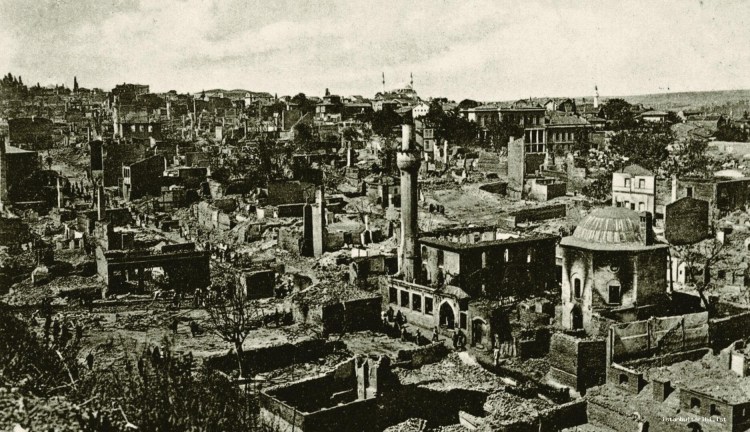
Fires have long played a defining role in shaping Istanbul’s urban fabric. Although the modernization of firefighting institutions in the late Ottoman and early Republican (1920s-1940s) periods gradually transformed fires from large-scale disasters into more manageable incidents, the spaces they left behind remained a persistent feature of the city (Figure 1).2 These fire-ravaged zones were not simply technical problems awaiting reconstruction. Rather, they emerged as socially and politically contested terrains, raising questions about order, security, and the regulation of urban life.
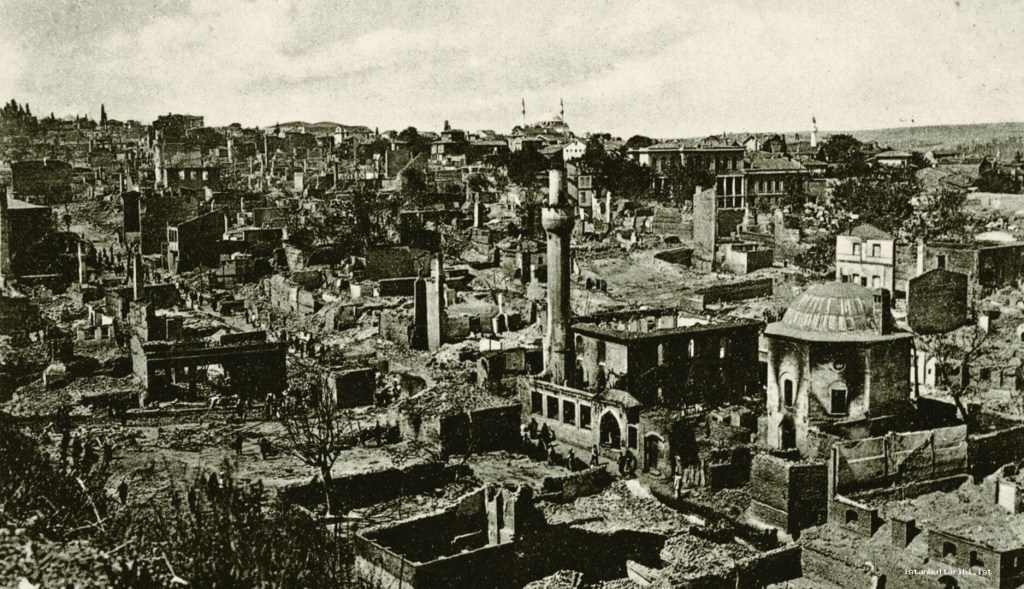
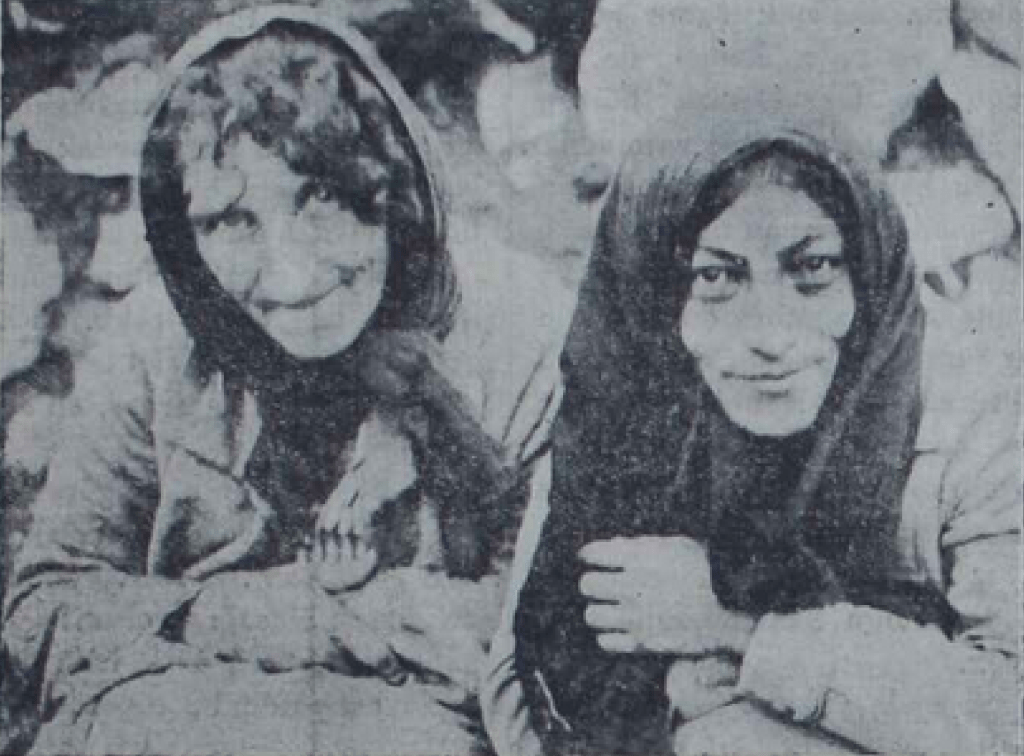
Despite their devastation, these sites were far from empty. Marginalized populations, including the urban poor, beggars, alcoholics, and particularly women associated with prostitution, occupied or frequented these spaces (Figure 2). These groups were not only socially stigmatized but also medicalized, often being linked to the spread of diseases such as syphilis.3 As a result, fire zones became spaces where discourses of morality, public health, and urban governance intersected.
Fire-ravaged zones functioned as what Ann Stoler conceptualizes as “zones of vulnerability,” landscapes shaped by ongoing processes of ruination rather than mere physical decay. These were spaces where imperial legacies, infrastructural neglect, and everyday survival strategies converged.4 Crucially, they also made visible forms of life that were otherwise pushed to the margins of urban historiography. Paying attention to these zones, therefore, allows us to shift the focus from top-down planning narratives to lived experiences structured by precarity, gender, and informal economies.
This vulnerability was particularly pronounced at night. While fire zones were relatively unproblematic during the day, they became associated with danger, crime, and moral disorder after dark. The lack of adequate street lighting, an issue frequently raised in contemporary accounts, transformed these areas into what were perceived as breeding grounds for illicit activity. For example, complaints about the darkness surrounding the Ragıp Paşa Library in Laleli emphasized how such conditions enabled “immoral women” to operate within these ruins.5 Here, infrastructural deficiency and moral anxiety became tightly intertwined, reinforcing the perception of fire zones as spaces requiring surveillance and intervention.
Literary representations from the period further illuminate how these spaces were gendered and moralized. In Suat Derviş’s İstanbul’un Bir Gecesi (One Night in Istanbul), the character Asiye, an unemployed tobacco worker, seeks refuge in a fire-damaged area and eventually turns to sex work to survive.6 Similarly, figures like Fosforlu Cevriye are depicted as inhabiting the city’s marginal landscapes of “hidden alleys, fire-ravaged areas, cemeteries, city walls, Tekfur Palace ruins, and orchards.”7 These narratives do more than reflect social realities; they actively construct a spatial imagination in which prostitution becomes inseparable from these urban ruins.
At the same time, public discourse framed these women not only as morally suspect but also as vectors of disease, mobilizing a language of contamination that positioned them as threats to the health of the broader urban population. In this framing, anxieties surrounding prostitution became inseparable from fears of epidemic spread, thereby legitimizing the intensified regulation and policing of both these spaces and the bodies within them. In the public eye, fire-ravaged zones were described as “nests of germs,” and their inhabitants as embodiments of social decay as much as criminality. Women were depicted in strikingly dehumanizing terms as “women in dirty, tattered robes, with the traces of red paint on their pale faces, a mix of animal greed and desperation for a morsel of bread in their eyes, ready to latch onto anything before them, sinking their repulsive teeth into it.” Such portrayals not only reinforced the association between these spaces and disease but also constructed these women as active agents of contamination. These women, it was claimed, deceived “young honorable men” and spread syphilis, thereby deepening the stigma attached to both the inhabitants and the urban margins they occupied.8
Fire zones were also inhabited by other vulnerable groups, such as beggars, whose presence exposed them to overlapping forms of violence. The case of Havva, an elderly woman murdered in a makeshift shelter within the Sultanahmet fire ruins, illustrates how these spaces could become sites of vulnerability. Yet even in such instances, narratives often reproduced moral suspicion, linking victims to rumors of illicit activity, thereby reinforcing the association between these spaces and deviance.9
These concerns were echoed by urban residents, who frequently complained about the presence of “vagabonds” and morally suspect individuals in fire-ravaged areas. Calls for increased policing and surveillance reveal how these spaces were imagined as threats to urban order.10 What emerges here is not merely a story of neglect, but one of active governance: fire zones became one of the key sites where the boundaries of acceptable urban behavior were defined and enforced.
The historiography of early Republican Istanbul has predominantly focused on large-scale planning initiatives, particularly Henri Prost’s master plan and the modernization agenda of state authorities.11 However, such narratives tend to overlook the temporal and spatial gaps between destruction and redevelopment, gaps that were inhabited by vulnerable populations and shaped by everyday practices.
From a spatial perspective, these ruins were often imagined as wounds within the urban body, pathologies that needed to be healed. Early Republican discourse frequently framed them as areas requiring urgent intervention, both physically and morally. The question was not only how to rebuild these sites, but how to cleanse them of disease, of immorality, and of the populations deemed undesirable.
Seen through the lens of gender and prostitution, fire-ravaged zones thus emerge as critical sites for understanding the social history of early Republican Istanbul. They reveal how urban space, moral regulation, and public health anxieties converged in the governance of vulnerable populations. More importantly, they demonstrate that the making of the modern city was not only a matter of planning and reconstruction, but also of policing bodies, disciplining behaviors, and managing the uncertain lives that unfolded in its ruins.
Zehra Betül Atasoy is an Assistant Professor at Kadir Has University, Faculty of Art and Design. She holds a Ph.D. in Urban Systems–History from a joint program at NJIT and Rutgers University, and earned her architecture and history of architecture degrees from Istanbul Technical University. Her research focuses on women’s everyday urban practices and the lived experience of health in early Republican Turkey.
- “Şükrüye’nin Suçu Geç Vakit Meçhul Şahıslarla Yangın Yerinde Dolaşmak,” İstanbul Ansiklopedisi Archive, retrived from https://istanbulansiklopedisi.org/handle/rek/17167?locale=tr ↩︎
- Kenan Yıldız, “Şehir Topoğrafyasına Etkisi Bakımından Osmanlı Dönemi İstanbul Yangınları,” Büyük İstanbul Tarihi, 1, 486-503, retrieved from https://istanbultarihi.ist/24-sehir-topografyasina-etkisi-bakimindan-osmanli-donemi-istanbul-yanginlari ↩︎
- Yücel Yanıkdağ, “Psikopatlar, Frengililer, Veremliler ve Maderzad Caniler: Osmanlı’dan Cumhuriyet Türkiyesi’ne Dejenarasyon Korkusu,” Osmanlı’dan Cumhuriyet’e Salgın Hastalıklar ve Kamu Sağlığı içinde, ed. Burcu Kurt ve İsmail Yaşayanlar (Istanbul: Tarih Vakfı Yurt Yayınları, 2017), 47-71. ↩︎
- Ann Laura Stoler. Imperial Debris: On Ruins and Ruination (Durham: Duke University Press, 2013), 9-24. ↩︎
- “Kari Sütunu: Zifiri karanlık ve kaldırımsız sokaklar,” Milliyet, 4 September 1931. ↩︎
- Suat Derviş, İstanbul’un Bir Gecesi (Istanbul: Ithaki, 2018), 119-120. The novel was first serialized in 1939.
↩︎ - Suat Derviş, Fosforlu Cevriye (Istanbul: Ithaki, 2016), 14. The novel was first serialized in 1944-45.
↩︎ - Abidin Oktay, “Yangınlıkta neler görebilirsiniz? Sosyal sefaletin en korkunç nümuneleri..,” Yeni Asır, 4 February 1937.
↩︎ - “Adliye ve Polis: İhtiyar dilenci kadınını gırtlağını keserek öldüren katil,” Son Posta, 3 June 1941.
↩︎ - M. Salahattin, Mahalle aralarında gördüklerim..: Bugün de size kendi mahallemi gezdireceğim: kimseye vefası olmıyan bir bina..,” Milliyet, 28 September 1929. ↩︎
- In 1933, the central government held an international urban design competition for the master plan of Istanbul. Thereafter, in 1936, the Istanbul Municipality hired French architect and planner Henri Prost. He remained the city’s chief planner until the end of 1950, and his vision continued playing a prominent role in the redevelopment of the city. Prost was one of the significant figures of the first generation of French urban planners, who were instrumental in the institutionalization of the discipline. His work especially in Moroccan towns of Fez, Marrakesh, Meknes, Rabat and Casablanca between 1913 and 1923 became widely known and particularly the planning of Casablanca was accepted as a success of the twentieth century urbanism at that time. See F. Cana Bilsel, “Shaping a Modern City out of an Ancient Capital: Henri Prost’s Plan for the Historical Peninsula of Istanbul,” 11th Conference of the International Planning History Society (IPHS) (2004): 1. F. Cana Bilsel, “Henri Prost’s Planning Works in Istanbul (1936-1951): Transforming the Structure of a City through Master Plans and Urban Operations,” in The Imperial Capital to the Republican Modern City: Henri Prost’s Planning of Istanbul (1936-1951), ed. C. Bilsel and P. Pinon (Istanbul: Istanbul Research Institute, 2010), 101-144. ↩︎

