

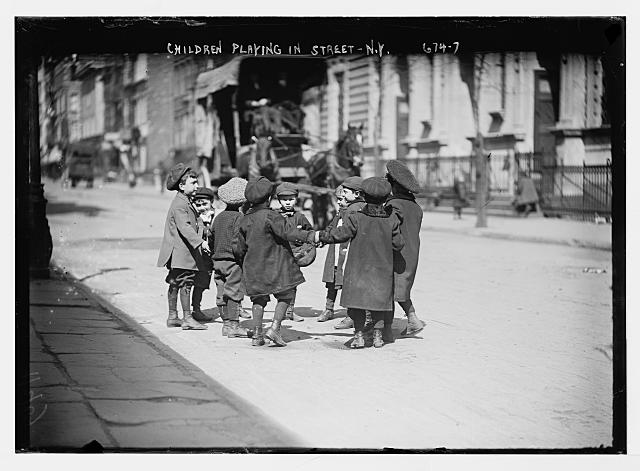
This post is the first entry in our May theme month, Cities at Play.
By Alexandra Miller
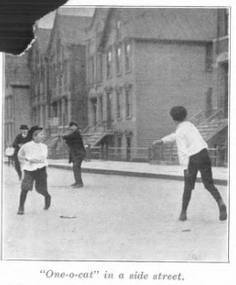
The bullet ripped through Max Kaufman. It was a Thursday morning in August 1919, and the twelve-year-old boy was playing in front of his Brooklyn home in the rapidly developing stretch of Snediker Avenue between Dumont and Livonia Avenues. There was a month of summer left, and with no job, Max spent his days playing. He had seven brothers and sisters, and neighbors who shared his Russian and Jewish heritage—enough playmates to stage nearly any team sport or game.1 The nearest playground, Linton Park, was about a mile away. But rather than traverse the busy Pennsylvania Avenue to reach it, Max, like many children, stayed closer to home.
Max was a victim of a world in transition. As he played in the street in front of his home, forces around the city were hard at work taking play out of the streets. It was a diverse coterie: Progressive reformers bent on building playgrounds to get children off the streets, policemen intent on enforcing order in their districts by threatening young baseball players, and members of what historian Peter Norton calls “motordom,” who had a vested interest in making streets the sole domain of cars.2
Even before motordom won out, these competing uses started to chafe in their shared space. To Max, his stretch of Snediker Avenue was a place of play. But to Philip Wubnig, who fired the bullet that ricocheted up into Max’s abdomen, it was a place of work.3 The patrolman’s job that Thursday morning was to prevent the streets in his precinct from becoming a place for political speech. Wubnig fired his gun while chasing down three striking Brooklyn Rapid Transit workers accused of assaulting a policeman. Meanwhile, to the city’s planners, the street was also a place of modernization. New York was transitioning from Belgian block and macadam streets to asphalt, paving the way for cars to replace the streetcars at the heart of the strike. The friction between play, policing, politics, and pavement exploded in the chamber of Wubnig’s pistol. Max lived.4 But the world of combined street use was dying around him.
City streets were a theater for much of the turn-of-the-century Progressive Era’s moral dramas about urban life. Many Progressive reformers advocated building playgrounds and often cited stories like Max’s as evidence that children urgently needed to be taken off the streets. It is true that street play was often dangerous. Boys made a game of catching rides on horse carts and streetcars, sometimes falling beneath the wheels. In his semi-autobiographical novel Jews Without Money, Lower East Sider Itzhok Isaak Granich (Mike Gold) recalled his friend Joey Cohen being run over by a horse cart. When it passed, the cart left behind “the broken body of [his] playmate,”—Joey’s severed head still “hanging from the bloody axle.”5
Playground advocates joined others in the city who feared that streets posed a danger to children’s safety and their physical and moral development. The police routinely arrested young boys for playing in the street. Twenty years before Max was shot on Snediker Avenue, an officer shot seventeen-year-old Harlemite Charles McNally for playing street football.6 More often, the police used clubs. Even Theodore Roosevelt championed playgrounds during his presidency. A former NYPD Commissioner, he considered streets “unsatisfactory playgrounds for children, because of the danger, because most good games are against the law, because they are too hot in summer, and because in crowded sections of the city they are apt to be schools of crime.”7
These Progressives wanted kids off the street. They proposed playgrounds as the solution. Playgrounds were supposed to be fenced and full of play matrons, soft grass, swings, slides, merry-go-rounds, and other play equipment. The goal was to create spaces where children could be safe and grow into healthy and moral adults, sheltered from what the reformers considered the moral quagmire of the modern city. At the Second Annual Playground Congress in 1908, George Johnson made these intentions clear. In his introductory remarks, he stated: “In our nation of diverse peoples there is special need of games which develop those qualities in the individual that are essential to social control.”8
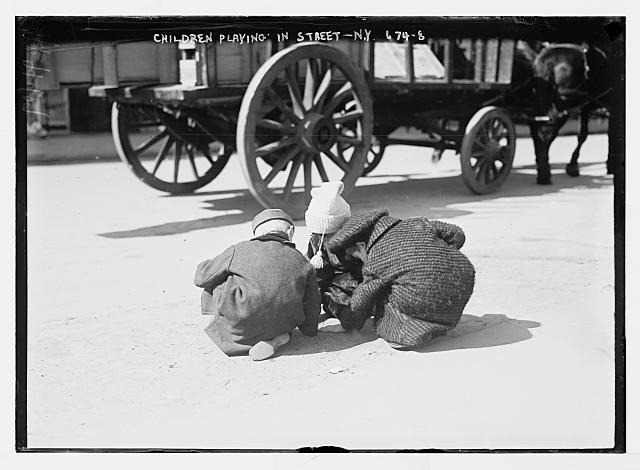
For the first decades of the twentieth century, playground advocates worked intensively.9 But until the 1930s, when planner Robert Moses began building his vision on the federal dime, playground construction could take years. In 1907, twenty years after the first playground was built in Boston, Jacob Riis lamented that many playgrounds “exist yet only on paper.”10
By the late 1920s, even some of the strongest advocates for playgrounds, like Joseph Lee, president of the Playground and Recreation Association of America, had resigned themselves to the realities of street play. Lee conceded that “the street has the great advantage of being near the home. The mother can see from her window what goes on and when necessary have a voice or take a hand in it with salutary effect.”11
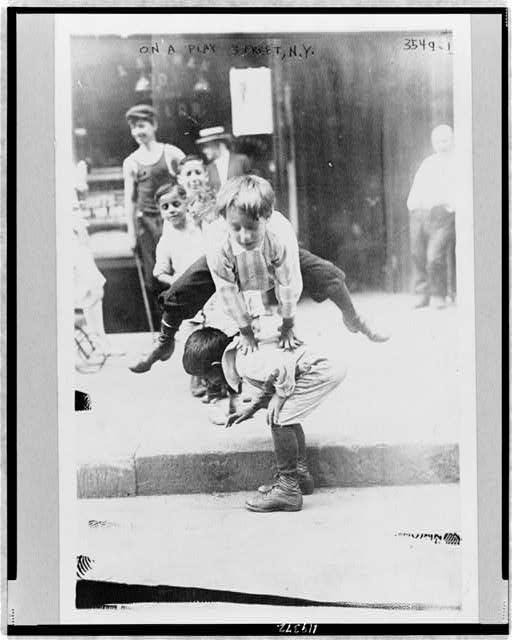
Children agreed. The open space of the street, where kids could make their own rules, was an attractive haven for those living in cramped and crowded tenements. 12In his memoir A Lost Paradise, another Lower East Sider, Samuel Chotzinoff, fondly remembered the early years of the twentieth century, when he and his childhood companions “play[ed] on the sidewalks and in the gutter until the air grew dark and we could barely tell who was who.” After sunset, “in the light of the gas lamps,” he and his friends “played leapfrog over the empty milk cans in front of the grocery store. Each of us would vault over as many as seven cans!”13
Many parents also preferred that their kids play in the street. When one neighborhood police officer asked in 1924 why so few children went to a nearby playground, a mother answered that women “want the children to play where we can see them and where they can hear us when we call them.”14 New York social workers routinely noted that most children played in the street.15
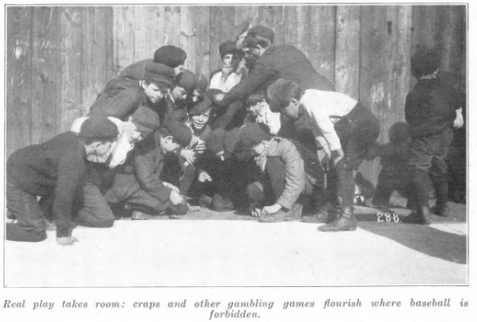
Faced with reluctant parents and kids and high construction costs, playground advocates pivoted. By 1914, they persuaded the city to set aside play space on public streets. By the end of that first year, there were thirty play streets in Manhattan closed to traffic by a chain, rope, guard, or sign in the afternoons.16 In 1923, Board of Aldermen President Murray Hulbert called New York’s adoption of the play street the “most significant step taken by the city toward the fulfillment of its social service obligations.” He boasted that there were at least six closed streets in every precinct where “children may romp and play without fear of bodily injury from swiftly moving vehicles.”17 The following year, when Mayor John F. Hylan closed more streets, The New York American celebrated the decision, declaring that “streets have never been regarded as the exclusive property of vehicles.”18
The newspaper was partly right. Before the 1930s, cars did not control New York streets. In fact, Norton suggests that “cars were at best uninvited guests.”19 Motorists plowed into a world alive with street vendors, hackmen, pickers, walkers, street cars, dogs, horses, and even the occasional cow, as well as children at play. But the American continued: “This world was not made for trucks; it was made for childhood.”20 Rather than allow cars to rule the pavement, the paper preferred ceding it to kids. The message was clear—the two could not share the street.
But closing streets for play meant sacrificing the rich street world of traffic, commerce, and transit. Dividing the street world was a perfect solution for no one. Businessmen protested in favor of motor traffic. Alfred H. Witte wrote to the mayor, grumbling that shutting his stretch of Luquer Street between Clinton and Henry Streets would hurt his ginger ale business as well as other bottlers and peddlers on the block. He proclaimed himself to be “heartily in favor of children having a play ground” but asked that the city close “any other block than this one.”21 He was overruled.
Others simply saw no reason to give streets to children. Edith Frye did not want her stretch of Kent Street closed. She charged the mayor with pursuing “fads and frills” by setting aside streets for children when they could just as easily play in vacant lots.22 Other New Yorkers silently voiced their distaste for play streets by driving right past the signs declaring the block closed to traffic. The NYPD issued internal memos reminding patrolmen to enforce regulations on play—and even fired some who failed—but they could not be everywhere at once.23
By the mid-twentieth century, cars seemed to rule the road. More formal playgrounds proliferated. And yet, play streets never disappeared. They remained part of city policy throughout the twentieth century.
In recent years, NYC Parks has again begun reviving play streets. While waiting for new playgrounds, New Yorkers can choose to open their streets. Echoing the Progressive Era’s health-related arguments, the city suggests that doing so could “help combat the childhood obesity epidemic.”24
The persistence and revival of play streets reminds us that the story of street life continues to be written. When planners or administrators limit street use, kids can be left with less space, or even no space. But play remains a key mode of placemaking and navigating between autonomy and authority in the city. Kids need to play, and play takes up space.
Alexandra Miller is a PhD student at George Mason University and the author of two previous pieces published on The Metropole: “The Neighborhood Nuisance: One Woman’s Crusade to Shape Brooklyn,” and “Playing with Fire: Pyrotechnic New York Youth at the Turn of the Twentieth Century”
- U.S. Census, 1920. ↩︎
- Peter D. Norton, Fighting Traffic: The Dawn of the Motor Age in the American City (MIT Press, 2008), 3, 7. ↩︎
- Also spelled Wubnick, Wupnig. ↩︎
- “B.R.T. Men Vote to Strike for Union Recognition: Order Adopted at Tumultuous Meeting Made Effective. For 5 O’clock. Demands All Rejected Receiver Garrison Refuses to Treat with Any but Company’s Employes. Police Ready for Trouble Leader Says Power House Men Will Join—Subway and Elevated Motormen Are Not Included. Attacks The B.R.T. B.R.T. Men Vote to Strike Today Police Prepare for Trouble. Plan to Fight Strike. Garrison’s Reply. Sees No Justice in Demand,” New York Times, Aug. 6, 1919; “Policeman Shoots Boy in Strike Row; Fights Everywhere,” Brooklyn Daily Eagle, Aug. 7, 1919; “The Police in the Strike,” New York Times, Aug. 8, 1919; “Operate on Strike Victim,” Brooklyn Daily Eagle, Aug. 9, 1919; “Boy Shot by Policeman Determined Not to Die,” Brooklyn Daily Times, Aug. 10, 1919; “Boy, Shot in Strike Riot, Exonerates Policeman,” Brooklyn Daily Eagle, Aug. 11, 1919; “Boy Shot During Strike Does Not Blame Policeman,” Brooklyn Daily Times, Aug. 11, 1919; “Seek Funds to Save Life of Boy Shot by Policeman,” Brooklyn Daily Eagle, Aug. 13, 1919; “Seek Funds to Pay for Kaufman’s Case,” Brooklyn Daily Eagle, Aug. 14, 1919; “Boy Shot in B.R.T. Strike, Given Hospital Care Free,” Brooklyn Daily Times, Aug. 15, 1919; “Not Enough Nurses at Crowded Hospital,” The Chat, Aug. 16, 1919; Isaac Frank to Police Commissioner, Aug. 15, 1919, series 1, box 141, folder 1512, Office of the Mayor: John F. Hylan, New York Municipal Archives (NYMA); Augusta E. Abel to Commissioner of Police, Aug. 14, 1919, series 1, box 141, folder 1512, Office of the Mayor: John F. Hylan, NYMA. ↩︎
- Michael Gold, Jews Without Money (Carroll & Graf Publishers, 1930), 49. ↩︎
- Marilynn Johnson, Street Justice: A History of Police Violence in New York City (Beacon Press, 2003), 92; “Shot Down by a Policeman: A Boy Pistoled, Apparently for Playing Football in the Street—Witnesses of the Shooting Say That it was Deliberate and Unnecessary—The Policeman Asserts That He Fell and His Revolver was Discharged Accidentally—A Charge of Clubbing Also Made,” New York Tribune, Nov. 26, 1897. ↩︎
- Theodore Roosevelt to Cuno H. Rudolf, Feb. 16, 1907, in Playground Association of America, The Playground, 1, no. 1 (April 1907): 5. ↩︎
- George E. Johnson, speech in Playground Association of America, Proceedings of the Second Annual Playground Congress (New York, September 8-12, 1908), 55. ↩︎
- Suzanne M. Spencer-Wood, “Turn of the Century Women’s Organizations, Urban Design, and the Origin of the American Playground Movement,” Landscape Journal 13, no. 2 (1994): 124-138; Galen Cranz, “Women in Urban Parks,” Signs 5, no. 3 (1980): S79. ↩︎
- Jacob Riis, The Children of the Poor (Charles Scribner’s Sons, 1908), 75. ↩︎
- Joseph Lee, “Life and City Planning,” in The Playground 19 (1925): 455.
↩︎ - Pamela Riney-Kehrberg, The Nature of Childhood: An Environmental History of Growing Up in America since 1865 (University Press of Kansas, 2014); David Nasaw, Children of the City: At Work and At Play (Anchor Books, 1985). ↩︎
- Samuel Chotzinoff, A Lost Paradise: Early Reminiscences (Alfred A. Knopf, 1955), 71.
↩︎ - R.K. Atkinson, “The Inner-Court Playground,” in The Playground 18 (1924): 359.
↩︎ - John Collier, Edward M. Barrows, The City Where Crime is Play (People’s Institute, 1914).
↩︎ - Playground and Recreation Association of America, under direction of Joseph Lee, The Normal Course in Play: Practical Material for Use in the Training of Playground and Recreation Workers (A.S. Barnes and Company, 1925), 45. ↩︎
- Address of Murray Hulbert at the Recreation Congress, Springfield, Illinois, Oct. 12, 1923, series 3, box 24, folder 258, Office of the Mayor: John F. Hylan, NYMA. ↩︎
- “The Right Stand on ‘Play Streets,’” The American, April 14, 1925, clipping, series 3, box 24, folder 260, Office of the Mayor: John F. Hylan, NYMA. ↩︎
- Norton, Fighting Traffic, 1.
↩︎ - “The Right Stand on ‘Play Streets.’” ↩︎
- Albert H. Witts to Joseph Sinnott, June 27, 1923, series 1, box 144, folder 154, Office of the Mayor: John F. Hylan, NYMA; Joseph F. Sinnott to John A. Fannot, July 24, 1923, series 1, box 144, folder 154, Office of the Mayor: John F. Hylan, NYMA. ↩︎
- Edith Frye to John P. Mitchel, Dec. 30, 1914, series 1, box 73, folder 764, Office of the Mayor: John P. Mitchel, NYMA. ↩︎
- John A. Harris to Frances W. Rokus, April 3, 1924, series 1, box 144, folder 1543, Office of the Mayor: John F. Hylan, NYMA; R.E. Enright to John F. Hylan, April 21, 1925, series 1, box 145, folder 1550, Office of the Mayor: John F. Hylan, NYMA; The City Record 44, no. 11 (1916): 7642. ↩︎
- “Play Streets Program,” NYC Parks, https://www.nycgovparks.org/programs/playstreets; “Our work at NYC Play Streets,” Street Lab, https://www.streetlab.org/where-we-work/playstreets/. ↩︎
 The Metropole
Well done. Readers might be interested in viewing King Vidor’s classic The Crowd (1928) which offers a terrifying scene of a little girl run over by a truck in NYC which in varies ways appears threatening.
LikeLike