
By Grace Gillies
In the early second century BC, Rome was rocked by a scandal so intense that the consuls decided to pursue investigations instead of leading their foreign campaigns. These investigations led to severe restrictions to the worship of Bacchus (Greek Dionysos) and even the execution of Roman citizens. The Bacchanalian conspiracy has been interpreted as xenophobic backlash in the wake of foreign wars, as well as the state’s anxiety about the formation of private associations as Rome grew. Within this context, however, it is also a pre-modern example of concerns about what Henri Lefebvre has called a city’s “night-time spaces.”
The fullest account of the events of 186-181 BC comes from Livy’s History of Rome. According to Livy, the cult first came to northern Italy through an unnamed “priest of rites performed in secret and at night.”1 The priest’s humble Greek origins clash with the Roman nobility who become enmeshed with this cult, but after this introduction he disappears from the narrative. Instead of a charismatic foreign charlatan seducing people into taboo, Livy paints the cult’s debauchery and escalating violence as an inevitable result of inebriated people mingling at night:
After the wine had set fire to their souls, and the night (nox) and the fact that men and women were meeting together, young with old, had snuffed out all of shame’s discernment, first every kind of debauchery occurred, since everyone had pleasure provided for whatever desire they were naturally inclined to. Nor was there only one kind of transgression—that is, the indiscriminate defilement of noble men and women—but also false witnesses, false seals and wills and evidence came out of that same workshop. There were poisonings from that same source, and the slaughter of families done in such that a way that not even corpses remained for burial. Much was dared by deception, more by force. The violence was concealed by the fact that, amidst the defilement and slaughter, no voice could be heard over the ritual howling and the clash of drums and cymbals.2
The night is fundamental to these horrors. Livy is specific about the impact of the wine and the exact nature of the mix of men and women of various ages, but “the night” (nox) is all-encompassing in its simplicity. It is both the catalyst for people losing their ability to tell right from wrong and the protective aegis for the ensuing defiance of social order.
This fits with the cultural associations the Romans had with night. Their very language for it implies a concern about lack of control. In his work on the Latin language, Varro theorizes that the word “night,” nox, comes from the word “to harm,” nocere.3 Moreover, the interval between evening and dawn, when the cult would have been active, was traditionally known as “timeless night” (nox intempesta), suggesting a period that could not even be structured by timekeeping.4 The urban night was associated with danger, particularly to anyone unlucky enough to travel without lamps and bodyguards.5
As the cult spreads to Rome, Livy claims the urban landscape is as key to its growth as the night had been: “The stain of this evil from Etruria pierced Rome as if infecting it with disease. At first the larger size of the city and its greater tendency to put up with such evils concealed the events…”6 The nature of Rome is such that pernicious cults seem a biological certainty, their spread as unavoidable as the city’s seasonal plagues.
After this description of the cult’s establishment in Rome, Livy explains how it is discovered by one of the consuls, Spurius Postumius Albinus.7 This narrative revolves around a young noble named Publius Aebutius, whose scheming stepfather wants to exploit him through the cult. Luckily, Aebutius’s girlfriend, a freedwoman sex worker named Hispala Faecenia, witnessed the cult while enslaved and is able to warn him. Aebutius speaks with his aunt, who speaks with the consul, who gets Hispala to describe the cult’s activities.
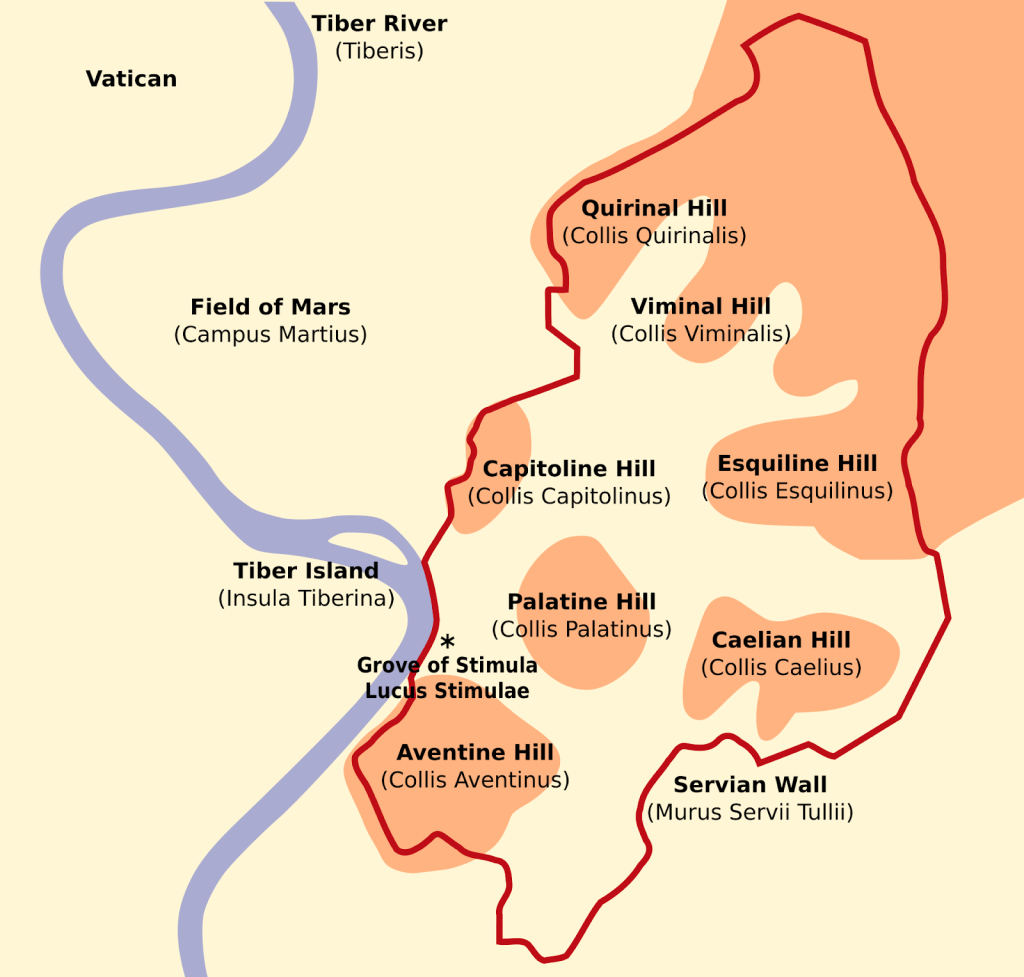
This narrative is grounded in the Aventine hill and environs: Aebutius’s family lives on the hill, and the cult is active in a grove near the base of it, the grove of Stimula (see fig. 1).8 The Aventine hill stood at the edge of the city, initially outside its official demarcation, and was associated with the integration of foreign cults and generally welcoming foreigners into Rome.9 A series of foreign wars in this period—most prominently the Second Punic War—combined with a simultaneous expansion of Roman citizenship exacerbated conservative Roman anxieties about foreign influence. The cult of Bacchus becomes a proxy for these fears and how they play out in the urban landscape.
Hispala’s description of the rites broadens the scope of the cult to the entire city. She explains that at first the cult was celebrated only during the day, and only by women, with married citizen women taking turns leading. One of those priestesses, however, let men join and switched the rites from day to night. Livy repeats his narrative of the ensuing corruption, ultimately suggesting that the nocturnal cult becomes its own city
From that point when the rites were celebrated together, men mixed with women, and the lawlessness of the night had drawn near, there was no outrage, no crime was left undone. More defilement was done by men amongst themselves than women. If any of them were unwilling to endure a vile act and reluctant to commit crimes, they were sacrificed like animals. To think nothing beyond the pale—this was their greatest belief. Men spouted prophecies as if their mind had been seized, with a mad shaking of their body; married women, wearing the clothes of the Bacchae, their hair down, ran with burning torches to the Tiber, and after the torches had been dunked in the water, since living sulphur was mixed with the lime, the flame came out of the water intact. Men were said to be ‘seized by the gods’ when, while they were bound, machines ripped them out of sight into hidden caves: these were the men who refused to be part of a conspiracy or associate with crimes or endure defilement. [The cult] was an enormous mob, at this point almost another citizenry (populum), including noble men and women.10
The description stresses the ways in which the cult defies the natural order. Cultural taboo is perversely central to its beliefs, and even the laws of nature are violated by things like torches that do not go out in water. Underneath the language of chaos, however, is a concern about organization: the cult systematically intimidates people into criminal activity.
The state’s response was likewise systematic. After the consul tells the senate what he has found, Livy reports that the senators were seized by the fear “lest these conspiracies and nocturnal gatherings bring about some secret treachery or danger.”11 Livy describes extensive investigations that resulted in citizen executions, and senatorial decrees restricting worship that were posted around Italy. A copy of one of them, discovered on a bronze tablet in Tiriolo, proclaims a ban on places of worship for Bacchus (unless individually approved by an appeal to the praetor and senate), as well as group worship (any more than five people), and activities associated with the function of these communities like private treasuries and communal oaths.12
This response has led scholars to read the scandal as a reflection of the state’s anxiety about unsanctioned urban organizations. Erich Gruen has pointed out the ways in which backlash against a foreign cult cannot be the whole story: Bacchic worship existed in Italy well before 186 BC, and individuals were allowed to continue to worship afterwards with government permission. It was group gatherings specifically, along with community-related infrastructure and the meeting spaces that facilitated them, that were banned. All of this suggests that the true threat was not the foreignness of the cult but its function as an organization.13 Sarah Bond has discussed this scandal as part of a period of backlash against the growing popularity of private associations in Rome.14 Jean-Marie Pailler has even gone so far as to say that the cult was treated as an attempt to “function like a ‘state within the state.'”15 This interpretation is borne out in Livy’s description when he says the cult reached the point of becoming another populus, the term used to describe the people of Rome in official phrases like the senatus populusque Romanus (SPQR). Livy envisions the cult as a kind of equal but opposite Rome, an inverted nocturnal state—a night city.
Nocturnal sites and the cultures they produce have been discussed as “night-time spaces” by Henri Lefebvre.16 He defines these spaces by the presence of transgressive activities normally banned during the day. Robert Williams has expanded on Lefebvre’s work by exploring the ways in which night spaces produce the threat of “deterritorialization.”17 Darkness breaks down social borders, disrupts traditional processes of surveillance, and allows opportunities for the creation of potentially counter-hegemonic subcultures. Livy’s concern with the “lawlessness of the night” fits with this anxiety about darkness and the spaces it produces. The cult of Bacchus is presented as one of these subversive subcultures: it exists because of night’s darkness, encourages practices that defy tradition, and becomes threatening to the status quo.
Williams also discusses the modalities used by the state for “reterritorialization.” This includes the tactic of exclusion, wherein undesirable people and activities are shut out of a protected space. Examples range from bouncers at night clubs to the practice of shutting a city’s gates at night.18 The state’s response to the cult of Bacchus can be interpreted as an example of exclusion. The restrictions on worship function as an invisible city gate and the government, in approving people’s privilege to worship on an individual basis, function as the city’s bouncers.
Like many scholars of the night, Williams prioritizes the modern period. Including the Bacchanalian conspiracy in the history of night spaces ensures that pre-modern negotiations with these spaces is not left, so to speak, in the dark. Similarly, it can help illuminate what Rome found so threatening about the cult of Bacchus, and why their response was so severe. Just as it was not simply the fact that it was a foreign cult, it was not simply the fact that it was an unsanctioned private association. The night space of the cult was key to the danger it posed; it was a group operating not only outside of official channels but outside the bounds of any possible control, in the time of night not even time could contain.
Grace Gillies is an Adjunct Lecturer, CUNY Queens College. Grace’s research focuses on the culture of the city in urban literature, as well as Roman representations of gender and sexuality.
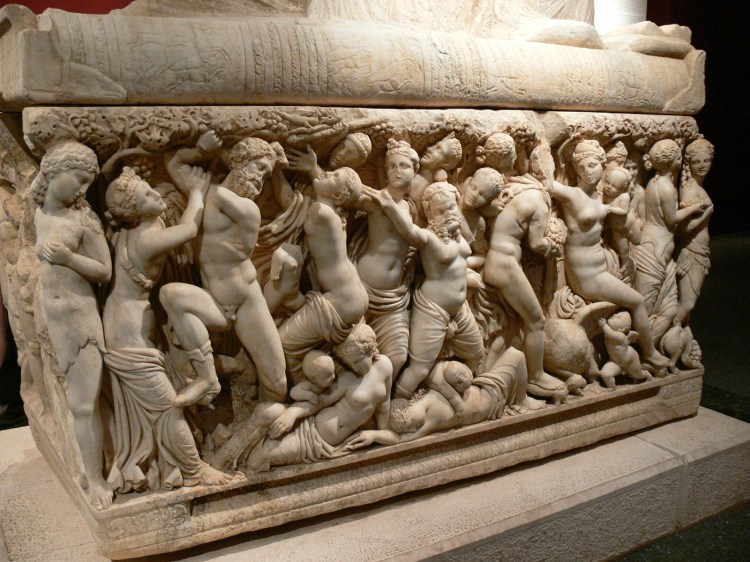
Featured image (at top): a bacchanal depicted on a Roman sarcophagus in the Antalya Archaeological Museum; photo taken by Wolfgang Sauber, from https://commons.wikimedia.org/wiki/File:Antalya_Museum_-_Sarkophag_7.jpg (accessed April 10, 2026).
- Livy, History of Rome 39.8. All translations are my own. ↩︎
- Ibid. ↩︎
- Varro, On the Latin Language 6.6 ↩︎
- Ibid 6-7. For a discussion of this phrase in the context of Roman time-keeping, see James Ker, The Roman Day: Quotidian Time and Forms of Life in Ancient Rome (Johns Hopkins University Press, 2023): 84-87. ↩︎
- Angelos Chaniotis, “Many Nations, One Night? Historical Aspects of the Night in the Roman Empire,” in Rome: An Empire of Many Nations New Perspectives on Ethnic Diversity and Cultural Identity (Cambridge University Press, 2021): 149-151; for a discussion of the night in an economic context, see Andrew Wilson, “Roman Nightlife,” in La Nuit: Imaginaire et Réalités Nocturnes Dans Le Monde Gréco-Romain, Entretiens Sur l’antiquité Classique 64 (Fondation Hardt, 2018): 59-81. ↩︎
- Livy, 39.9. ↩︎
- Ibid, 39.9-13. ↩︎
- Ibid, 39.12. ↩︎
- See Eric M. Orlin, “Foreign Cults in Republican Rome: Rethinking the Pomerial Rule,” Memoirs of the American Academy in Rome 47 (2002): 1–18, as well as Lisa Marie Mignone, The Republican Aventine and Rome’s Social Order (University of Michigan Press, 2016): 100-108. ↩︎
- Livy, 39.13.
↩︎ - Ibid, 39.14. ↩︎
- CIL I2.581=ILS 18=ILLRP 511. Tr. ARS. L. ↩︎
- Erich Gruen, “Religious Pluralism in the Roman Empire: Did Judaism Test the Limits of Roman Tolerance?,” in Rome: An Empire of Many Nations New Perspectives on Ethnic Diversity and Cultural Identity (Cambridge University Press, 2021): 173. ↩︎
- Sarah E. Bond, Strike: Labor, Unions, and Resistance in the Roman Empire (Yale University Press, 2025): 58-59. ↩︎
- Jean-Marie Pailler, “Dionysos against Rome? The Bacchanalian Affair: A Matter of Power(s),” in Dionysus and Politics: Constructing Authority in the Greco-Roman World, ed. Filip Doroszewski and Dariusz Karłowicz (Routledge, 2021): 87. ↩︎
- Henri Lefebvre, The Production of Space, trans. Donaldson Nicholson-Smith (Wiley-Blackwell, 1991): 319-320. ↩︎
- Robert W. Williams, “Night Spaces: Darkness, Deterritorialization, and Social Control,” Space and Culture 11, no. 4 (2008): 514–32. ↩︎
- Ibid, 524-25. ↩︎


