
By William Gourlay
In February 1923, following the demise of the Ottoman Empire, the founders of modern Turkey assembled to formulate their next steps. Mustafa Kemal, the leader of the Turkish Nationalist Movement that had recently defeated an invading Greek force, delivered the opening address at a “national conference” in the Aegean port city of İzmir.[1] Delegates from across the country debated economic and political principles, some of which were to become central to the running of the Republic of Turkey, which was established later that year.[2]
Why hold such an event happen in İzmir? İstanbul, for centuries the seat of the Ottoman sultans, would seem the first choice, or Ankara, later instituted as the capital of the Turkish Republic by Mustafa Kemal. In early 1923, however, neither were viable options.
Following the Ottoman’s WWI defeat, İstanbul was occupied by Allied forces, and Ankara was then still little more than a provincial town. Since the late eighteenth century, İzmir had been the largest and wealthiest port in the Ottoman Empire; it was the “pearl of the Orient,” Turkey’s “eye on Europe.”[3]
Yet, conditions in İzmir were not ideal for an assembly of dignitaries either. During the Turkish Nationalists’ victory over the Greeks several months earlier, İzmir had been put to the torch. Two thirds of the city, its commercial centre and waterfront, lay in ruins. What set İzmir apart, however, was that after its reclamation from the Greeks it emerged as a potent symbol of the Turkish national struggle.[4] Thus, it was the ideal venue for decision makers to gather and determine the trajectory of the soon-to-be-created Turkish state.
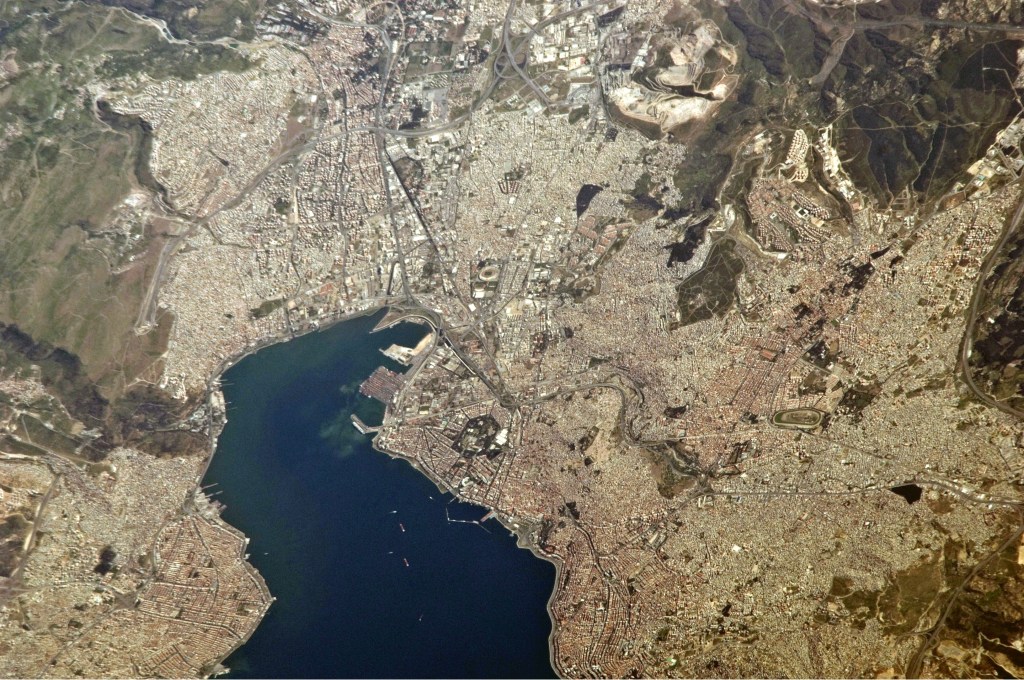
A century later, İzmir’s symbolism still resonates. Now the third-largest city in Turkey, its emergence from the ruins of war mirror that of the republic itself. It has been a barometer of Turkey’s modernization project and a bastion of Turkish nationalism. Its burgeoning trade and entrepreneurial spirit proved central to the twentieth-century resurgence of the Turkish economy. At the same time, İzmir retains its own distinctive identity and ethos, and in many ways, the echoes of its past are apparent in the present day. An ethnically diverse trading hub that largely marched to its own beat during the Ottoman period, it was recreated and reimagined as a model Turkish city, yet in recent years İzmir has pursued its own trajectory, often in contradistinction to broader currents in Turkey.
Ottoman Smyrna/Gâvur İzmir
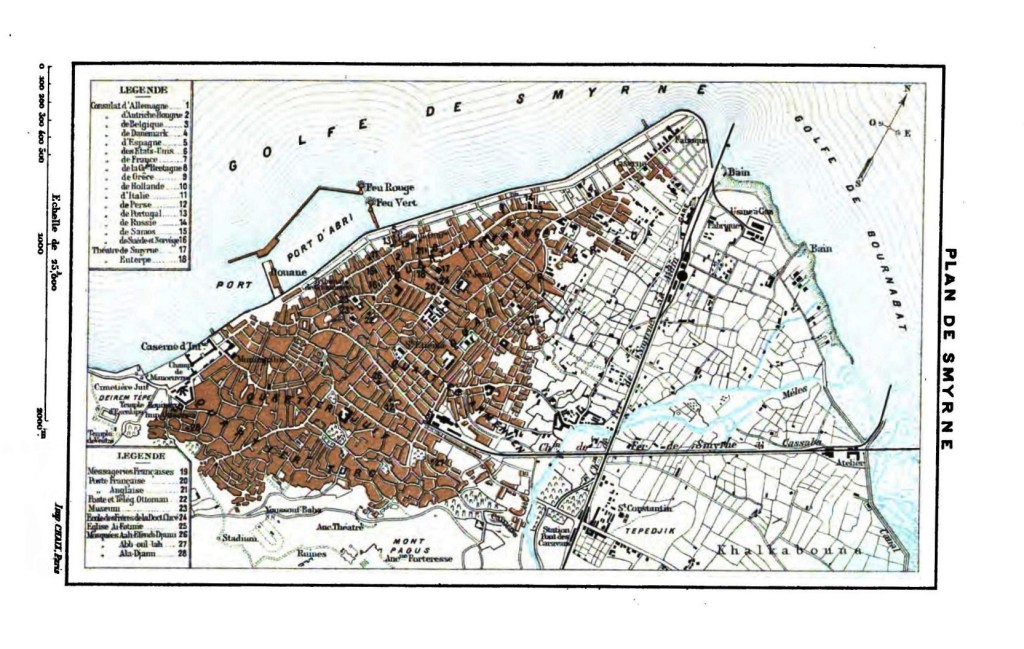
Before İzmir, the largely homogenous Turkish metropolis we see today, there was Smyrna, a city built on ancient Greek foundations and boasting a singularly diverse ethnic makeup. The Turkish presence in İzmir extends almost one thousand years, yet there was no Turkish majority until 1923. Ottoman İzmir/Smyrna was lauded for its “cosmopolitan” ambience. Censuses recorded Greeks, Turks, Armenians, Jews, and Levantine Franks, among others.
The archetypal Levantine city, it revealed both European and Middle Eastern characteristics: humming bazaars, mosques, and camel caravans, alongside churches, synagogues, theaters, cafes, and department stores. One mid-nineteenth-century visitor remarked, “Smyrna had no earthly right to the title of a Turkish city, except the accident of its happening to be in Turkey.”[5] Many Turks spoke of “Gâvur İzmir” (“Infidel İzmir”), alluding to the non-Muslim majority, yet Turkish residents exhibited a sense of pride in its distinctiveness and autonomy, a city where one did not “kiss the hem of the sultan.”[6]
Such attitudes are perhaps a reflection of the fact that İzmir cast off its village status and became an important city largely without direction or input from the Ottoman palace.[7] From the seventeenth century, local Turkish, Greek, Armenian, and Jewish merchants, all of whom were Ottoman subjects, and expat English, Italian, and French communities drove İzmir’s integration into the world economy, leading to its growth and development. Greeks and Armenians were prime movers in international trade, establishing connections with merchants in Western Europe, while Jews played key roles as financiers. These communities also spoke Turkish, facilitating the export of abundant local produce to international markets.[8] İzmir become the preeminent trading entrepôt in the eastern Mediterranean.[9]
As befits an economic powerhouse, by the late Ottoman period, İzmir had become the main commercial banking center in the Middle East, while also seeing rapid cultural and social change.[10] Even though, during the Tanzimate era of internal reforms, the Ottoman government sought to regulate and centralize control, İzmir was economically powerful enough to follow its own path. International visitors remarked upon its “liberal” atmosphere, in comparison to elsewhere in the Ottoman realm; others described it as “extravagant” and a “miniature Paris.”[11] Genteel society consumed literature, magazines, and newspapers in several languages, and, as is not uncommon in port cities, İzmir had its less salubrious sights: rowdy taverns, music halls, brothels, and pockets of poverty.[12]
In effect, late-Ottoman İzmir operated in a microcosm of its own making, largely independent of the Ottoman sultans, exchanging goods, influences, and ideas between the Muslim Middle East and Christian Europe.
Smyrna Burns, İzmir Emerges
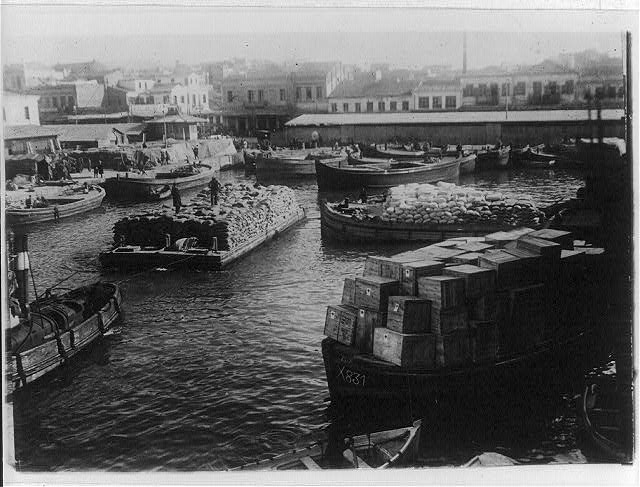
The arrival of a particular European idea—nationalism—was one factor leading to the collapse of the multiethnic Ottoman Empire, as Serbs, Greeks, Bulgarians, and others in the Balkans fought to establish their own nation-states, often spurred on by European powers. Turkish and Greek nationalisms clashed in the Anatolian hinterland, the Turks eventually emerging victorious and establishing the Republic of Turkey, a nation-state premised on the idea of Turkish homogeneity. The clash of nationalisms also spurred the demise of “cosmopolitan” Smyrna. The final chapter of the Greco-Turkish war was the fire that destroyed the city’s historical core. The New York Times lamented: “Only Ruins Left in Smyrna.” A devastated city offered a clean slate on which the Turks could implement their nation-building program. Gone were the multilingual bazaars and laneways of Smyrna; here was an opportunity to create a new, purely Turkish city.
This project was undertaken both at human and physical levels. The destruction of Smyrna led to the flight of its Greek and Armenian communities. The Turks who remained found themselves occupants of a largely deserted city. Testimonies from the time recount desolate and derelict neighborhoods.[13] A visitor in 1926 said the “stream of riches” from İzmir was drying up and the port dying.[14] Population exchanges between Greece and Turkey, in pursuit of ethnic homogeneity in both states, whereby Muslims in Greece were transferred to Turkey and ethnic Greeks in Anatolia were transported to Greece, brought further major demographic shifts.[15]
Exchange protocols, coming into effect from December 1923, saw İzmir and its environs become one of the top five destinations for Muslims arriving from Greece and the Balkans.[16] This was part of a multipronged program to Türkleştirmek (Turkify) the nation-state. In İzmir, it resulted in the upending of the social and economic orders. Non-Muslims had made up much of the merchant class in prewar Smyrna, but also the working classes. The local economy had shrunk with their departure, and many newly arrived Muslims endured hunger, unemployment, and homelessness until local agriculture and industry were rekindled.[17] Meanwhile, the creation of purportedly homogenous populations did not always proceed smoothly. Immigrants, many of whom did not even speak Turkish, often found themselves excluded socially and administratively.[18]
Turkification in the early years of the Turkish republic also consisted of the reconstruction—and reimagination—of urban landscapes. The focus was on Ankara, but İzmir was another priority, given its ravaged state. European urban planners Henri Prost and Rene and Raymond Danger were commissioned in 1924 to create a master plan for the reconstruction of İzmir, devising a city configured according to École des Beaux Arts principles.[19] Even while the new republic consolidated its Turkish identity, it emulated and adopted European ideas and norms, in an attempt to characterize Turkey as a modern European nation-state and to discard purportedly backward associations with the Middle East. An İzmir deputy in the national assembly expressed a desire that the city assume “modern lines” rather than recreating its earlier “primitive” form.[20]
Due to Turkey’s straitened economic circumstances, compounded by the Great Depression, İzmir’s reconstruction was delayed for several years. Work began in the early 1930s, with the intention that the Ottoman imprint of the city be erased and new “national spatialities” imposed.[21] Broad boulevards, roundabouts, and open squares—the first of which was Republic Square, facing the waterfront and crested with a statue of Mustafa Kemal Atatürk—replaced the haphazard and narrow warren of streets of the Greek and Frankish quarters of Old Smyrna. Meanwhile, a new feature, the Kültürpark, including arts and sports facilities, and later the home of the İzmir International Fair, was established on the remains of the old Armenian neighborhood.[22]
Thus, İzmir re-emerged, but it was a different entity. Old Smyrna had been organic, chaotic, having blossomed through the input of ethnically diverse local communities as its agricultural and industrial produce sped integration in the world economy. The new İzmir was the conscious creation of the Turkish state, an entity linked to a nationalized economy, thoroughly Turkified, deliberately forward-looking and unheeding of the past, conceived and constructed according to “modern” principles and a centrally managed national plan.[23]
In the Ascendant
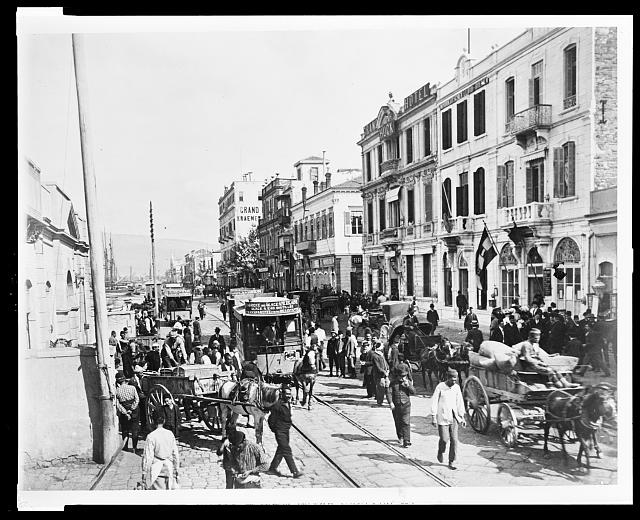
With time, the wheels of commerce ground into action again in İzmir. By the mid-1930s textile factories were boosting their productive capacity, while trade in the agricultural produce of the Anatolian hinterland—everything from almonds, figs, and grapes to olive oil and melons—rapidly expanded to markets in the US, Europe, and the Middle East, and a new generation of Turkish merchants took up where the Greeks, Jews, and Armenians had left off.[24]
The construction of new port facilities at Alsancak in 1955 gave impetus to the revival of İzmir as an international port. The centrality of the port, and the trade that passed through it, to İzmir’s identity and prosperity has long been recognized. A goal of İzmir’s entrepreneurial class was to attract foreign investment, including through the establishment of a trade fair as early as 1927. By 1937, taking place in the newly constructed Kültürpark, it was dubbed the “İzmir International Fair.” Like the 1923 gathering of Turkey’s founding elites, the fair illustrates İzmir’s role as a cog in the machinery of modern Turkey as well as the city’s entrepreneurial spirit, its determination to look outwards and engage with the wider world.
Meanwhile, economic development across Turkey brought demographic changes, the most significant of which was rapid urbanization. This was a double-edged sword, providing human capital to fuel the economy but also leading to issues such as overcrowding, housing shortages, and, later, urban sprawl.[25] After WWII, new urban plans were devised for İzmir, including one by le Corbusier (1948) and a comprehensive land-use plan by noted Turkish architect Kemal Ahmet Aru (1955), to accommodate arrivals from the Anatolian countryside and manage the city’s resources and infrastructure.[26] Further economic progress and pro-market policies from the 1980s saw the city expand, both geographically and as an engine of the Turkish economy. New suburbs and industrial developments and the first shopping malls attracted rural migrants and catered to an expanding consumer class. By the 1990s, İzmir was fueled by optimism and buzzed with the atmosphere and juxtapositions of a boomtown. As happened in other major cities, like İstanbul and Ankara, elements of old Turkey jostled with the new: geçekondu shanty houses alongside new apartment complexes and the occasional shepherd grazing his flock beside highway roadworks.
The first decade of the twenty-first century was one of considerable economic growth for Turkey, particularly in the big three metropolises: İzmir, Ankara, and Istanbul. The Brookings Institution ranked İzmir as the fourth-fastest-growing metropolitan economy globally in 2010. By 2014 it had risen to second in terms of growth in employment and per capita GDP. As had happened previously, shifting economic conditions led to demographic changes. İzmir’s economic vitality became a magnet for internal migration, and for the first time it outperformed İstanbul as the destination of choice, to the extent that some people abandoned İstanbul in favor of İzmir.
It was not solely economic imperatives that contributed to İzmir’s appeal. Business opportunities in comparison to Istanbul remained limited, but İzmir is and was seen as offering a better lifestyle for those seeking respite from the overdevelopment and congestion of the megacity. İzmir also enjoyed a reputation as a more “modern” city. Life was less frenetic, the average marriage age was older, unemployment rates were lower, and educational levels were higher. A leading business figure later argued that the city offered a model for development whereby an open political culture fostered economic advances. In 2016 then İzmir Mayor Aziz Kocaoğlu touted the city as Turkey’s “window to the West.” Legend has it that a local politician once quipped that if İzmir were to apply to join the EU, it would be accepted, even if the rest of Turkey was not.
Meanwhile, the head of Turkey’s Religious Affairs Directorate, Ali Görmez, once scolded İzmir for its lack of regard for religious sensitivities. The public and opposition political figures swiftly rebuked Görmez. İzmir locals tend to pride themselves on the easy-going atmosphere of their city and its relaxed attitudes as compared to more conservative Turkish regional cities. Such differences have broadened as President Recep Tayyip Erdoǧan and his Justice and Development Party (AKP), in power since 2022, have sought to create a more pious, conservative political community. Despite the AKP’s electoral dominance across inner Anatolia, İzmir remains a stronghold of the opposition People’s Republican Party (CHP), clinging resolutely to its ideals of secularism and consistently voting against the AKP in general elections and referenda. In the 2023 general election, the CHP won a majority in all fourteen of İzmir’s urban electoral districts and all but two of its sixteen regional districts.
In effect, a century after rising from the ashes, İzmir has grasped the baton of the “liberal” city from old Smyrna and appears determined to pursue a trajectory of its own invention, without undue interference or judgement from elsewhere in Turkey.
Coming Full Circle
In the twilight of the twentieth century, some argued that even though İzmir had reasserted its commercial capacity, its largely assimilated population and efforts to ignore its “cosmopolitan” history had led to the loss of the “creative heterogeneity” that once inspired and fueled old Smyrna’s growth and potential.[27]
Yet, İzmir was never as monolithic as some imagined or as hard-line as nationalists might have wished. A Jewish community remains, as does a community of Levantines, the descendants of English, French, and Italian merchants who settled in the region in the late Ottoman period and facilitated trade with Europe. Through the 1980s and 1990s, İzmir was one of several main destinations of internally displaced Kurds fleeing the conflict that wracked southeast Anatolia, and since 2012 many Syrian refugees have passed through the city.[28] This is not to say that ethnic diversity was universally embraced or that migrant communities integrated smoothly. Many Kurds experienced a range of problems, from unemployment to social exclusion, while the Turks’ initial warm reception for Syrian refugees has cooled and Turkish-Syrian relations are tense.[29]
Turkey’s determination to ignore its multiethnic past is well documented, but with the passage of time there has been gradual acknowledgement that the social fabric in Turkey is more multifaceted than previously described, while some have begun to look back at earlier eras of co-existence as something of a golden age. Attempts to acknowledge and foster ethnic diversity have occurred at individual and official levels. İzmir’s municipal government, under the direction of Tunç Soyer, mayor since 2019, has taken steps in this direction, mostly notably in its efforts to renovate parts of the city’s historic Jewish neighborhood. The local Jewish community is more assertively declaring its presence following the establishment of an annual festival that celebrates Sephardic literature, music, drama, and cuisine. In the last decade, several of İzmir’s Christian places of worship have also seen their first religious services since the destruction of Ottoman Smyrna. In 2015, Greek worshippers conducted Easter services in the recently refurbished Church of St Voukolos, and in 2017, Armenians conducted a liturgy at the Cathedral of St. John.
Under the current mayoralty, the city appears to have recovered its verve and its taste for innovation and enterprise, if in fact, they were ever lost. Mayor Tunç Soyer extols a “circular culture” vision for İzmir, one that aims to enhance democratic engagement, building connections between peoples and between natural and urban environments as the city evolves. In accordance with such an approach, İzmir has become a member of the European Bank for Reconstruction and Development’s Green Cities program, while also being lauded by the EU for its “smart development.” Its aspirations do not end there. Since 2020, İzmir has aspired to win Cittaslow accreditation, thus becoming the first metropolis to join a movement that recognizes improvements to quality of life that the slowing down of urban rhythms can bring, as well as applying for UNESCO status as a city of Outstanding Universal Value.
These initiatives would suggest that İzmir has by no means lost its “creative heterogeneity.” As a busy, expanding city of four million residents, it is not without crowds, congestion, and other challenges that beset large urban conglomerations, yet it is a dynamic hub, fully enmeshed in the apparatus of modern Turkey. At the same time, it remains true to its ideals. İzmir retains its own identity and character, and as indicated by winning the Parliamentary Assembly of the Council of Europe award in 2022 for the town most active in promoting the European ideal, it seems to be assuming the mantle that Smyrna once bore, being Turkey’s eye on Europe, and vice versa.

William Gourlay is a writer and researcher with a focus on Turkey and the Balkans. He currently teaches Middle East politics and history at Monash University, Australia, and was previously a Research Associate in the Middle East Studies Forum at Deakin University, Australia. He has worked as a teacher, journalist, and editor in London, İzmir (Turkey), and his native Melbourne. His book The Kurds in Erdoǧan’s Turkey was published by Edinburgh University Press in 2020.
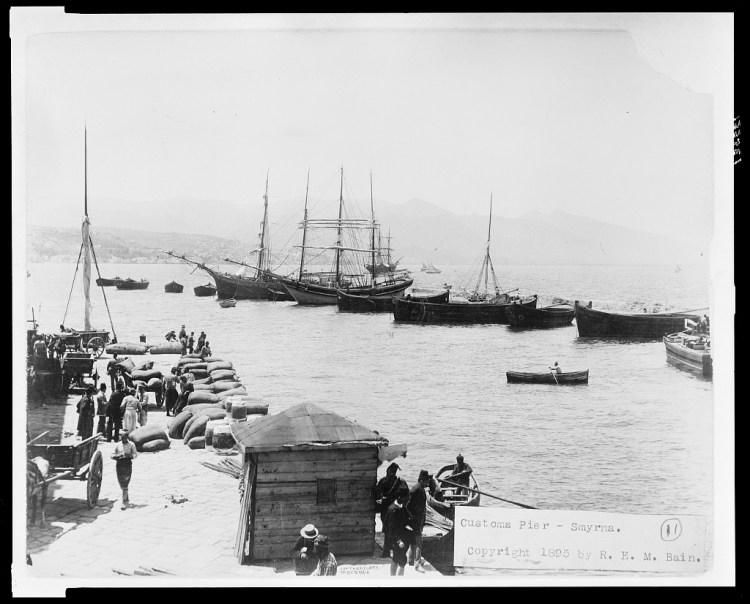
Featured image (at top): “Customs Pier – Smyrna” (1895), Robert E. M. Bain, Prints and Photographs Division, Library of Congress
[1] Mustafa Kemal later became first president of Turkey and in 1934 adopted the moniker Atatürk.
[2] Michael Finefrock, “Laissez-Faire: The 1923 Izmir Economic Congress and Early Turkish Developmental Policy in Political Perspective,” Middle Eastern Studies 17, no. 3 (1981): 375-392.
[3] Philip Mansel, Levant: Splendour and Catastrophe on the Mediterranean (London: John Murray, 2011), 33, 34.
[4] Michael Finefrock, “Laissez-Faire,” 376.
[5] Biray Kolluoğlu, “Cityscapes and Modernity: Smyrna Morphing into İzmir,” in Ways to Modernity in Greece and Turkey: Encounters with Europe, 1850–1950, ed. Anna Frangoudaki and Çaǧlar Keyder (London: I.B. Tauris, 2007), 217.
[6] Leyla Neyzi, “Remembering Smyrna/Izmir: Shared History, Shared Trauma,” History and Memory 20, no. 2 (2008), 110.
[7] Edhem Eldem, Daniel Goffman, and Bruce Masters, The Ottoman City between East and West: Aleppo, Izmir, and Istanbul (New York: Cambridge University Press, 1999), 83.
[8] Devrim Dumludaǧ and Bülent Durgun, “An Economy in Transition: Izmir (1918-38),” Middle Eastern Studies 47, no. 6 (2011), 926.
[9] Eldem, Goffman, and Masters, The Ottoman City between East and West, 38, 128.
[10] Elena Frangakis-Syrett, “Banking in Izmir in the Early Twentieth Century,” Mediterranean Historical Review 24, no. 2 (2009): 115-32.
[11] Biray Kolluoğlu, “Cityscapes and Modernity,” 223.
[12] Malte Fuhrmann, “Down and Out on the Quays of İzmir: ‘European’ Musicians, Innkeepers, and Prostitutes in the Ottoman Port-Cities,” Mediterranean Historical Review 24, no.2 (2009): 169-185.
[13] Leyla Neyzi, “Remembering Smyrna/Izmir,” 119.
[14] Ellinor Morack, “Turkifying Poverty,” 503.
[15] Erik Zürcher, Turkey: a Modern History (London: I.B. Tauris, 2004), 164.
[16] Elif Yıldızer Özkan and Hayat Zengin Çelik, “The Settlement of the Emigrants in İzmir between 1923-1930 According to the Treaty of Lausanne and Liquidation Requisitions,” Journal of Modern Turkish History Studies 20, no. 41 (2020), 591.
[17] Ellinor Morack, “Turkifying Poverty, or: The Phantom Pain of Izmir’s Lost Christian Working Class, 1924–26,” Middle Eastern Studies 55, no. 4 (2019), 499.
[18] Elif Yıldızer Özkan and Hayat Zengin Çelik, “A Qualitative Research on Emigration and Identity in İzmir–Eşrefpaşa,” International Migration 60, no. 5 (2022), 124.
[19] Kalliopi Amygdalou, “Building the Nation at the Crossroads of ‘East’ and ‘West’: Ernest Hébrard and Henri Prost in the Near East,” Opticon 1826 16, no. 15 (2014): 1-19.
[20] Ellinor Morack, “Expropriating the Dead in Turkey: How the Armenian Quarter of İzmir Became Kültürpark,” European Review of History 28, no. 2 (2021), 250-251.
[21] Biray Kolluoğlu, “Cityscapes and Modernity,” 227.
[22] Ellinor Morack, “Expropriating the Dead,” 241.
[23] Biray Kolluoğlu, “Cityscapes and Modernity,” 217-227.
[24] Devrim Dumludaǧ and Bülent Durgun, “An Economy in Transition,” 929-42.
[25] Hasibe Velibeyoǧlu, “Development Trends of Single-Family Housing Estates in İzmir Metropolitan Fringe Area,” (Masters thesis, İzmir Institute of Technology, 2004), 58-60.
[26] Isin Can, Irem Ince, and Claudia Yamu, “The Rationale Behind Growth Patterns: Socio-spatial Configuration of Izmir, Turkey, 1700s– 010,” Proceedings of the 10th International Space Syntax Symposium. The Izmir municipality subsequently implemented further urban and regional development plans in 1973, 1988, 2003, and 2007.
[27] Eldem, Goffman, and Masters, The Ottoman City between East and West, 134.
[28] Serkan Turgut and Çetin Çelik, “Kurdish Students’ Perceptions of Stigma and Their Destigmatization Strategies in Urban Contexts in Turkey,” Race Ethnicity and Education (online), April 27, 2022, https://doi.org/10.1080/13613324.2022.2069735.
[29] Neslihan Demirtaş-Milz and Cenk Saraçoǧlu, “Space, Capitalism and Kurdish Migrants in Izmir: An Analysis of Kadifekale’s Transformation,” in The Kurdish Issue in Turkey: A Spatial Perspective, ed. Zeynep Gambetti and Joost Jongerden (London: Taylor & Francis, 2015): 185-212.

