
Editor’s note: This is the third installment in The Metropole’s theme for November: Metropolitan Consumption. All other entries for the theme can be found here.
By Matthew King
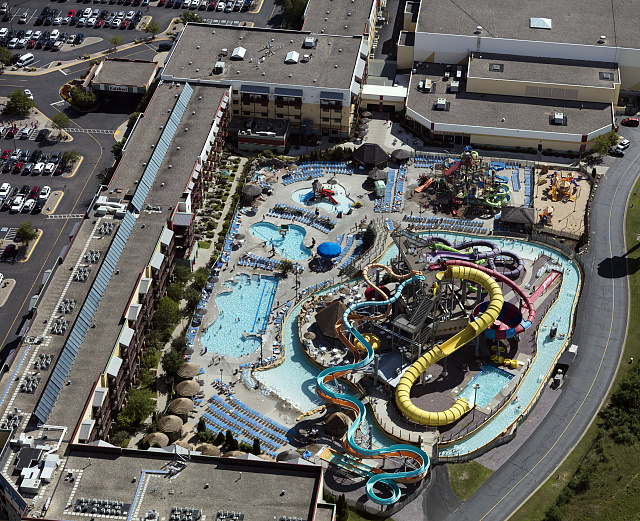
On any given day, in any season or weather, the Wisconsin Dells’ indoor water parks are voracious, consuming over 16 million gallons of water and untold megawatts of power to maintain a balmy 84°F climate. At the Kalahari Resort, tens of thousands of gallons of water flow daily through its looping slides and “lazy river” tributaries. Two miles away, the Wisconsin River winds past ancient sandstone cliffs, natural wonders that first brought tourists to the area during the mid-19th century. “There are people who come to the Dells and probably have no idea that this is all here,” said Harlan Feldt, a Wisconsin Dells Boats tour guide, in a 2014 interview. “Waterparks are very good for the economy of the Dells, they certainly attract people, but I sometimes think they may pull people away from the natural aspects.” [1]
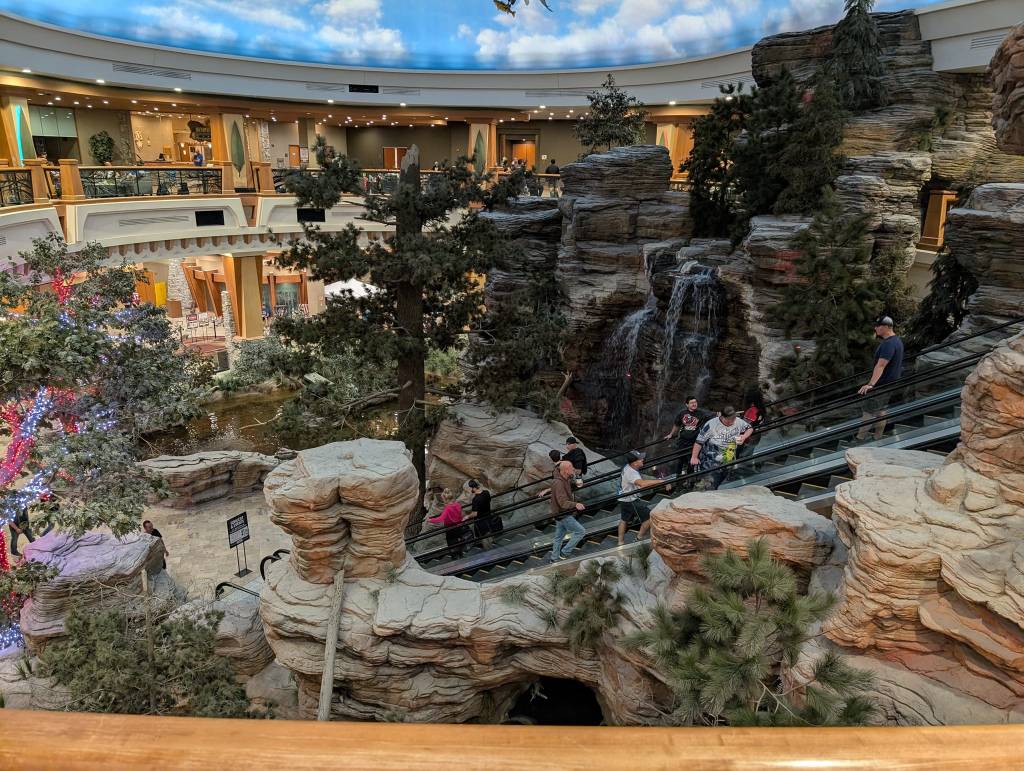
In the decade since that interview, the region has only cemented its place as the “Waterpark Capital of the World.” Adding more resorts and slides each year, the Dells tourism economy nearly doubled to an estimated $2.05 billion in 2014, drawing over 5 million annual visitors. The Dells now boasts the highest waterparks per capita and holds records for the largest outdoor, indoor, and indoor-outdoor waterparks.[2] For many of today’s visitors, their closest glimpse of the natural rock formations might be the man-made replica in the Ho-Chunk Casino and Convention Center, an immersive lobby exhibit with cement cliffs, plastic ferns, illuminated waterfalls, and wire-strung birds, its terrain carved through the middle by a giant escalator.
If the Dells have become a caricature of mass tourism, its extremes also provide an instructive mirror. In its transformation from sacred landscape to scenic destination to amusement mecca, during a time of great social and technological changes no less, we see how metropolitan consumption has been prioritized above all other factors. Can wonder be preserved while being shared, or does the very act of consuming beauty destroy it? As the indoor waterparks model spreads to more tourism hubs, from Colorado Springs to Pennsylvania’s Pocono Mountains to Virginia Beach, the model’s birthplace is finally showing signs of a turn back to the land.
Courtesy of Joel Karnick
Visual media brings the city to the countryside
Before the water slides and roller coasters, before the steamboats and wax museums, the Wisconsin Dells belonged to the Ho-Chunk Nation. For these indigenous people, the dramatic sandstone formations represented far more than scenic beauty—they were sacred space, woven into creation stories and spiritual practice.[3] The area known as “Nįįš hakiisųc,” or “rocks close together,” provided shelter, sustained their community through fishing and farming, and connected them to ancestors who had lived there for millennia.[4] Then, in the early and mid 1800s, a series of violent removals led by the U.S. government forcibly moved tribes west of the Mississippi, in what decendents later called the “Wisconsin Trail of Tears.”[5]
By the time mass tourism began in earnest, a profound erasure had occurred in the metropolitan imagination: the forced removal of the Ho-Chunk transformed the Dells into “wilderness,” an ostensibly untouched natural wonder awaiting discovery rather than a homeland recently emptied of its inhabitants. This veneer of virgin landscape—a place teeming with life now rewritten as empty frontier—made it ripe for commercial leisure exploitation.
Soon, local newspapers beckoned affluent city-dwellers from Chicago, Milwaukee, and Minneapolis, promoting then-Kilbourn City as possessing a “wild grandeur and majestic beauty…no place in the West will prove more attractive for pleasure seekers and lovers of nature.”[6] As cities saw dizzying change due to the Industrial Revolution and corporate power, many residents were eager for an antidote or escape, and railroad companies sought to enlist passengers on their new train lines.
Across the U.S., landscape photographers like Andrew Joseph Russell and Carlton Watkins had begun to capture and disseminate iconic American landscapes, from Utah’s Promontory Point to San Francisco’s Telegraph Hill. These visions inspired a young H.H. Bennett, then working odd jobs around Kilbourn City while trying to jump-start his photography career.[7] In letters to his father in Vermont, he complained about his economic struggles, calling the town a “little, insignificant, dull, out of the way, place.”[8] In a coup of domestic compromise, his wife Frankie agreed to take over his portrait studio work so he could explore the great outdoors.
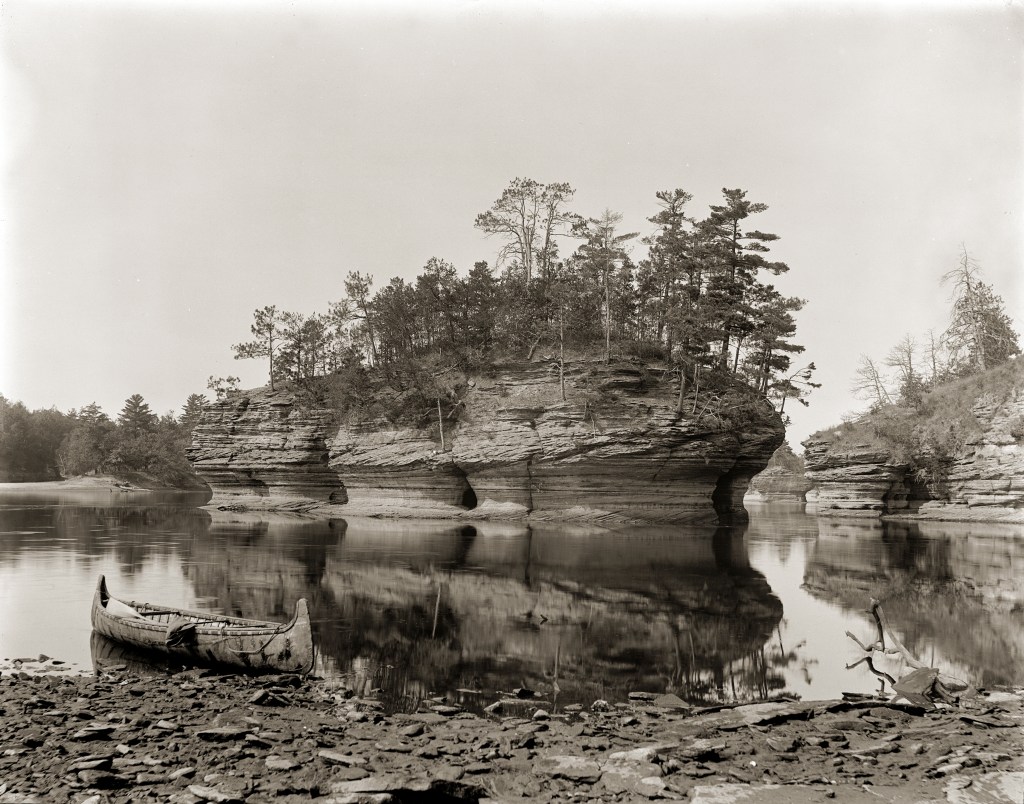
Bennett’s famous Dells photographs portray an almost otherworldly planet. Odd towers of misshapen rocks, their tops sprouting evergreen firs like hairs, stand surrounded by a placid river. Sometimes a lone canoe appears, a trace of past human life. As Bennett famously told his wife: “it is easier to pose nature and less trouble to please.”[9] That doesn’t mean he was against clearing trees or manipulating the landscape for a better vantage point; such contrived settings still required labor to appear effortless.[10]
This aesthetic reflected a global 19th-century trend: the emergence of the “picturesque,” which created critical distance between land and observer. As cultural historian Raymond Williams argued in his influential analysis The Country and the City, such paintings and photographs constructed rural landscapes as rustic and idyllic, seemingly outside history—even as they were being rapidly subsumed within emerging networks of capital and consumption.
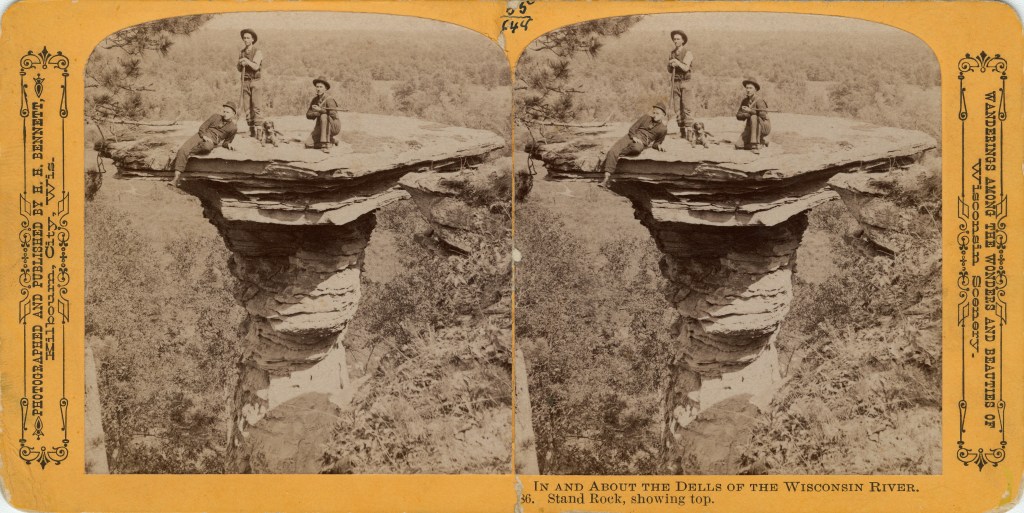
In another photo series, Bennett includes well-dressed Victorian tourists in the frame. They navigate the waters in a wooden canoe, or stand atop a cliff, looking at ease or possibly lost, other times posing for the camera like a 21st-century social media user.
Courtesy of Wisconsin Historical Society
Courtesy of Wisconsin Historical Society
Dells historian Steven Hoelscher notes how these classic portraits facilitated a “closing of the frontier,” taming the rural hinterland from “working river into a picturesque landscape.” Left out of these vistas are the area’s many less savory histories: “an agricultural region of overworked wheat farms, poorly drained sand plains, hastily developed towns, quickly set rails, labor unrest, and recent Indian removals.”[11] Only by eliding these social, political, and environmental conflicts were Bennett’s photographs able to portray the fiction of a tranquil, undisturbed wonderland.
While a skilled photographer, Bennett’s creations captured audiences for another reason: their advanced formats. Stereographic images, which required a large box and portable dark room to produce, turned pictures of rock formations into immersive holograms. Gathered in a household’s parlor room, the era’s urban bourgeoisie peered into a handheld optical device, resembling a cruder, wooden version of today’s virtual reality binoculars; inside, two slightly askew images approximated a 3D experience.[12] Bennett was also an early adopter of stop-action shutters, allowing him to capture his most famous photograph in 1886: his son, Ashley, positioned mid-air, leaping from a cliff’s ledge to the iconic Stand Rock.
By the early 1900s, the sleepy lumber camp of Kilbourn City had evolved into a seasonal tourist economy, and the remaining Ho-Chunk had to decide how to engage with it. These early interactions enact what Mary Louise Pratt calls a “contact zone,” or social space “where cultures meet, clash, and grapple with each other, often in contexts of highly asymmetrical relations of power.”[13] Some Indians contracted with Bennett for staged photographs, posing in traditional attire while rejecting his calls to wear certain headdresses or props. His workbooks reveal payments of anywhere from 70 cents to $4.25, about the same as his assistants.[14]
Other tribesmen performed along the riverbank for passing tour boats. Over time, this practice evolved into the formalized Stand Rock ceremony, which ran from 1919 to 1997. For a while, the Ho-Chunk even ran “Indian camps” as a living display of indigenous culture, a kind of Colonial Williamsburg walking visitors through daily tasks and traditional clothing and cooking styles. Some elders even led their own river boat tours.[15]
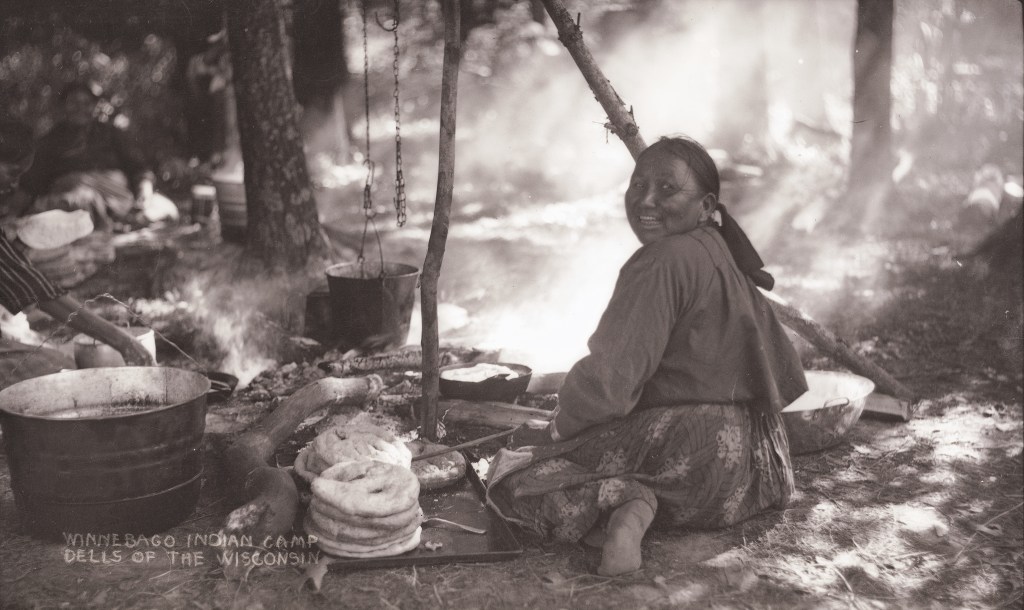
Courtesy of Wisconsin Historical Society
While these engagements were fraught with moral and aesthetic compromises, they also represented acts of courage. Anishinaabe writer Gerald Vizenor offers the term “survivance” to describe such creative self-preservation, presenting “an active sense of presence over absence, deracination, and oblivion.”[16] Scholar Sarah Anne Stolte notes that the Ho-Chunk “played a part in the 20th-century trends that commoditized Indian identity for public consumption in America,” even as they exercised agency in their ability to “design the skits and choose the dance sequences,” while also gaining financial independence.[17] The endurance of these traditions asserted a native presence and combatted the prevailing “vanishing race” theory, parroted in mainstream newspapers and reinforced by many of Bennett’s iconic photos.
As the Dells tourism market boomed, Bennett proved himself an adroit salesman at every inflection point. Early on, he gave scenic rocks in his pictures catchy English names, from Stand Rock and Chimney Rock to the Sugar Bowl and Black Hawk’s Profile. Before the large boat companies squeezed him out, he pioneered the fast-turn souvenir photo, snapping tourists on their arrival and returning with a printed copy for their departure. When the Kodak box camera democratized photo-taking in the early 1900s, leading to a 63% drop in his portrait sales from 1897 to 1905, he pivoted to another tourist staple: merchandise. “I am [now] in the souvenir and Indian relic trade quite extensively,” he said in 1906, stocking his shop with a mix of “make-believe Indian things” from northeast manufacturers, as well as “real and very old Indian relics that I have got from my Winnebago friend.”[18]
Natural tourism morphs into futuristic spectacle
The first tourist era of the Dells followed this arc of connection: railroads and river boats linked to the main vein of Broadway, with its watering holes and boarding houses. Local establishments like the Showboat Saloon and Stanton’s Palm Garden survived the Depression, often operating from their basements. In 1927, building contractor William Newman installed the man-made, 250-acre Lake Delton to develop more resort shoreline in the area. But the postwar period, and the rise of the automobile, brought about a new chapter marked by dispersion.
As cars became affordable to middle-class families, the Dells evolved from a railroad destination requiring multi-day stays into a weekend getaway. New businesses gravitated towards the US 12 highway between the downtown Wisconsin Dells and Lake Delton. Along both commercial strips, a new family-oriented tourism economy proliferated, of go-kart tracks, mini-golf courses, wax museums, haunted houses, and gift shops selling rubber tomahawks and beads.
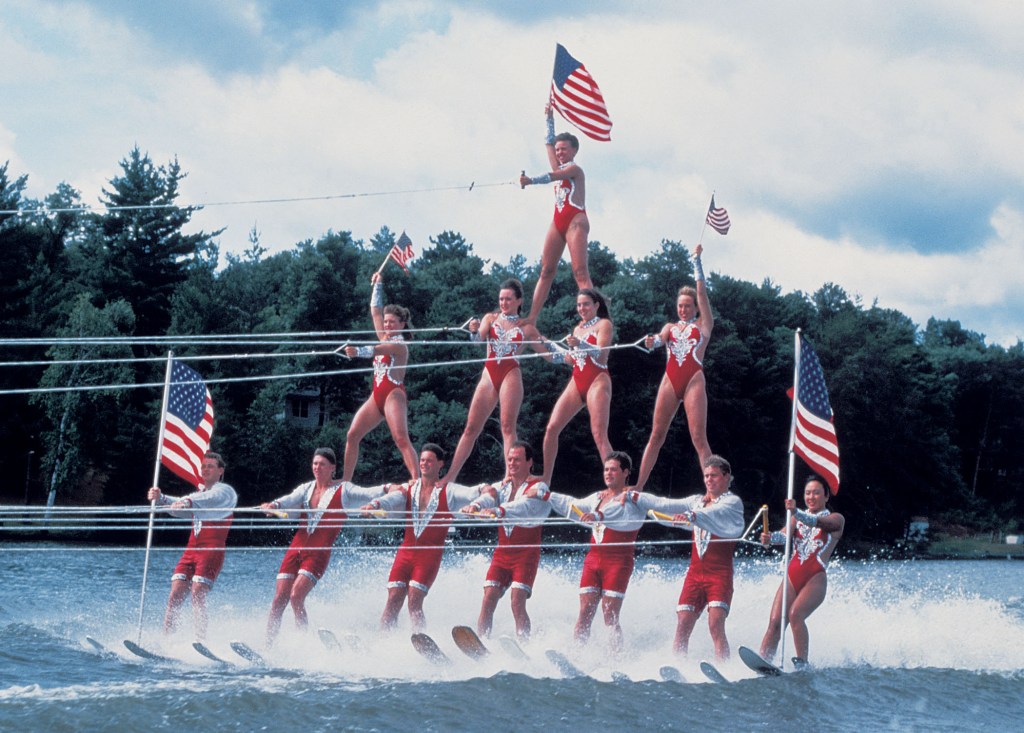
In the 1950s, a burst of roadside attractions along US 12 further shifted the axis of gravity. Storybook Gardens featured whimsical scenes from the likes of Humpty Dumpty to Cinderella, while the Wonder Spot stuffed a playland of optical illusions into an unassuming cabin. Tommy Bartlett, a radio personality from Chicago, established his water ski shows in 1952, which became a signature attraction; set on Lake Delton, they had little to do with the surrounding landscape or history, instead featuring pure spectacle and athletic feats, its performers often wearing patriotic swimsuits or riding NASA space shuttles.
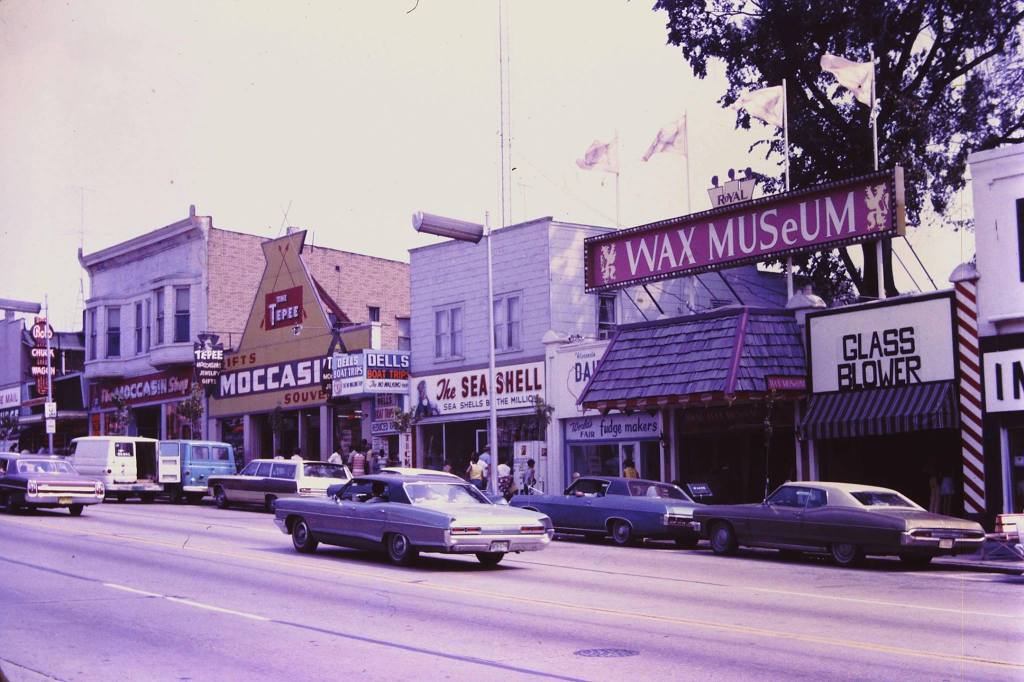
Courtesy of Larry Kapp
Across online forums and Facebook Groups, older generations of tourists recite the names of these beloved attractions like forgotten dreams. They talk about the Biblical Gardens, which featured manger scenes and multiple crucifixion displays. They talk about the space-age Xanadu, billed as “A house of tomorrow,” with a mish-mash of tech and toys for adults and kids alike. And of course, they recall the Duck boat tours, featuring amphibious vehicles that can trawl both land and water, which have helped preserve the river as a key, if waning, attraction.[19]
Every cohort pines for childhood memories that seemed simpler or more wholesome. Boomers recall the old-timey attractions that, even if bizarre, felt at least unique to the Dells, while their parents yearn for the even humbler past of boat rides and supper clubs. Multiple group members note that now “it’s all about making money hand over fist” and “greed is killing the Dells.” By the early 1980s, geographer John Fraser Hart had already eulogized this moment:
“A boat trip to see the gorge is presumably still a reason for visiting the Dells, but the natural scenic attractions of the area have been increasingly overshadowed by the garish signs and outlandish architecture of manmade marvels. The Dells area is either a showplace of tourist attractions, or the kind of place that gives tourism a bad name, depending on your point of view.”[20]
Where Bennett’s photographs had at least trained viewers to contemplate sublime nature, the new tourist gaze sought novelty, thrills, and variety. Families no longer came to spend a week photographing rock formations—they came for packed two-day weekends with children who needed constant stimulation. In the Dells, that became not just nature, but history, Westerns, the occult, water sports, the future. In more recent decades, the attractions have become ever- stranger: an upside-down White House replica; a giant Trojan Horse with a go-kart running through its belly; on the main downtown stretch, a Museum of Torture Devices.
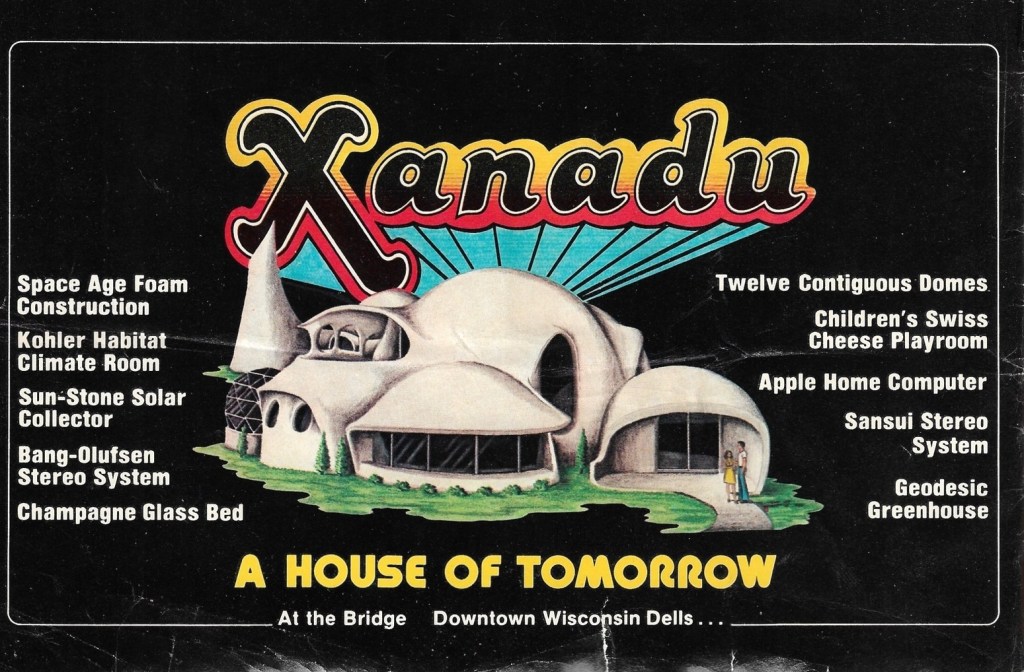
Courtesy of Jake Beard.
The indoor waterpark at the end of history
The Dells’ water slide tradition began with a humble design. In 1977, local developers poured a few concrete grooves into a hillside off Highway 12 and opened it to the public as Sir Goony’s Waterslide. The rides followed a very gradual downward slope and required a sliding mat to protect from the rough surface, which skinned against exposed feet, elbows, and knees.
In some ways, the Dells were behind the curve. When Sir Goony’s opened, Orlando had already unveiled the first modern waterpark: Wet ‘n Wild, the brainchild of SeaWorld founder George Millay. In 1978, New Jersey saw the opening of its infamous Action Park, the subject of the 2020 documentary Class Action Park about its hazardous (and sometimes deadly) attractions. Finally, in 1979, the Dells welcomed its first proper waterpark: Noah’s Ark, which today boasts over 50 water slides as the largest outdoor water park in the world.
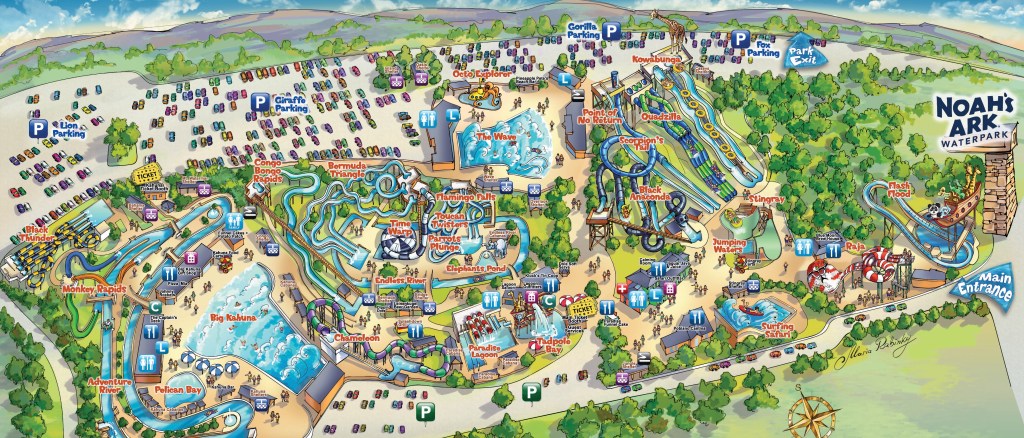
Map illustration by Maria Rabinky. Courtesy of Noah’s Ark Waterpark.
For a brief time in the new waterpark era, it seemed like the Dells’ old attractions would stay relevant. A 1982 television ad rescues a traffic-clogged woman and transports her to the great outdoors, with visions of river tubing, multiple kinds of tour boats, and nature hikes along the cliffs–as well as a stereotypical Plains Indian waving from the riverfront.[21] A 1981 ad positions the Indian character atop a cliff, in full head dress, beckoning with his fingers, saying “Follow me.”[22]
Then came the supernova: the first indoor waterpark resort. This innovation was especially important for the Dells, a summer destination in a region known for its long, harsh winters. In 1989, the Polynesian Resort opened as the first of a wave of indoor and hybrid waterparks, and by the early 1990s, the Dells was claiming its “world’s capital” moniker. Between 1995 and 2014, the number of hotel rooms in the area ballooned from 3,000 to 10,000.[23]
Local leadership aggressively marketed this year-round economy. In 1995, the tourism board spent roughly $2 million on annual marketing, a budget that quadrupled to $8.35 million in 2022.[24] This megafund is largely supported by a resort room tax, first introduced in the late 1960s, of which the vast majority of revenues go back into marketing and promotion. From a purely economic perspective, the strategy has been a resounding success, shifting 58% of visitor spending to months outside of peak summer (June through August).[25]
The Kalahari Resort emerged the biggest winner in the space. Its Dells-born founder had always been a business addict, starting over nineteen businesses over the years, from selling Christmas trees to running a pizza restaurant. Then, as he tells it, one day he found inspiration on a family trip to South Africa. “On my first day there, I looked around and said, ‘This is it,’” he shared in a 2018 interview.[26] Today, the resort features carved doors and stone figures imported from Africa, alongside hundred-foot-tall plastic slides and new ride concepts, like a giant bowl that provides the experience of being flushed down a toilet.
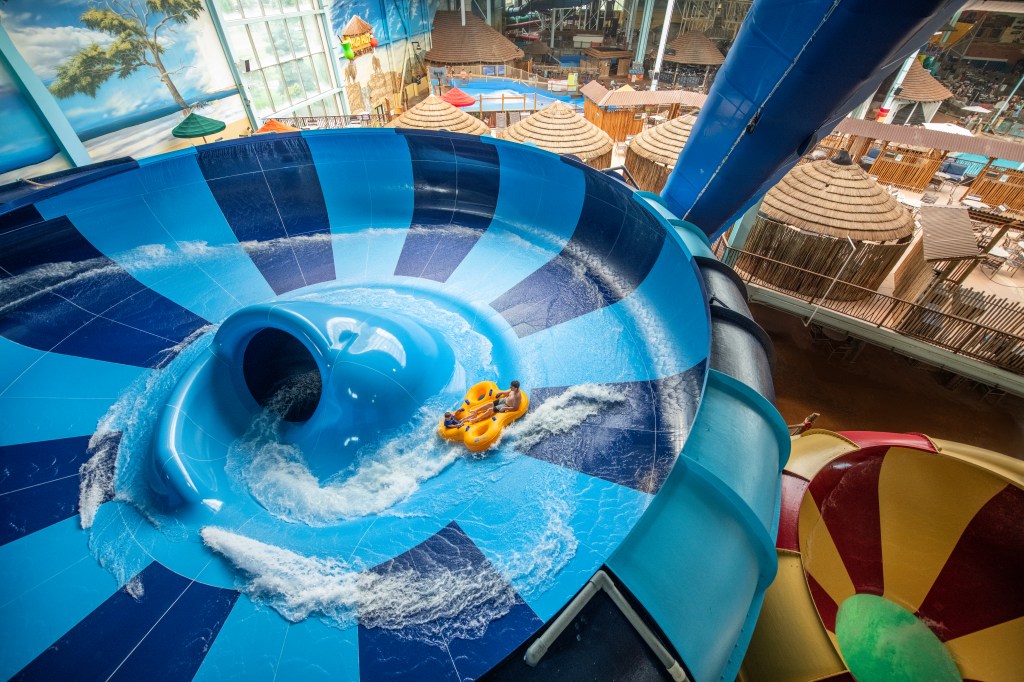
Courtesy of Kalahari Resorts & Convention.
By the early 2000s, the Dells’ television ads were almost exclusively focused on water parks and their on-site attractions, from go-karts to arcades. They even introduced a recurring character named “Tubie,” an anthropomorphized inner tube.[27] Sandwiched in the middle of these ads, if at all, is a second or less of the ancient riverfront. Another ad campaign bizarrely shows random people, from a middle-schooler to a housewife, devilishly aroused by a splash of water to their face, as memories of a waterpark visit rush over them. The voiceover slogan – “You’ll never look at water the same way again” –-arguably sums up the original promise of the Dells back in the 1850s, except now in an entirely different, almost placeless, context.[28]
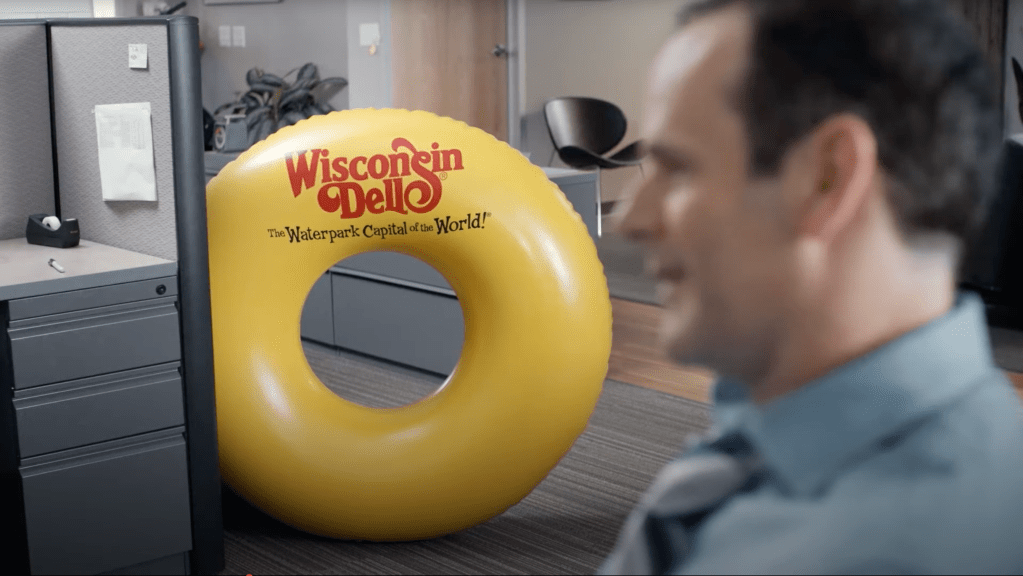
Courtesy of Boelter + Lincoln
Early signs of a return to ‘natural’ tourism
Water parks continue to thrive because they are a highly compelling product for families. These climate-controlled boxes offer a virtual wonderland for kids to explore, in a relatively safe space, with minimal concerns about sunscreen. Guests enjoy the all-inclusive splendor of a cruise ship experience with the convenience to come and leave by car on their own schedule. But with the changing climate and consumer tastes, there are also recently some emerging threats to this consumption model.
In addition to cultural gripes, Dells tourism faces critical environmental questions. Indoor waterparks consume massive amounts of energy, a figure that these privately held companies have been far less transparent in reporting, unlike their water usage. While the Dells has absorbed its massive water demands with relative ease thanks to the abundant freshwater nearby, the rise of extreme heat in the summer has increased the risk of drought, as seen in a historically dry stretch for much of the 2023 growing season.[29] Even though the Great Lakes region holds one of the world’s largest supplies of freshwater resources, it still faces likely water security challenges; water levels across all lakes have fallen below historic averages in recent years and are projected to decline further.[30]
At the same time, there are signs the city is re-prioritizing the environment. While major chains like the Kalahari, Great Wolf, and Wilderness maintain a strict “all under one roof” business model, their sites hardly mentioning a single external attraction, other resorts like Chula Vista promote the boat tours and dinner cruises to their guests, even if that “off-campus” activity hurts their bottom line. In 2022, the Dells tourism board gifted the city a new public place: Elm Street Plaza, in the heart of downtown, offering concessions, music, seating, and art works. Attendance for boat tours has remained steady enough to support multiple operators, and is further helped by creative iterations such as the popular Ghost Boat tours. In 2023, a new attraction, Land of Natura, billed as “America’s Largest Inflatable Waterpark,” opened by filling a manmade lake with slides and obstacle courses. One co-founder alluded to what he sees as “the trend in nature-based attractions and getting outdoors.”[31]
The longevity of this return to the land remains to be seen. It could be another passing fad, like Xanadu, or Storybook Gardens, or the Wonder Spot. For now, the waterpark model continues its imperial march. Kalahari will soon open a $76 million indoor waterpark addition in the Dells, its third expansion in as many years.[32] The company now has locations across five states, from Round Rock, TX to the Pocono Mountains. Even coastal towns are now susceptible, with Virginia Beach recently approving plans for a Pharrell-backed, $350 million oceanfront water park and entertainment complex.[33]
Is any natural getaway safe from the lure of the indoors? Can the human story written across these landscapes be one of sustainable coexistence? The Wisconsin Dells offers no definitive answers, only a mirror reflecting our evolving choices about what we value, consume, and preserve in the places we claim to love.
At the turn of the last century, Bennett the techno-optimist thought it was the arrival of a major dam that would ultimately doom the area. The project had popular support, as a local majority sought to modernize the economy. Bennett lamented those who saw the dam as a catalyst to “become a great manufacturing point. I have always felt that our future is in the Dells.”[34]
The dam did raise river levels, as he suspected, but that obscured only a couple dozen feet from view. Few factories moved in to leverage the water power. Ironically, it was the burgeoning tourism industry, already set in motion by Bennett’s iconic photographs, that would lure the masses away from the river–consuming the landscape that at first it seemed to celebrate.

Matt King is a journalist, critic, and editorial strategist exploring the intersection of business, technology, urbanism, and environmental ethics. His essays and reportage on topics ranging from zombie office towers and clean-up tech to wooden skyscrapers and space junk have appeared in The Atlantic, The New Republic, MIT Technology Review, and The Baffler, among other publications. Several pieces have been anthologized by Longreads, cited as “notables” in the Best American Essays series, and discussed widely in public radio, academic journals, and hacker forums. Born and raised in Illinois, he holds a Bachelor’s degree from NYU’s Stern School of Business and was an MFA nonfiction writing fellow at Emerson College. He currently lives in Baltimore.
Featured image (at top): Aerial view of a water park and surrounding accommodations in the Wisconsin Dells of Wisconsin, once a natural attraction formed by eroding sandstone cliffs along the Wisconsin River that grew into a family-oriented tourist attraction, Carol M. Highsmith, photographer, August 23, 2016, Prints and Photographs Division Library of Congress.
[1] Barbara Gonzalez, Mara Jezior, and Jasmine Sola, “The Shift: Water World,” Curb: UW School of Journalism, 2014.
[2] Rachel Vasquez, “How Did Wisconsin Dells Become ‘The Waterpark Capital of the World’?”, Wisconsin Public Radio, Jan. 19, 2022.
[3] Libby Rose Tronnes, “Corn Moon Migrations: Ho-Chunk Belonging, Removal, and Return in the Early Nineteenth-Century Western Great Lakes,” UW Philosophy Dissertation, 2017, pp. 38-39.
[4] Helmbrecht, Johannes and Lehmann, Christian, ed., Hocak Teaching Materials, Volume 1: Elements of Grammar/Learner’s Dictionary (SUNY Press, 2010), p. 160.
[5] Erickson, Dave, dir., Thunder in the Dells (Ootek Productions, 1992), 07:04.
[6] Sarah Rath, “A Shared Vision: Henry Hamilton Bennett and William H. Metcalf”, The Wisconsin Magazine of History, Vol. 98, No. 4 (SUMMER 2015), pp. 14-27.
[7] Rath, Ibid.
[8] Steven Hoelscher, “The Photographic Construction of Tourist Space in Victorian America,” Geographical Review, Vol. 88, No. 4, J. B. Jackson and Geography (Oct., 1998), pp. 548-570
[9] Jim Temmer, “A Compelling Vision: H. H. Bennett and the Wisconsin Dells,” The Wisconsin Magazine of History, Vol. 85, No. 4 (Summer, 2002), pp. 12-19.
[10] Rath, Ibid.
[11] Hoelscher, Ibid.
[12] Sarah Anne Stolte, “Performance, gestures and poses in postcards of Ho-Chunk in Wisconsin Dells,” Recasting Commodity and Spectacle in the Indigenous Americas, University of Chicago Press, 2014
[13] Mary Louise Pratt, Imperial Eyes: Travel Writing & Transculturation, Routledge, 1992.
[14] Steven Hoelscher, “Viewing Indians: Native Encounters with Power, Tourism, and the Camera in the Wisconsin Dells, 1866–1907,” American Indian Culture and Research Journal, 2003.
[15] Stolte, Ibid.
[16] Gerald Vizenor, ed., Survivance: Narratives of Native Presence, University of Nebraska Press, 2008.
[17] Stolte, Ibid.
[18] Hoelscher, “Viewing Indians”
[19] John Ohnstad ed., “”The Boats” are no longer the main attraction in Wisconsin Dells,” Facebook Group: Lake Delton/Wisconsin Dells Photo History, Mar. 30. 2024.
[20] Resort Areas in Wisconsin, John Fraser Hart, Geographical Review, Vol. 74, No. 2 (Apr., 1984), pp. 192-217 (26 pages)
[21] 1982 Dells TV ad, https://www.youtube.com/watch?v=xzoN9-eqhfA
[22] 1981 Dells TV ad, Museum of Classic Chicago TV, https://www.youtube.com/watch?v=XBm3N2933PA
[23] “Water World,” Curb, Ibid.
[24] “2022 Annual Report”, Wisconsin Dells Visitor & Convention Bureau.
[25] “2024 Wisconsin Dells: Economic Impact Summary,” Wisconsin Dells Visitor & Convention Bureau.
[26] Parija Kavilanz, “He started his first business at 20. Now he runs a $300 million water park empire,” CNN, Oct. 11, 2018
[27] “Webinar” ad, Boelter + Lincoln, https://www.youtube.com/watch?v=ybs4UpcgNMY
[28] “Bubbler-Splashback” TV ad, Boelter + Lincoln, https://www.youtube.com/watch?v=KIzSclWykWQ; Kitchen TV ad, Teri Schnaubelt, https://www.youtube.com/watch?v=zwwYm4FfFnI
[29] Breanna Bylak. “Echoes of 1988 drought resurface as Wisconsin’s dry spell persists,” Jul. 7, 2023.
[30] Stefan Gössling, C. Michael Hall, Daniel Scott, “Climate change, water, and Great Lakes tourism,” Tourism and Water, Channel View Publications, Ch. 5, Text Box 5.1
[31] John Gittings, “Dells tourism eclipses record $2 billion in economic impact in 2023,” WiscNews, Jun. 20, 2024
[32] Ashley Kaster, “Kalahari unveils $76M waterpark expansion in Wisconsin Dells,” Fox 11 News, Jan. 9, 2025
[33] Bruce Buckley, “Surf’s Up at Virginia Beach Water Park Development,” Engineering News-Record, Jan. 27, 2025
[34] Rath, “A Shared Vision,” Ibid.

