
Interviewed by Grace Gillies
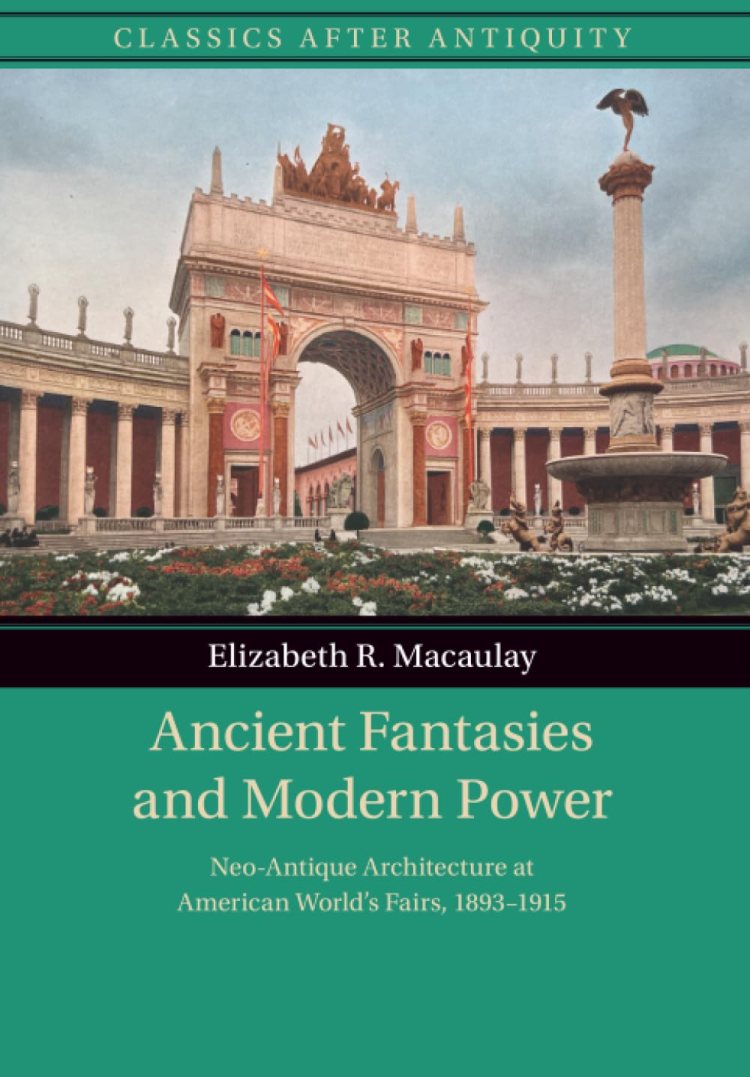
American world’s fairs at the turn of the twentieth century built visions of modernity and the future that were pointedly expressed through a language of the past. In Ancient Fantasies and Modern Power: Neo-Antique Architecture at American World’s Fairs 1893-1915, Elizabeth Macaulay unpacks the context and subtext of Greco-Roman and Egyptianizing art and architecture in these fairs. Through a comprehensive and interdisciplinary analysis of the neo-antique structures from five different fairs in this period, Macaulay shows how the legacy of these fairs continues to shape our understanding of both modern and ancient urban landscapes.
How did your research come to focus on these world’s fairs?
While preparing for a seminar on classicizing art and architecture in New York City, I learned that a Roman column from the ancient city of Jerash (in modern-day Jordan) stood in Queens. My mentor from graduate school, who knew everything there was to know about Nabataean and Roman Jordan, did not know about the column or why it was there, so I figured that I was on to something interesting. The Hashemite Kingdom of Jordan gave this column to the City of New York as a gift during its participation in the 1964-1965 World’s Fair. As a result, I got interested in World’s Fairs. Specifically, I was and am interested in how antiquity and modernity interacted at American World’s Fairs. World’s Fairs are truly one of the most important socio-economic, political and cultural phenomena; everything happened at them—from presidential assassinations (President William McKinley) to the origins of Disney World-and-Land rides (such as “It’s a Small World,” which started out as a tribute to UNICEF sponsored by Pepsi-Cola at the 1964 New York World’s Fair). Hundreds of millions of people visited the fairs in the United States and across the globe.
So I started to dig a little deeper into American World’s Fairs and how the architects and organizers looked to Greco-Roman and Egyptian structures for aspects of the architecture of the fairs. It was clear that ancient–or neo-antique–architecture was essential to creating the fantasy worlds that were central to several major American World’s Fairs in the late nineteenth and early twentieth century. That seemed so weird, so contradictory, that I had to know more.
This book prefers the term “neo-antique” to “neoclassical,” arguing that “neoclassical” is overly generalizing and privileges Greek and Roman references at the expense of other relevant cultures, such as Egypt and the Near East. Where could the term “neo-antique” be most effectively adopted, and what do you hope its impact will be?
I developed this term and framework with my colleague, Katharine von Stackelberg, when working on our edited volume, Housing the New Romans (OUP, 2017). We argued that the architecture of the ancient Mediterranean, North Africa, and West Asia was important to post-antique architecture in Europe and North America. Egyptomania and Egyptianizing architecture were critical, especially in nineteenth-century (and to a lesser extent, twentieth-century) Europe and the Americas. Think of the modern obelisks in Washington, D.C., and Buenos Aires. We were trying to highlight the complexities and messiness of the reception of ancient architecture and to de-center Greco-Roman architecture in this conversation. We wanted to challenge the siloed nature of academia. Egyptologists know the reception of ancient Egypt; scholars of Ancient West Asia know their material; classicists, the afterlife of Greece and Rome. What we saw–and what I still see–is that similar processes of reception (the reinterpretation of different aspects of antiquity) were happening, and so I wanted to examine those receptions together rather than apart. I would like the framework to help us think about connections and similarities. Also, it should encourage us to rethink what “neo-classical” means. Neo-classical is used as a catch-all for anything remotely classicizing, but it is often defined narrowly as being academic, staid architecture. In fact, the receptions of classical architecture can vary from its use for museum architecture (e.g., St. Louis Art Museum, Cleveland Museum of Art, Cincinnati Art Museum, the MFA in Boston, the Philadelphia Art Museum, the Metropolitan Museum of Art, and the National Gallery in Washington, D.C.) to the stripped-down classicism in the Puu Kapyla Housing, workers’ homes in Finland, or the Stockholm Public Library (1920–28) by Gunnar Asplund.
I think the framework of the neo-antique could be used in other parts of the world too: Which periods of antiquity are favored in China, Korea, Vietnam, Cambodia, or Japan—and why?
I was struck by how deliberately the classical style was chosen for the Chicago fair in 1893, and how, even after the success of that fair made neo-antique architecture a popular choice, it was not universally adopted, and remained at odds with contemporary architectural trends. What do you hope readers will come away understanding about the choice to employ neo-antique style in this period?
I think that the selection of neo-antique, especially classical forms, for civic centers (like in San Francisco, Columbus, and New York City) reflects the close association of these forms with civic virtues. Many courthouses and buildings associated with justice were built in the style of a classical (Greek or Roman) temple, including the U.S. Supreme Court. There was a desire to have cities be “beautiful;” urbanization of cities in the United States was rapid, and cities were often dirty, unhealthy, and unpleasant. Classical forms could represent the dream of what a city could look like and be like. The choice of neo-antique architecture was often also symbolic. These forms were also used for museums. The idea that design could improve the lives of city dwellers—well at least in their public and quasi-public spaces—was very present here. Greco-Roman forms signified high culture and sophistication, which is what many members of the United States elite were striving for. Many of America’s elites were attempting to compete with Europe culturally and so replicating historical architectural forms and out-doing (or doing them better) than they could be done in Europe was a goal of such architecture. This is why skyscrapers were sometimes built in historical styles, at least initially.
The book explores neo-antique spaces as hyperreal, drawing on theory from Jean Baudrillard and Umberto Eco. These hyperreal spaces, as you discuss, invoked the ancient world but deliberately did not recreate it exactly; the effect is beyond realism, a “neo-antique dreamland.” The book also reflects on the fact that these spaces remain a prominent lens for the ancient world in the United States. What do you see as the impact of these spaces on Americans’ understanding of ancient urban spaces, and what role should these spaces play in teaching ancient cityscapes?
I think that we can see the Court of Honor at Chicago’s influence in public spaces or civic centers in the United States. Such spaces are a great way into teaching about ancient urbanism and architecture, especially for students who have not traveled abroad or who have not studied antiquity. So if you start by reading about these fairs and then going out into your city or town, you can find the influences of the fair and, especially, of Greco-Roman antiquity. I have always led walking tours with my students, especially when I have taught about the neo-antique buildings of New York City. Standing at the intersection of Wall Street and Broad Streets (where there are four neo-antique buildings) helps you understand both ancient and modern city design. The organized approach to space in the fairs and the grids of certain cities in the United States and Latin America is a great way into studying the influence of the ancient grid and the planning that went into ancient cities.
Your work seems to be in conversation with a growing body of scholarship that looks critically at the field of classical reception studies, including work by Shane Butler, Grant Parker, and the Postclassicisms Collective. It is also aligned with Marthura Umachandran and Marchella Ward’s recent reconceptualization of classical studies as “critical ancient studies.” What do you hope for the future of “critical ancient reception studies”?
Scholars are investigating the diverse people that populated antiquity through new archaeological and textual evidence (new papyri are being translated, as museum collections are being studied in depth and excavation continues). They are asking different questions of evidence. We must acknowledge that past scholars wrote certain types of histories (the stories of the great men of history), and we as scholars of the twenty-first century must seek to change that. We can and should do comparative work, like anthropologists have long done. There is a lot that scholars still need to do, but by embracing the change and new possibilities, the discipline can change and evolve and thus not only survive the huge disruption that universities are experiencing, but we can find a way for the study of antiquity to thrive.
In these fairs, it seems neo-antique architecture was often deployed in the service of racist narratives, including white fantasies of supremacy, the “Lost Cause” narrative of the South, justifications for western expansion, and exoticizing, alienating representations of Egypt. How do you hope readers will contextualize these fairs in the history of racist co-option of the classical past?
At American World’s Fairs, certain classicizing buildings and sculpture symbolized western expansion and the lost cause narrative in extremely problematic ways. Triumphal arches appear at many of these fairs and celebrate the manifest destiny of the United States. However, what is fascinating to me is that at the same fairs the classical styles were also often used by marginalized groups. So in Chicago, the Woman’s Building used classical forms as did the Haitian Pavilion. At the opening of the Haitian Pavilion, Frederick Douglass delivered a speech which praised the building for its architectural style. Here the classical style symbolized Haiti’s cultural sophistication and democratic tradition.
The Nashville Parthenon did not explicitly promote the Lost Cause narrative, (unlike the fair’s classicizing History Building, which did), but it was the most important building in a fair that honored and celebrated Confederate veterans (The Tennessee Centennial Exposition of 1897). During and after the fair, the Parthenon became associated with Nashville’s reputation as the Athens of the South or West because it was a seat of learning. It has transcended some of the racist rhetoric of the 1897 fair. The new Athena statue now in the Nashville Parthenon was funded by the donations box. The sculptor Alain LeQuire who sculpted the Athena and other artists and artisans worked on the sculpture free of charge. LeQuire saw his statue as a symbol of democracy; it was finished in 1989 just as the pro-democracy demonstrations were crushed in Tiananmen Square.
Also the buildings were not all white, nor did they aim to promote White Supremacy through their color. San Francisco has a lot of color in its buildings, because Jules Guérin worked to coordinate color with the natural colors and beauty of San Francisco. The Parthenon also used color. The choice of white sometimes happened simply because the buildings needed to go up quickly and it was cheaper.
Egypt occupied a complicated place. Ancient Egypt could be viewed positively, as a place of ancient technology and longevity, but it also sat on fault lines. The Luxor Temple at Chicago was designed to educate and entertain. It was also a hyperreal space par excellence; it was designed so that one could visit and never actually need to go to see the ruins of ancient Egypt. The Shelby County Pyramid at Nashville celebrated the new Memphis and its county but the author of one of the tracts about it denied that ancient Egyptians could have actually built the great Pyramid at Giza. Eventually, though, Egyptian architecture is only included as a gateway to a “Cairo Street” which was designed to evoke orientalist fantasies as at the fairs in Omaha and Buffalo.
I think that these buildings remind us that the past and ancient architectural forms can be used and abused, used for both good and bad purposes. So understanding the past and its architecture helps us to work against abuses of the past.
The introduction calls attention to an executive order from President Trump first issued in 2020 (3), which declared that “classical architecture shall be the preferred and default architecture for Federal public buildings.” In 2025, it was reissued under the title “Make Federal Architecture Beautiful Again.” How can this book help us interpret the ongoing use of neo-antique architecture in political discourse?
I want people to think about how complex this architecture is. It is often seen as a simple stage set, but it is so much more. I can’t think of the Make Federal Buildings Beautiful executive order without thinking of January 6, 2021, and the storming of the Capitol building. The Capitol Building is a symbol of our flawed democracy, but a symbol of that democracy. To me, it shows that these traditions are intertwined. Classical buildings can symbolize both what is good in the United States and what is not.
The executive order implies that American architects cannot do anything original or creative. American architects have designed and built extraordinary buildings in historic styles, be it Neo-antique or Gothic, but these buildings are from our past—not our present or future. They are essential to the development of U.S. architecture but they are now part of its history. Kimberly Cassibry and I have written about the proposed triumphal arch. It lacks originality in its design; basically, it is a taller knockoff of the Arc de Triomphe. President Trump seems to think the past is the only way to build a future for the United States. We need to look for new forms for our buildings and new ideas for our future.
Elizabeth R. Macaulay is Professor of Liberal Studies at the CUNY Graduate Center. Her research examines the intersection of antiquity and modernity.
Grace Gillies is an Adjunct Lecturer, CUNY Queens College. Grace’s research focuses on the culture of the city in urban literature, as well as Roman representations of gender and sexuality.

