

Reviewed by Robert Dubovy
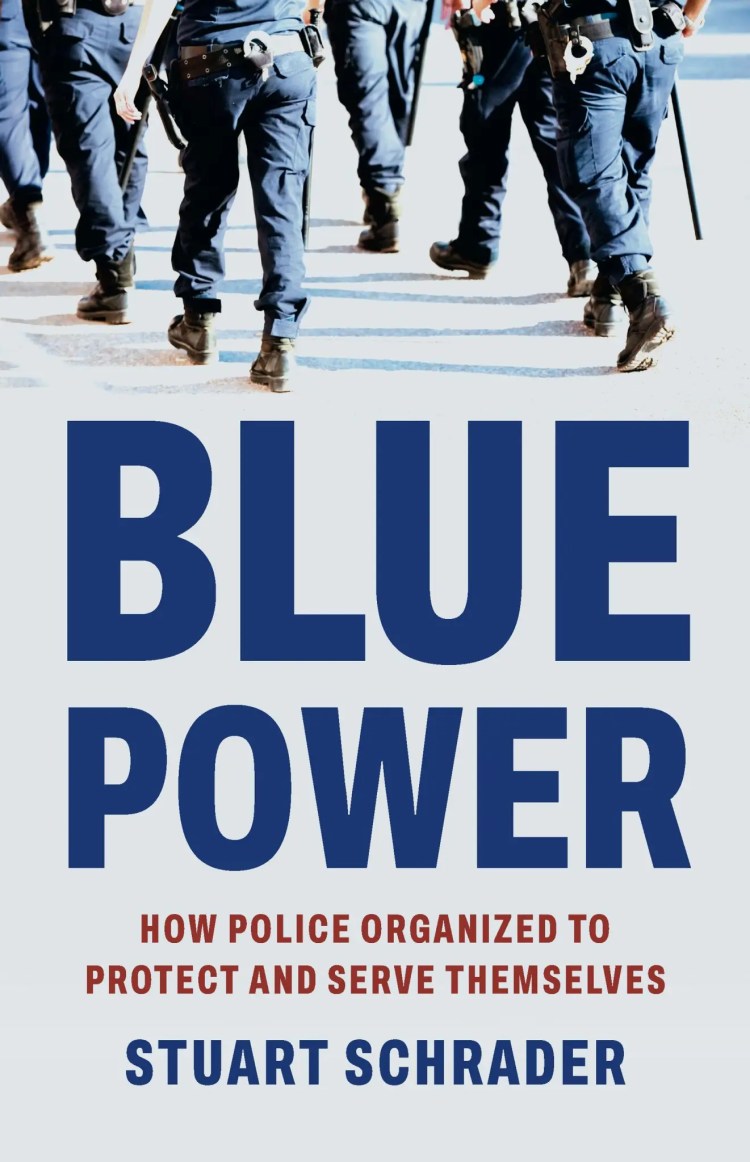
In 2010, Heather Ann Thompson wrote that American cities suffered “deep racial and political conflicts” and “experienced tremendous distress from substantial economic disinvestment” after WWII. She challenged researchers to explain how the expansion of the carceral state and the rise of mass incarceration played a role.1 Stuart Schrader’s new book Blue Power: How Police Organized to Protect and Serve Themselves answers that call. Schrader focuses on the backlash from rank-and-file police officers against the professionalization movement led by police administrators attempting to elevate the status of the police by instilling military-style discipline in their departments. Police administrators organized and unified those efforts through their union, the International Association of the Chiefs of Police (IACP). Resentful of restrictions on their discretion and autonomy, rank-and-file police began to use their own police unions to reject attempts at reform and oversight from their leadership or elected officials. The astonishing political success of rank-and-file bargaining and lobbying efforts won generous wages and benefit packages, and shaped public discourse around crime control to inflate the status of the police at the expense of the most marginalized. Schrader shows that rank-and-file police unions shaped the urban crisis by diverting enormous economic and political capital to municipal police departments amid increased budgetary austerity from the 1970s forward.
Schrader shows that rank-and-file collective action originated as cities ended the spoils system associated with machine politics. As police autonomy increased, police command attempted to establish sole control over hiring, promotion, and discipline of patrol officers. In response, rank-and-file officers looked to establish their own unions. The American Federation of Labor and the Teamsters attempted to organize the rank and file in Detroit in 1941 with organization drives and legal action.2 These efforts failed as courts deemed police departments too essential for collective bargaining rights and administrators lobbied for full control of their departments. For the next twenty years, patrol officers organized work slowdowns and mass callouts to pressure cities to recognize their right to bargain collectively.
Cities held firm until the urban rebellions of the mid-1960s put more pressure on them to ensure public safety. Detroit police finally won collective bargaining rights through the Detroit Police Officers Association after using the Detroit Rebellion of 1967 as leverage, a conflagration they themselves caused through rampant racial profiling, harassment, and violence. Cities like Baltimore, Los Angeles, and New York followed similar patterns. Schrader calls this approach “collective bargaining by riot” and argues that it “strained and fissured the laboring classes” rather than engendering solidarity.3 Gains won for police wages and pensions put increased strain on municipal budgets already constrained by austerity measures necessitated by shrinking tax revenue. Municipal and state spending on law enforcement almost doubled from 1969 to 1973 as the federal government promised to cover 20% of expenditures through the Law Enforcement Assistance Administration. However, LEAA only covered 4% of expenditures due to a focus on innovation initiatives rather than manpower expansion or increases in wages or pensions. To cover the shortfall, “cities cut back on other services” which “was itself criminogenic.” In response to the resulting increase in crime, city leaders felt “pressure to invest in public safety…causing a spiral of increasing costs in some cities or a binge and purge of police hiring and firing” in others.4 This pattern illustrates that gains won by police unions played an outsized role in the urban crisis during the late 1970s.
By the 1990s, Schrader argues that “Blue Power” had coalesced as a powerful national political force. Local, rank-and-file unions unified under the banner of organizations such as the National Association of Police Organizations to lobby lawmakers on Capitol Hill to divert more money and power to police departments around the country. Even the IACP had adopted the “tactics of the rank-and-file insurgency” and used them to “make elected officials accountable to police, rather than the other way around.”5 The 1994 Crime Bill represented the apotheosis of those efforts. The bill provided funding to hire 100,000 more police officers. More importantly, it showed that support for police funding acted as a shibboleth for legislators to prove they were tough on crime and had left the permissive liberalism of the ‘60s behind. The chief author of the bill, then-Senator Joe Biden, bragged that he “called the cops” and asked them what they needed when crafting the bill. Police lobbying efforts convinced NRA-backed Republicans to support the assault weapons ban that accompanied the bill rather than block police funding. A majority of the Congressional Black Caucus ended up supporting the bill as well, recognizing that badly needed funding for their districts could only come “packaged as crime prevention.”6 Police interests now trumped most other concerns from city hall to Capitol Hill and engendered bipartisan support.
Schrader’s focus on the police as a political force clarifies the rise of authoritarianism in the United States and the political transformation it has wrought. Police political activity has done more than win increased economic benefits for the rank-and-file. It has also naturalized the police viewpoint to the exclusion of overpoliced and under-protected communities and activists who envision community supports that exist outside of the carceral state.7 Increasingly, the police shape how elected officials and the public view the problems that plague their communities and position themselves as the only solution. Support for police departments increases apace.8 Schrader’s work here is an impressive examination of how police unions won that support.
Robert Dubovy is a Ph.D. student at the University of Connecticut. He is currently researching police training and the elevation of police expertise in the mid-20th century.
- Heather Ann Thompson, “Why Mass Incarceration Matters: Rethinking Crisis, Decline, and Transformation in Postwar American History,” The Journal of American History, December 2010, Vol. 97, No. 3 (December 2010), 703-734, 706 ↩︎
- Stuart Schrader, Blue Power: How Police Organized to Protect and Serve Themselves (New York: Basic Books, 2026), 5 ↩︎
- Schrader, 61. ↩︎
- Schrader, 95. ↩︎
- Schrader, 283-4. ↩︎
- Schrader, 286-8. ↩︎
- Schrader, 318 ↩︎
- Gallup reports that in 2024 support for law enforcement increased to 51% from their lowest point of 43% in 2022 as public backlash against police involved shootings became less prevalent. In the same poll, support for other institutions sat at 28%: https://news.gallup.com/poll/647303/confidence-institutions-mostly-flat-police.aspx Also, the Center on Juvenile & Criminal Justice shows that law enforcement funding and staffing has increased steadily since 1990 despite a decrease in measured law enforcement effectiveness: https://www.cjcj.org/reports-publications/report/more-law-enforcement-spending-accompanies-worse-not-improved-crime-solving ↩︎
 The Metropole