

Interviewed by Ryan Reft
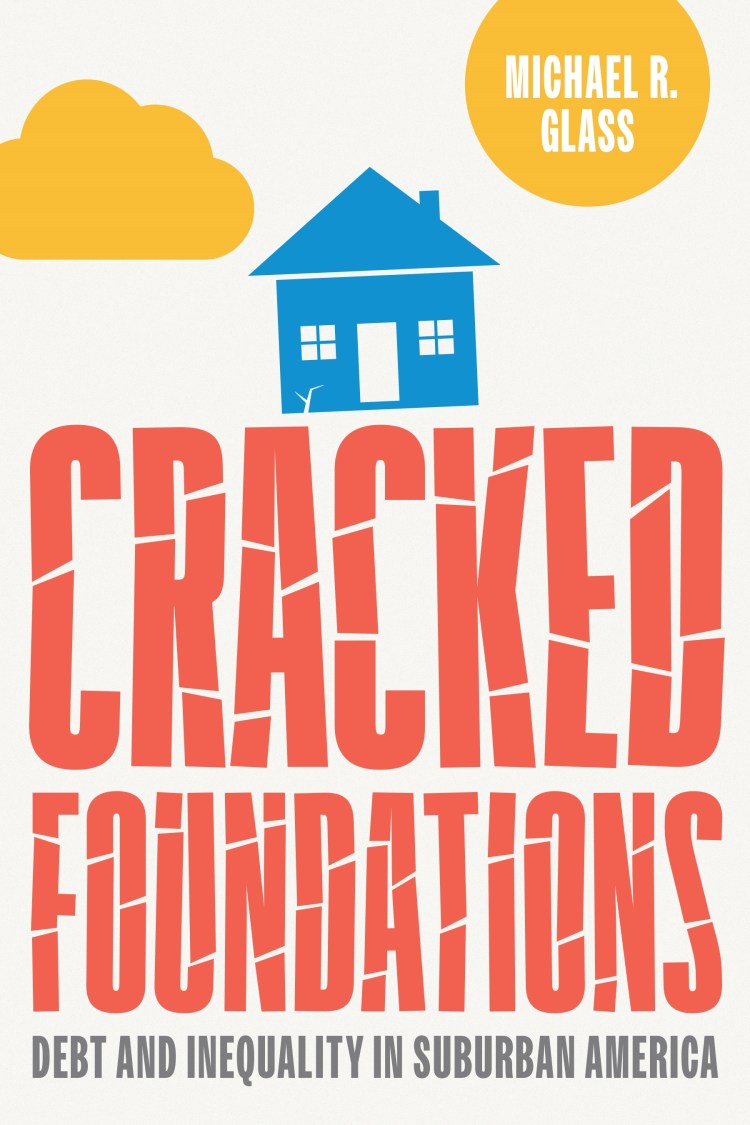
In Cracked Foundations: Debt and Inequality in Suburban America, Michael Glass explores the growth of Long Island’s suburbs as a proxy for the nation. In particular, Glass reveals the role that debt and debt financing played in constructing a suburban landscape that by the 1950s and 60s had become mired in complicated and costly economic structures that contributed to great inequality in housing and education for residents. Even when state reforms, such as New York’s “equalization” efforts, attempted to solve or mitigate these issues, they often, Glass notes, “reinforced rather than mitigated local wealth disparities.” (11) Historian Ryan Reft sat down with Glass to explore the book’s themes.
Your work seems to be in dialogue with recent books by Destin Jenkins, Andrew Kahrl, and Keeanga-Yamahtta Taylor, a body of literature that looks at the impact of debt, debt financing, and taxation policies at the intersection of race and housing. What does Cracked Foundations and the work by this cohort tell us that’s new about American homeownership and suburbanization?
You’re absolutely right that these scholars are major influences on my work, and I appreciate you noticing those connections!
Taken together, Taylor (on home mortgages), Jenkins (municipal debt), and Kahrl (property taxes) have shown how race fundamentally structured these financial systems. Segregation has persisted not only because of exclusionary policies like redlining, but also because of how these systems generate value and distribute resources. In other words, these authors have followed the money.
My big contribution is to apply these same insights to the suburbs. Urban historians are familiar with the long and sordid history of racial exclusion in the suburbs. However, we’ve often elided the differences between neighboring suburbs. I show how mortgages, bonds, and property taxes produced race and class inequality across Long Island. In many ways, the strains were even more intense in the suburbs. The small size of these municipalities made them more beholden to financial systems. Realtors and developers dominate suburban politics to a greater degree than in cities, and Levittown wields far less power in the bond market than a city like New York.
My book shows that delivering housing and education through debt financing made suburban life unsteady and precarious from the very beginning.
Why did Long Island become the subject of your book?
Before going to graduate school, I worked for many years as a public high school teacher in New York City. That experience sparked an interest in educational inequality, and my research initially focused on New York City.
But then two things happened. First, on the 60th anniversary of the 1954 decision in Brown v. Board of Education, studies noted increasing segregation in suburban regions, with metropolitan New York having some of the highest rates nationwide. Second, following the murder of Michael Brown protests erupted in Ferguson, a small suburban community outside St. Louis. I was struck by how many of the initial news reports described Ferguson as “urban” and “inner city,” completely eliding how the suburban setting intensified the predatory policing there.
These developments pulled me toward the suburbs. I eventually settled on Long Island because, despite its iconic status in American history, it was relatively understudied at the time. That’s no longer true, thanks to excellent new books by Tim Keogh and Stephen Koeth.
Lastly, having grown up in Colorado Springs, Colorado, I’m a child of the suburbs myself. One of my colleagues jokingly refers to my work as “suburban noir,” which is probably spot-on. My teenage angst coming full circle!
Though historians such as Kathleen J. Frydl have explored the G.I. Bill and its impact on race, homeownership, and education, you explore how it and the FHA ultimately set up a system of suburbanization dependent less on quality and more on corporatization. “The FHA and VA were corporate backstops not social welfare agencies.” (40) The G.I. Bill and VA home loans are often lauded for enabling people to become homeowners who could not have before, but in Cracked Foundations you deconstruct this idea, arguing that what it really did was establish a system that increasingly transformed the home into a commodity or asset. What were the repercussions of this development and what should readers take away from this history that might be applicable to today?
In this opening chapter, the focus is on a contentious set of hearings before the House of Representatives in 1952. Across the country, veterans shared horror stories about their newly purchased homes – leaky roofs, swampy yards, and cracked foundations (hence my book’s title).
Reading this testimony, it became clear that many witnesses had fundamentally misunderstood the role of federal agencies such as the Federal Housing Administration (FHA) and Veterans Administration (VA). In addition to the financial support for mortgages, the homebuyers also believed that “FHA-insured” and “VA guaranteed” promised quality construction – in large part because homebuilders emblazoned those tags on their advertisements. But lawmakers dismissed the complaints, reminding the witnesses that the insurance was for the mortgages, not the houses. When unexpected repair costs arose, they were on their own.
This episode shows that we need to revise the narrative of postwar housing policy. To be sure, FHA and VA support allowed white heterosexual families to buy brand-new houses for no money down, something unimaginable today. Nonetheless, those agencies did not guarantee well-built or stable housing. Especially as the rest of the social welfare state withered over subsequent decades, Americans increasingly relied on housing asset appreciation for their economic security. The only way to fully realize that accrued equity is by selling the house. In fact, during the 1950s the average stay in Levittown was just five years. People were constantly selling and moving.
These postwar suburbs were not the havens portrayed in Leave It To Beaver. They were hastily built communities of what we would now call “starter homes.”
One of the many intriguing arguments made in the book has to do with the intersection of housing and education. The postwar housing boom led to a great deal of debt financing particularly in regard to school bonds. However, it seems as if local officials and residents assumed that the low interest rates of the 1950s would persist forever and when they didn’t, financial and educational chaos ensued. What does this tell us about not only the housing market but also the nation’s education system?
The postwar era was a period of all-time low interest rates. New suburbs relied on municipal bonds to finance all the infrastructure of modern life: streetlights, sewers, parks, libraries, and most of all public schools for the baby boom children. The repayment costs led to soaring property taxes and mounting resentment, but during the 1950s communities still paid between 2 and 4 percent on their bonds. Crucially, this was also the era of federal redlining – a brief “golden age” of cheap credit for the white heterosexual families who had access to it.
By the 1960s and 1970s, the civil rights movement began opening more suburbs to people of color. Yet by that time, the bond market was collapsing. Communities that borrowed in this later period could expect to pay between 6 and 8 percent, if not more. Because suburban schools depend so heavily on municipal bond markets, these shifts in interest rates had enormous consequences for educational inequality.
The end of the book focuses on Roosevelt, a Long Island district that transitioned to being majority-Black during the 1960s. When the school district borrowed to renovate its aging schools, it paid three times the interest rate that an all-white district would have paid two decades earlier. In many ways they were simply victims of bad timing.
I think this shows that postwar suburbanization not only created inequality across space, but also inequality across time. It mattered when a homeowner or government borrowed. We’ve recently experienced this dynamic with the brief window of rock-bottom mortgage interest rates during the pandemic. Compared to today, it was a different world buying a house in 2020.
According to your work, desegregation efforts in Long Island largely failed. You write, “While sorting through these vexing policy choices, local and state officials systematically privileged white comfort and shunted burdens onto Black students, parents, and communities. In this way, they ended up reproducing white supremacy within racially balanced schools. The color lines faded, but inequality persisted.” (149) How did this play out in Long Island and to what extent can what happened there be said to have happened nationally?
“Failed” might be too strong, because school desegregation represented an incredible grassroots mobilization. For instance, on the opening day of school in 1963, local civil rights organizations staged a simultaneous boycott of segregated elementary schools across Long Island. Black parents kept their children home and marched them to the front steps of all-white elementary schools, demanding entry. These direct-action protests, coupled with lawsuits filed by the NAACP, led to desegregation orders that established important legal precedents.
At the same time, desegregation in New York was quite limited and flawed. From the outset, state and federal officials limited their focus to only those districts with mixed-race enrollments. Desegregation therefore never touched all-white districts like Levittown, and officials abandoned efforts in districts like Roosevelt that transitioned to majority-Black enrollments. Moreover, they defined integration as achieving “racial balance,” or racially proportionate enrollments. Even in places that won sweeping court orders, the implementation usually entailed closing schools in Black neighborhoods and transferring the students to previously all-white schools. The enrollments became “balanced,” yet while trampling on a basic sense of fairness.
Many Black parents became disillusioned with how desegregation played out. At the national level, these same complaints from Black communities led Derrick Bell, then working for the NAACP Legal Defense Fund, to begin developing the ideas that would become “critical race theory.” The basic insight I take from critical race theory – the actual critical race theory, not the “wokeness” caricature – is that racism can persist in ostensibly race-neutral structures.
One of the biggest issues for Americans today is the issue of informal housing. Your research uncovers how homeowners often added units illegally to supplement their income and meet housing costs. The resulting increase in this form of housing had impacts on renters, homeowners, and schools. How do you explain this dynamic and what conclusions should readers draw from it?
Yes, this was a major surprise during my research. While scanning through microfilm reels of local newspapers, I kept coming across exposés of “illegal apartments,” that is, single-family homes illegally converted for multifamily occupancy. This took many forms: owners might rent out the basement, convert the garage into a dwelling, or wall off the attic as a separate apartment. Urban planners conducted comprehensive studies, and they estimated that by the 1970s between 10 and 20 percent of the single-family homes had been subdivided. A truly astounding statistic!
In addition to being exclusionary and costly, the postwar suburban development model was completely unsustainable. Today the housing stock in Nassau County consists almost entirely of single-family dwellings. But people in the suburbs also needed cheap rentals, especially low-income families, young singles, divorced couples, retirees, and undocumented immigrants. Because zoning prohibited multifamily housing in most places, homeowners and landlords met these needs by converting single-family homes into apartments.
The apartments were hidden, but certainly not a secret. Local officials absolutely knew the subdivisions were happening, and they let it continue because the informal apartments were meeting important housing needs. What I take from scholars of informal housing in the Global South – folks like Ananya Roy and Raquel Rolnick – is that turning a blind eye is itself a policy choice. It’s a way for government officials to manage housing needs in a context of scarcity.
My basic argument is that informal apartments became the tacit solution to the affordable housing crisis. It helped resolve contradictions: local officials could simultaneously declare their opposition to new apartment construction while continuing to quietly tolerate informal units.
What are some possible remedies for the issues you discuss in Cracked Foundations?
Big picture, we need to rethink how we finance and deliver housing and education. These essential public goods need a stabler foundation than depending on the whims of private capital markets. The solution is definitely not fifty-year mortgages, as recently proposed by President Trump; that would double-down on the same flawed approaches documented in my book.
In terms of schools, we desperately need alternatives to the bond market. I know that sounds pie-in-the-sky, but these arrangements are not inevitable. Legal scholars Robert Hockett and Saule Omarova have proposed a “National Investment Authority” to provide low-cost loans for public infrastructure. I’ve written elsewhere about the historical precedent of using teachers’ pensions to finance school construction. David Baker recently published an entire book full of innovative proposals. Whatever the approach, the goal should be developing creative funding sources.
For housing, I think the solution goes way beyond financing. Most importantly, I think we need to decenter homeownership as a universal aspiration. For over a century, the assumption has been that every American has an inborn desire to become a homeowner. In fact, my book shows that many postwar Americans jumped into homeownership for lack of better housing options. Recently I’ve been excited by the growing tenants’ movement. Reforms like rent control and good-cause eviction would go a long way toward strengthening housing security for everyone.
Michael Glass is an Assistant Professor of History at Boston College. You can find him on Bluesky @m-r-glass.bsky.social.
Ryan Reft (@ryanreft.bsky.social) is the former senior editor of the Metropole and a historian in the Manuscript Division at the Library of Congress.
 The Metropole