

By Dan Holland
Pittsburgh’s mid-twentieth century renaissance is often hailed as a transformational makeover for a city desperately trying to escape its smoky past. Male leaders such as Pittsburgh Mayor David Lawrence (1889-1966), who would become Pennsylvania’s 37th governor, Richard King Mellon (1899-1970), the Mellon Bank financier, and Edgar Kaufmann (1885-1955), who directed Kaufmann’s Department Store in Downtown Pittsburgh, are chiefly remembered for their urban renewal efforts in Pittsburgh. When it comes to the fight for civil rights, high profile men like Martin Luther King, Jr. (1929-1968), and Pittsburgh’s own K. Leroy Irvis (1919-2006), the first Black speaker of the Pennsylvania House of Representatives, and Paul F. Jones (1909-1960), the first African American to serve on Pittsburgh City Council, are often given credit.
But Pittsburgh is fortunate to have many women of color who broke barriers and made tremendous differences in the lives of all city residents during this same period. Their contributions advanced civil rights and promoted community-based development from the 1950s through the 1970s and beyond. While not all of them are household names—only one of the people mentioned here is recognized with a Pennsylvania Historical and Museum Commission (PHMC) historical marker—their contributions warrant closer inspection. As we celebrate Women’s History Month, it is worth recognizing Pittsburgh’s own “agitators”: Dorothy Mae Richardson, Ethel Hagler, Frankie Mae Pace, and Betty Jane Ralph.1
In Pittsburgh in the 1960s, Frankie Mae Pace led the opposition against further demolition of the Middle Hill District. Dorothy Richardson and Ethel Hagler, humble, virtuous church-going ladies of the city’s North Side, led protests for affordable housing and ultimately conceived of Neighborhood Housing Services, which became a national model. Manchester’s Betty Jane Ralph was a potent voice who helped the neighborhood forge its own identity as an attractive Black neighborhood.2 These women illustrate citizen resistance and neighborhood control of an ethical, principled agenda which ultimately prevailed in community development. They also show the humble beginnings of movements and programs that became national models.
Dorothy Mae Richardson (1922-1991)

Perhaps the most well known of the four, Richardson was a North Side neighborhood activist who established a grassroots organization that would become a national model for neighborhood investment. Born in Pittsburgh’s Manchester neighborhood, Richardson moved to Charles Street, in the city’s Perry South neighborhood, in 1938. She became an influential North Side fixture as a member of the Mt. Carmel Baptist Church and the Pleasant Valley Community Council. 3
Richardson’s religious background and deep roots in the community gave her moral weight in leading protests against powerful individuals. In 1965, Richardson formed Citizens Against Slum Housing (CASH) and led a demonstration at a housing conference on Pittsburgh’s North Side, in which David Lawrence delivered the keynote address.4 As later recounted by John T. Metzger, “The group used the demonstration to focus attention on the poor quality of privately-owned rental housing in low-income neighborhoods and on the inadequate relocation procedures of the Urban Redevelopment Authority.”5
In 1967, another protest in which CASH participated focused on a North Side slum property owned by Edward Talenfeld of Squirrel Hill. Employing Saul Alinsky-style tactics, Richardson and others picked up the trash in front of Talenfeld’s slum property, drove it to his Squirrel Hill home, and picketed out front. They then drove to Talenfeld’s Downtown office and dumped the trash there.6 It sent a clear message: we will not tolerate neglect of our community.7 In 1968, Richardson helped establish another organization, Neighborhood Housing Services (NHS), which became a national model.
Ethel Hagler (1908-2006)
Richardson had help from her friend, fellow North Side resident Ethel Hagler. A native of Dante, Virginia, Hagler came to Pittsburgh in 1931 with her husband, William Spencer Hagler. She was heavily involved with Brown Chapel African Methodist Episcopal Church, the Garden Club of Allegheny County, and helped found the Central Northside Neighborhood Council. NHS started in a portable trailer at the corner of Arch and Jacksonia streets in the Mexican War Streets.8 The program soon spread to other cities.
By any measure, the rapid replication of the NHS model is remarkable. In 1970, the Federal Home Loan Bank copied the NHS program in other communities, and by 1975, NHS was in 45 cities across the country. In 1978, Congress established the Neighborhood Reinvestment Corporation to nationalize the NHS model (it became NeighborWorks in 2005). By 1980, NHS could be found in more than 100 communities across the country.9 In sum, Pittsburgh’s experiments with citizen input and support for self-determination initiatives in the 1950s through the 1970s became a model for the rest of the nation, a pattern that repeated itself in subsequent decades.
Frankie Mae Pace (1905-1989)
Neighborhoods which directly experienced displacement, or the threat of displacement, such as the Hill District and Manchester, became Black Pittsburgh’s centers of resistance against the upheaval. The Hill’s Frankie Mae Pace not only became a strong voice against such development, she influenced the federal Model Cities Program that attempted to coordinate physical renewal along with social programs.10

A native of Clinton, Louisiana, Pace came to Pittsburgh in 1936 as part of the Second Great Migration. Pace built upon the rich organizing traditions of earlier Black female pioneers such as Daisy Lampkin (1883-1965), who is recognized with a PHMC marker in the Hill.11 Although she resided in the Hill, Pace was active in the Rodman Street Baptist Church in East Liberty. According to her obituary from 1989, she “worked to improve housing conditions and government programs for the city’s poor for more than 50 years.”12 Mayor David Lawrence appointed Pace to a special committee to fight poverty in 1954. She later led Pittsburgh’s efforts in the War on Poverty in the 1960s and helped develop the Model Cities Program in 1965.13

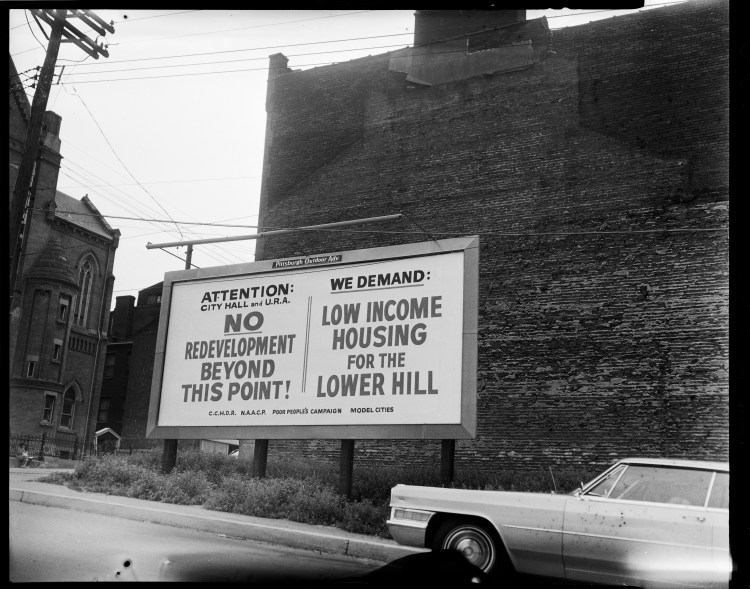
Dismayed with the negative effects of urban renewal upon the Black community in 1969, Pace and two other African American leaders in the Hill, Jim McCoy and Byrd Brown, erected a large billboard at the corner of Crawford and Wylie that read, “No Redevelopment Beyond this Point! We Demand Low Income Housing for the Lower Hill,” a symbolic rebellion of popular support against further redevelopment plans by the City in the Middle Hill.14 Their act of resistance was part of a nationwide grassroots movement to reclaim neighborhoods for residents, rather than outsiders’ visions of a community driven by elites. In an interview before her death in 1989, Pace stated, “‘I already knew even by the time I came here if you wanted something done in your neighborhood you had to find out who to see to get it done, then go there and speak up.’”15
Betty Jane Ralph (birth year unknown-2010)
Betty Jane Ralph served as Board Chair of the Manchester Citizens Corporation from 1970 to 1993 and engineered Manchester’s neighborhood revitalization. But her success came after many failures. In 1947, the Allegheny Conference on Community Development threatened to demolish much of Manchester’s Victorian houses to construct a utopian housing plan of block-style high-rises, similar to the fate experienced in the Hill District. In the 1960s, as white flight from the neighborhood accelerated, the Urban Redevelopment Authority of Pittsburgh (URA) initiated a massive road project, State Route 65, that ripped out Manchester’s Beaver Avenue commercial district and divided the neighborhood in two.
Faced with these imminent threats, Ralph organized residents who not only stopped the demolition of the neighborhood’s core, but also crafted their own ideas for how the community should look and function. She helped form one of the first community development corporations in the city, the United Manchester Redevelopment Committee, in 1962. Later renamed the Manchester Citizens Corporation (MCC), it helped the neighborhood forge an identity as an attractive Black neighborhood.
A Manchester resident since 1933, she was the beloved wife of Arthur J. Ralph for 64 years. According to one article about the Ralphs, Arthur met Betty Jane when he was 17 years old. “He served three years in the army and the first thing he did when he was honorably discharged was to marry his young sweetheart. A year later, their first daughter was born and today they are the proud parents of seven girls and numerous grandchildren.” They became the face of Manchester.
Between 1968 and 1972, MCC developed 780 new housing units. In addition, 107 public housing units were created as affordable housing options (these were replaced with a $30 million HUD-funded Hope VI initiative in the 1990s). MCC also shut down 23 nuisance bars that plagued the neighborhood. Recognizing the need to involve banks in the community’s revitalization, Betty Jane and Arthur helped form the Pittsburgh Community Reinvestment Group in 1988, which grew into a nationwide anti-redlining effort.
Her activism was legendary. In one protest against the URA and City of Pittsburgh Housing Authority in 1974, Ralph told the New Pittsburgh Courier, “We’ve always been fighters, and this is no exception. In all our many battles with the city administration, we’ve been committed to not letting the city come over here, do just what they want, and not consider the needs of the people living here in Manchester.”
Having lived in the neighborhood for 70 years, Ralph was instrumental in protecting Manchester’s distinctive architecture. In the 1970s, working with Pittsburgh History & Landmarks Foundation and the Allegheny Foundation, the neighborhood became the largest historic district in Pittsburgh, listed on both the City and National Register of Historic Places, for which the Ralphs achieved national recognition. In October 1996, the National Trust for Historic Preservation awarded the Ralphs the Trustees Award for Organizational Excellence at its national conference in Chicago.
The Ralphs’ crowning achievement was to oversee the construction of new homes on a former brownfield, dubbed Columbus Square, designed to blend in with the neighborhood’s historic style. As a result, Both Ralphs’ memories are kept alive with “Betty Jane Ralph Way” and “Arthur J. Ralph Way” in Columbus Square. This development and her other accomplishments stand as a testament to her vision, persistence, and hard work to transform Manchester into an attractive African American neighborhood.
Her memory is also kept alive by those who worked closely with her. Stanley Lowe, who was MCC’s longtime executive director in the 1970s through the 1990s, wrote in the Pittsburgh Post-Gazette, “If not for the organizing efforts of leaders like Betty Jane Ralph and Arthur Ziegler, with support from the Allegheny Foundation, Manchester might have vanished entirely. Instead, it survives today as Pittsburgh’s only African American historic district.”

The efforts of Richardson, Hagler, Pace, and Ralph demonstrate that strong Black women shaped Pittsburgh’s postwar urban landscape just as much as Lawrence, Mellon, Kaufmann, Irvis, and Jones. In fact, women were often drivers of powerful civil rights and community development movements, yet their contributions frequently go unheralded. At the neighborhood level, strong-willed, determined women achieved small but significant victories that ultimately influenced the national agenda. Historical markers are often good ways to memorialize people who have accomplished great things. As this article illustrates, many more markers are yet to come.
Dan Holland is the 2025-2026 Post-Doctoral Fellow at the Center for Africanamerican Urban Studies and the Economy (CAUSE) in the History Department at Carnegie Mellon University. He is also an adjunct professor of history at Duquesne University.
- With credit to the book by the same name: Dorothy Wickenden, The Agitators: Three Friends Who Fought for Abolition and Women’s Rights. New York: Scribner, 2021. ↩︎
- I write about Pace, Richardson, Hagler, and Ralph in my book, Communities of Resistance and Resilience in the Post-Industrial City: A Transnational Perspective from Lyon and Pittsburgh, 1980-2010 (Routledge 2024).
↩︎ - Fidel Campet, “Housing in Black Pittsburgh: Community Struggles and the State, 1916-1973” (PhD diss., Carnegie Mellon University, 2011), 341. ↩︎
- Lawrence had only been governor for one term, 1959-1963. In 1966, he was still an influential leader as a member of the Democratic National Committee from Pennsylvania. ↩︎
- John T. Metzger, “Social Capitalism in American Cities: Financial Institutions and Community Development” (PhD diss., Columbia University, 1999), 4. ↩︎
- Campet, 359.
↩︎ - These tactics were straight out of Alinsky’s handbook—“Ridicule is man’s most potent weapon” and “A good tactic is one that your people enjoy.” Alinsky, Rules for Radicals (1971)128. Italics in original. Richardson told the Pittsburgh Courier, “I’m more interested in the little people.” “Conference On Housing Is Defended,” Pittsburgh Courier, December 11, 1965. ↩︎
- Upon Hagler’s 90th birthday in 1998, a reflection in the Pittsburgh Post-Gazette noted, “With her neighbor Dorothy Richardson, she lobbied bankers to set up a program to get poor people housing loans. The group met in the trailer and manned it for people who would drop in. ‘One man had plaster fall in his house, and some people called to tell me. I told him to go to the trailer and tell them the situation and to apply for a loan. He got the loan.’ Word of mouth spread to other cities. Hagler and Richardson visited bankers in, for starters, Florida, Texas, California.” Diana Nelson Jones, “Heart of neighborhood beats in her,” Pittsburgh Post-Gazette, December 17, 1998, accessed September 6, 2017, http://old.post-gazette.com/columnists/19981217walk5.asp. Hagler died in 2006 at the age of 97. See also Diana Nelson Jones, “Obituary: Ethel Hagler / Respected community organizer from the North Side,” Pittsburgh Post-Gazette, November 16, 2006, accessed September 6, 2017, http://www.post-gazette.com/news/obituaries/2006/11/15/Obituary-Ethel-Hagler-Respected-community-organizer-from-the-North-Side/stories/200611150253. ↩︎
- Roy Lubove discusses NHS’s contribution in Twentieth Century Pittsburgh, Vol. II (1996) on pp. 101-102. See also “Policy Guide: NeighborWorks America (Neighborhood Reinvestment Act),” Community Wealth, accessed September 1, 2017, http://community-wealth.org/strategies/policy-guide/neighborworks-america.html. ↩︎
- According to a Pittsburgh Courier profile of Pace from 1974, she “had a leadership role in the committee which formulated and wrote the proposal for the Model Cities project. Pace was the only lay representative at Chicago University in the Model Cities Education Program.” Mattie Trent, “Black Female Leader,” New Pittsburgh Courier, Jun 15, 1974. In addition to Pace and Mayor Joseph Barr, one of the other Pittsburgh representatives at the Chicago meeting was David Lewis, then an architecture professor at Carnegie Mellon University and who started the architectural firm Urban Design Associates, “one of the first community-based city planning firms anywhere,” according to the Pittsburgh Post-Gazette. Mackenzie Carpenter, “David Lewis: An Urban Legend,” Pittsburgh Post-Gazette, January 24, 2012, accessed September 6, 2017, http://www.post-gazette.com/home/2012/01/24/David-Lewis-An-Urban-Legend/stories/201201240268. See also, “Mrs. Pace Will Spark ‘Cities Ills’ Confab,” New Pittsburgh Courier, April 22, 1967. ↩︎
- The Daisy Lampkin marker text reads, “Outstanding as an NAACP organizer, Mrs. Lampkin was its National Field Secretary, 1935-47. President, Lucy Stone Civic League, 1915-65. A charter member, National Council of Negro Women, and Vice President, The Pittsburgh Courier. She lived here [on Webster Avenue] until her death in 1965.” ExplorePAHistory.com, https://explorepahistory.com/hmarker.php%3FmarkerId=1-A-2EA.html. ↩︎
- “Frankie Pace, 84, led efforts to help poor,” Pittsburgh Press obituary, November 20, 1989. ↩︎
- Pace testified before Congress in March 1967, telling the Senate Education and Labor Committee as spending on the Vietnam War was accelerating, “‘Two-thirds of the people in my neighborhood have incomes under $3,000 a year. The housing is frequently sub-standard; the schools are not first class. If this country can spend billions destroying life, it can spend millions building it.’” When asked if she had been “rehearsed,” Pace told Vermont Senator Winston L. Prouty, “‘Nobody told me what to say. I wouldn’t have come down here if they didn’t let me say what I know is so. And that is, we need that money restored that you cut back.” She continued, “‘We could do a lot more good in Pittsburgh, even with the money we have, if the local people were allowed to allot the money where it is most needed, instead of you people down here earmarking it.’” “On Poverty Program: Frankie Pace Talks Back to Senators,” New Pittsburgh Courier, March 18, 1967. ↩︎
- McCoy formed the United Negro Protest Committee in 1963 and Brown was president of the Pittsburgh branch of the NAACP. “Billboard inscribed ‘Attention: City Hall and U.R.A. No Redevelopment Beyond This Point! We Demand Low Income Housing for the Lower Hill, C.C.H.D.R., N.A.A.C.P., Poor People’s Campaign, Model Cities,’ at Crawford Street near intersection of Centre Avenue, Hill District,” 1969, Charles “Teenie” Harris Archive, Carnegie Museum of Art, Heinz Family Fund, Accession Number 2001.35.9463. This intersection would later be called “Freedom Corner,” a symbolic rallying point for many civil rights demonstrations. ↩︎
- “Mrs. Frankie Pace: Hill District Activist, Businesswoman, Leader,” Hill Digital History, https://www.hillhistory.org/items/show/1. ↩︎
 The Metropole