

This is the eight and final post in Urban and Environmental Dialogues, our January collaboration with the Network in Canadian History and Environment (NiCHE). For other entries in the series, see here.
By Andrew Watson
In July 1896, Chicora, Oliver Mowat, and Ann Brown docked at Toronto Harbour. Each had come from a different corner of Lake Ontario bearing food, fuel, and building materials for the city. Chicora made three trips that July, bringing a total of 43 boxes, 47 barrels, and 1,164 baskets (36.7 tons) of fruit from Lewiston, New York (across the river from Queenston, Ontario on the Niagara River). Oliver Mowat delivered 1,839 tons of coal on four trips from Oswego, New York. Ann Brown travelled to the city four times to supply 101 tons of stone from various locations along the north shore of Lake Ontario. These vessels were three of the more than sixty ships that together made over 200 deliveries to Toronto Harbour that month. These ships that brought commodities to the city connected Toronto with a series of resource hinterlands, including the coal mines in Pennsylvania, orchards and fields of upstate New York, and the shallow limestone shoreline of Lake Ontario. Taken together, they represented a significant portion of the material and energy flows the comprised the urban metabolism of Toronto.
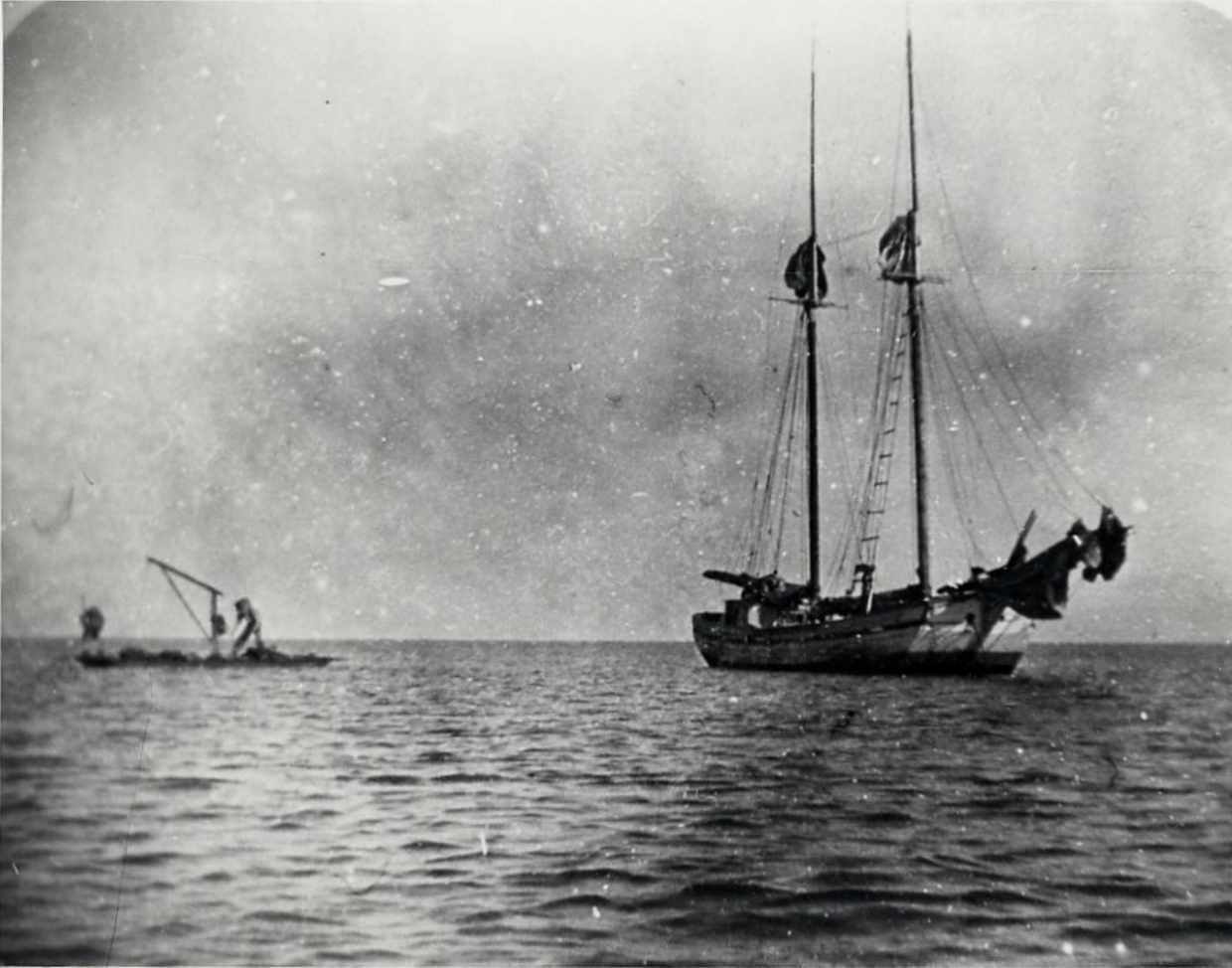
This post introduces a new SSHRC-funded project called “Assembling a City,” which uses customs house and harbour master ledgers to reconstruct parts of Toronto’s urban metabolism between the 1830s and 1930s.1 Many environmental historians imagine the work of William Cronon’s Nature’s Metropolis when they think about the relationship between cities and their resource hinterlands.2 The “Assembling a City” project builds on Cronon’s insights but relies more deliberately on quantitative methods informed by social metabolism research, which “focus[es] on material and energy flows within urban systems, accumulation of material stocks and the exchange processes of urban areas with their hinterlands.”3 The data developed for this study were drawn primarily from the Office of the Harbour Master fonds, held at the Archives of the Toronto Port Authority, as well as the Toronto Customs House fonds, held at the Archives of Ontario.4 As early as 1836, the harbour master in Toronto kept ledgers that recorded the name of every ship that unloaded cargo, the delivery date, the amount of each type of cargo it carried, and in some cases the consignee of the cargo. These ledgers cover over a century, from 1836 to 1937 (with a gap in the records between 1841 and 1849).
Toronto did not simply grow from a village to a town to a city. The city’s form and function emerged from both the internal dynamics and feedback loops of its population, businesses, and industries, and their reliance on resource hinterlands, which changed in response to broader social, economic, and environmental forces: wars and labour strikes, tariffs and trade agreements, droughts and extractivism, etc. For over a century, the Toronto port functioned as a vital node within a series of nested metabolic systems and served as a conduit between the city and Great Lakes resource hinterlands for many commodities, including fruit, coal, and stone.
Fruit
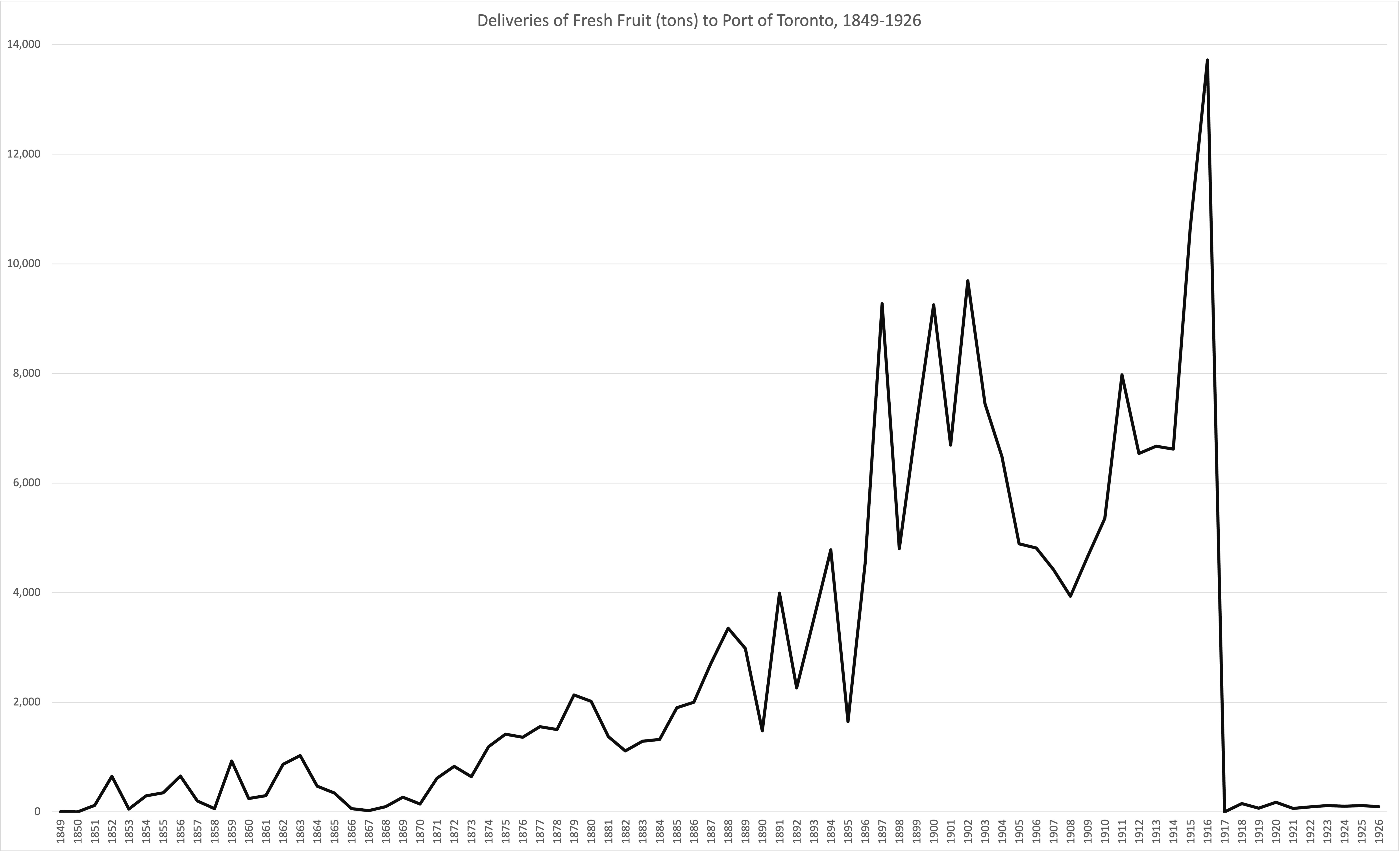
In the 1850s and 1860s, ships delivered nearly 7,000 tons of fruit to Toronto; just a few tons in some years and more than 1,000 in others. Shipments generally followed the seasonality of apple orchards and berry fields. During these two decades, more than two thirds of deliveries arrived between September and December. In the 1870s and 1880s, the amount of fruit delivered by boat to Toronto more than quadrupled to over 31,000 tons. Seasonality became even more pronounced during these decades, with more than 90 percent of deliveries taking place between August and November. The amount of fresh fruit arriving to the port increased dramatically during the 1890s, but the total amount fluctuated wildly from year to year. Deliveries from fruit-growing regions in upstate New York and Niagara became very important during the First World War for canning and preserving, but completely collapsed before the end of the war.5
Coal
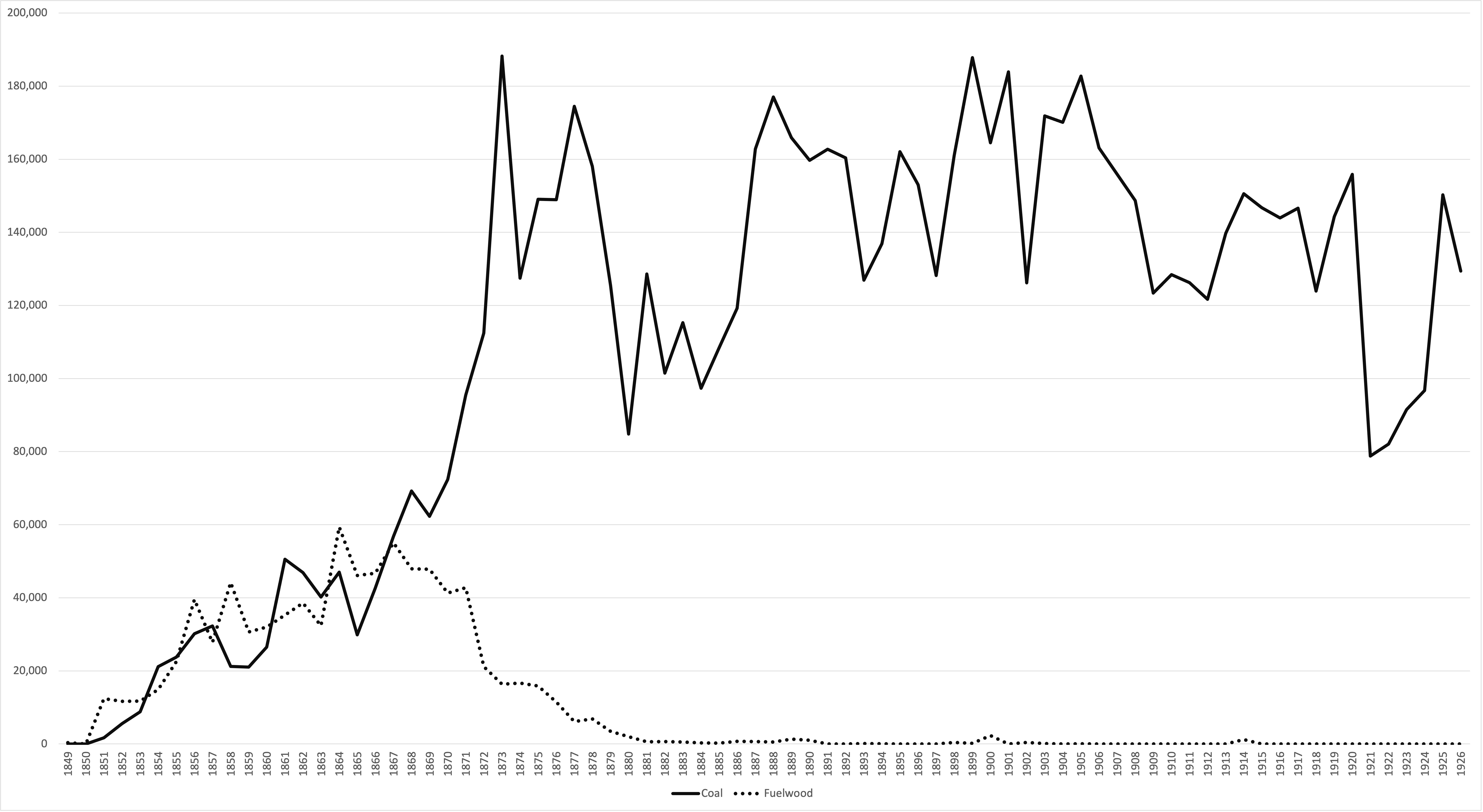
During the 1850s and 1860s, the amount of coal delivered to Toronto by boat was similar to the amount of fuelwood and increased steadily from a few thousand tons in the early 1850s to more than 70,000 tons in 1870. During the 1870s, railways began carrying significant amount of coal into the city, and by the 1880s nearly doubled the amount entering the city by vessel. Throughout the late nineteenth century, vessels brought consistent quantities of coal to Toronto, but lake shipments declined after 1900 as the amount from rail increased dramatically. By the 1880s, most of the coal arriving in Toronto by lake was anthracite shipped from Lake Ontario ports in New York State, particularly Oswego. Domestic, business, and industry consumers all preferred anthracite because it contained fewer impurities and burned cleanly compared to bituminous coal.6 As the railway assumed a more important role in coal deliveries between 1890 and 1920, the number of vessels carrying coal to Toronto remained steady and then declined, but the amount of coal each carried rose from an average of 450 tons in 1890 to 600 in 1902, and 4,100 in 1922.
Stone
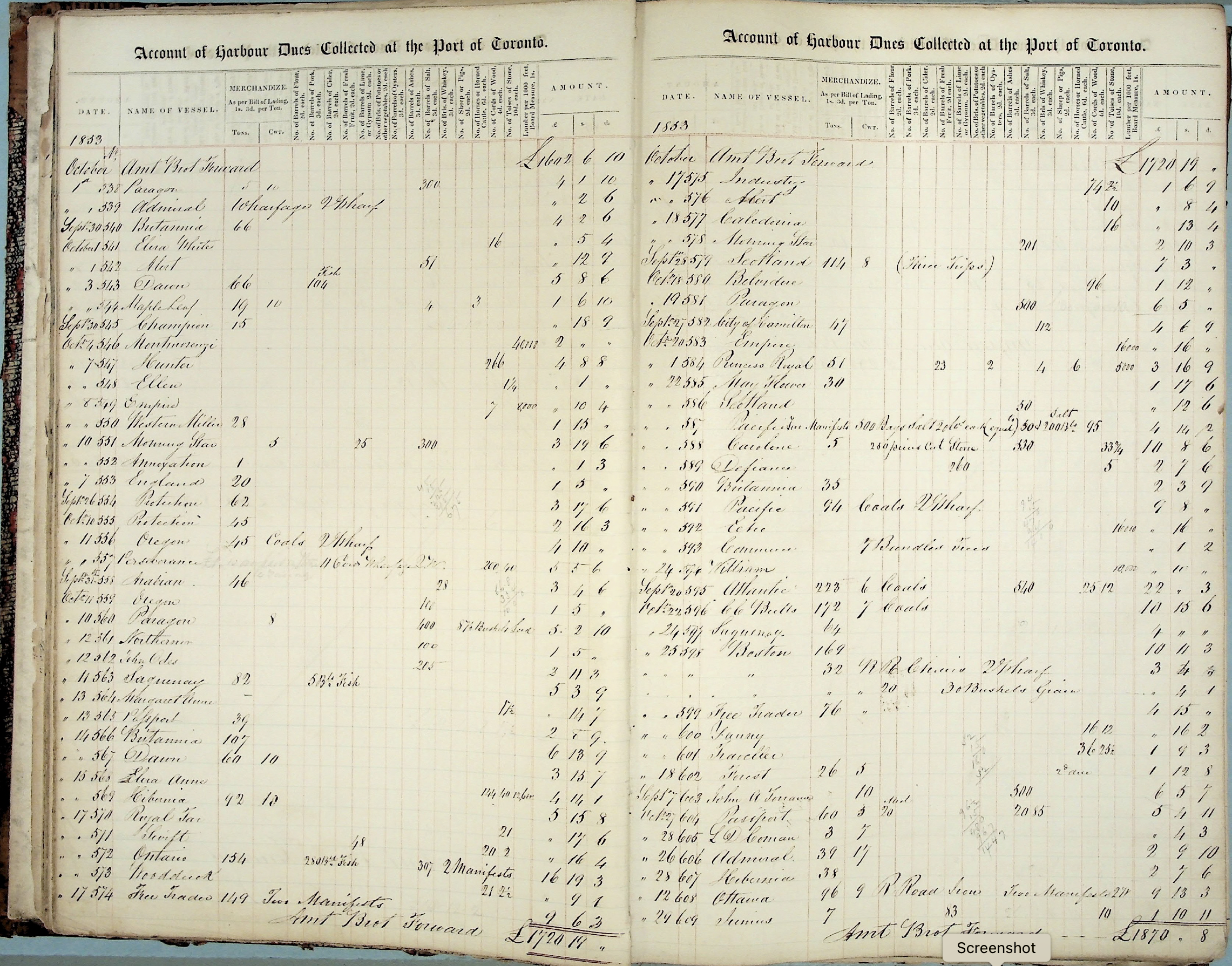
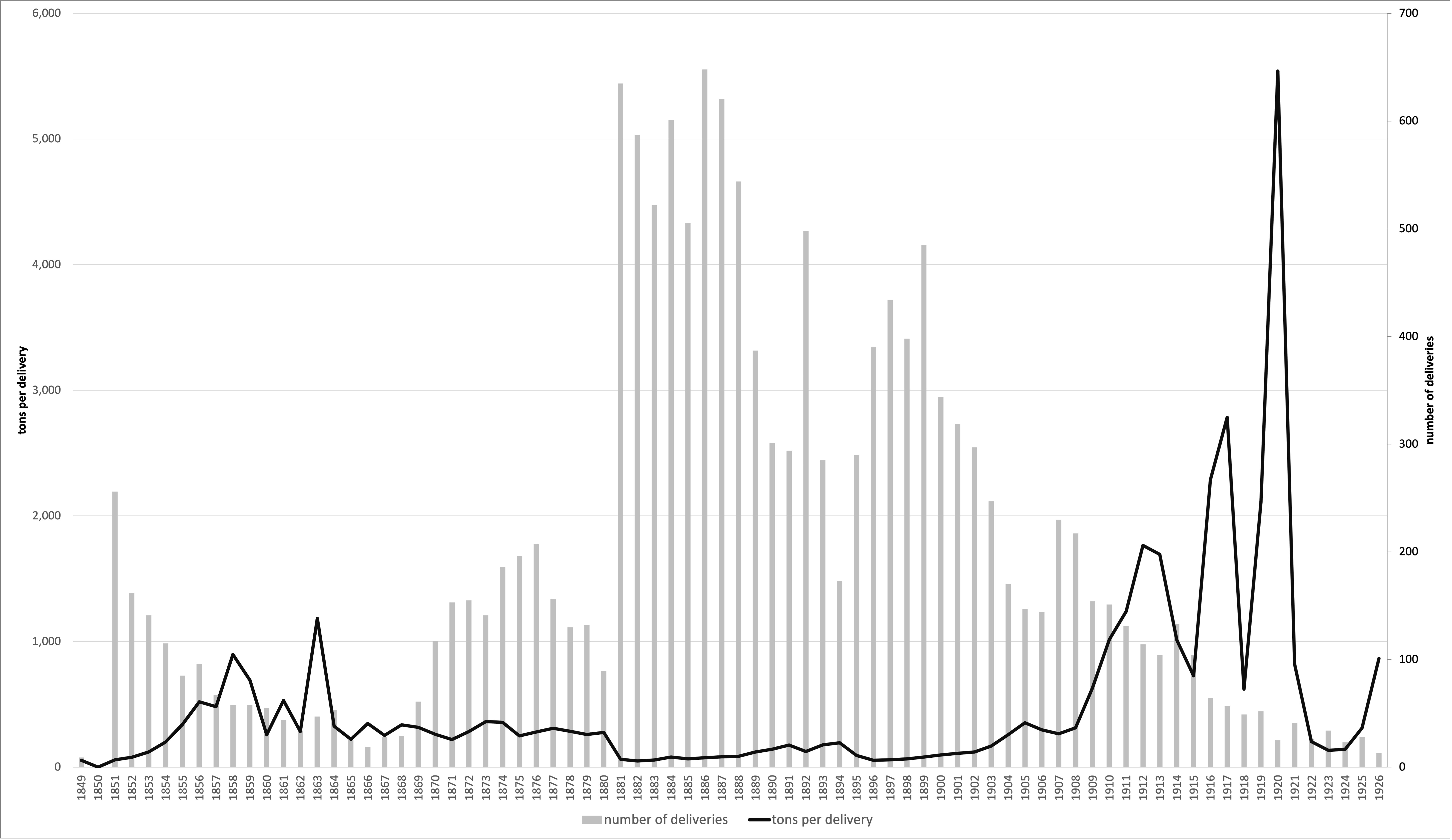
In the years before their foundations were built from concrete, buildings in Toronto rested mainly on enormous slabs of shale stone. Most of this stone was delivered to Toronto by relatively small ships called “stonehookers.” Using long rake-like tools called hooks, stonehooker crews mined the shallow waters along the coast of Lake Ontario, such as Frenchman’s Bay at Pickering.7 During the 1850s and 1860s, dozens of small vessels delivered only a few hundred tons in each shipment, averaging more than 20,000 tons annually. The stonehooking process remained relatively unchanged until the early twentieth century, but the number of deliveries of stone to Toronto’s port increased significantly from 207 in 1876 to 648 in 1886, resulting in an average of 48,000 tons of stone each year between 1884 and 1893. After 1908, stonehooking underwent significant changes. The number of deliveries per year dropped from 230 in 1907 to 25 in 1920, while the amount of stone per delivery rose from 313 tons to 5,542. Between 1908 and 1920, stonehookers brought more than 1,600,000 tons of stone to Toronto, an average of 127,000 tons each year.
The ledgers contain similar data about a wide variety of other commodities, including grains, livestock and meat, whiskey, lumber, lime and gypsum, and bricks. The project is still in its early stages, but the plan is to create a clean and standardized version of the data to make available for other researchers interested in Toronto’s urban history. These records provide a rare opportunity to glimpse inside the black box of an urban metabolism and explore how the flow of material and energy shaped Toronto as it grew from a small colonial port town to one of the largest city on the Great Lakes. At the same time, the data provide an opportunity to consider how a specific urban metabolism was linked to its resource hinterlands.
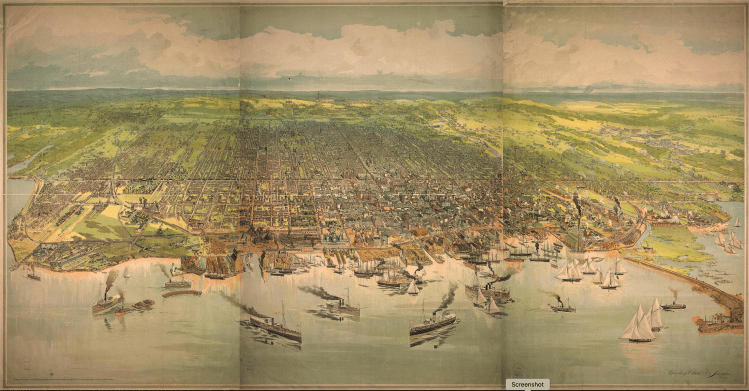
Featured Image (at top): Bird’s-eye view, looking north from harbour to north of Bloor St. and some points beyond, from Humber River on the west to Victoria Park Ave. on the east. (Barclay, Clark & Co., 1893) Courtesy of Toronto Public Library.
- Andrew Watson, Joshua MacFadyen, and Hannah Willness. Downtown Toronto’s Emergent Properties: Exploring New Methods for Using Port Records to Disaggregate Urban Metabolism in Toronto, Ontario, 1850-1926.” Historical Methods: A Journal of Quantitative and Interdisciplinary History, 57, 4 (2024): 267-282.
↩︎ - William Cronon, Nature’s Metropolis: Chicago and the Great West (W.W. Norton, 1991)
↩︎ - Helmut Haberl, et al. “Contributions of sociometabolic research to sustainability science,” Nature Sustainability 2 (March 2019): 174.
↩︎ - “Manifest books, account of harbour dues collected at the Port of Toronto, 1849–1937,” RG 2/5, Office of the Harbour Master fonds, PortsToronto Archives; “Vessel arrivals and tonnage, 1863–1977,” RG 2/6, Office of the Harbour Master fonds, PortsToronto Archives; “Toronto Customs House fonds, 1836-1841,” F214, Archives of Ontario.
↩︎ - “Preserving Fruit for Sick Soldiers,” The Globe (August 4, 1915): 6; “Liberal Rooms Canning Centre,” The Globe (September 10, 1917): 4; “Canning Peaches for the Soldiers,” The Globe (September 28, 1917): 4.
↩︎ - Andrew Watson, “Coal in Canada,” In Powering up Canada: A history of power, fuel, and energy from 1600, ed. by R.W. Sandwell. (Montreal: McGill-Queen’s University Press): 213–50.
↩︎ - Matthew Wilkinson, “The History of Stonehookers in Mississauga” https://www.modernmississauga.com/main/2020/9/23/the-history-of-stonehookers-in-mississauga (last accessed December 9, 2025); Richard Collins, “Remembering the Stonehookers of Port Credit” https://www.portcredit.com/blog/remembering-the-stonehookers-of-port-credit/ (last accessed December 9, 2025); Heritage Mississauga, “Remembering the Stonehookers” https://heritagemississauga.com/wp-content/uploads/2021/12/Stonehookers-Web-Document-November-2021-CITY.pdf (last accessed December 9, 2025).
↩︎
 The Metropole