

This is the fourth post in Urban and Environmental Dialogues, our January collaboration with the Network in Canadian History and Environment (NiCHE). For other entries in the series, see here.
By Carmen Gilmore
In summer 2021, I volunteered with the Saskatchewan Native Plant Society to create a photographic wildflower brochure of the Saskatoon Natural Grasslands (the Grasslands). I’d become more interested in prairie ecosystems as I dragged and later followed my children to outdoor learning opportunities, learning about bats, pishing for chickadees, and bluebird banding. As my interest in ecological conservation grew, photographing wildflowers was the next step of immersing myself in place. In the early summer mornings, I walked the Grasslands trails searching for flowering plants listed on the species inventory and crouched down to photograph these often-diminutive flowers.
My first summer on the Grasslands passed, and my wildflower brochure efforts continued into 2022. I simply couldn’t find many of the flowers in my assigned inventory, and connected to botanical experts in the local nature community asking why. I finally completed the wildflower brochure with assistance from the executive director of the Saskatchewan Native Plant Society, but my education about how cities decide which parts of nature are saved, and which aren’t, and which ones visitors are allowed to learn about was just beginning. My struggle with the Grasslands species inventory revealed how the models of conservation in national parks fail in urban conservation. Unlike a national park, there is no stated goal for what conservation success looks like in the Grasslands. Local stewards call attention to species loss in this ecosystem but species loss over decades exceeds individual memory: these shifting benchmarks, or assuming what you see today is the same as what existed in the past is a known challenge in conservation. If the Grasslands had the rights of a person, standards of intervention and rejuvenation could be explicit and there would be legal recourse. Lacking this protection, species loss in the Grasslands is made invisible, and acknowledging the permanent loss of prairie for future generations is extinguished too.
The Grasslands was not saved because of its wildflowers; it was saved because of its Plains Rough Fescue (Festuca hallii), a native grass species that evolved with grazing bison and periodic grassfire. As residential development in Saskatoon sprawled northeast in the 1990s, local ecologists such as Dr. Jim Romo and Ed Driver and several environmental groups fought for conservation of the Grasslands, then a scrappy patch of land still grazed by cattle and riddled with limestone and soil too clay-rich to farm. This fight was called the “Fescue Rescue” and played out over several years, but in February 1993, the City of Saskatoon sold the Grasslands to Meewasin, its local conservation agency, for $1 to “conserve the natural grasslands area in a natural state and use the natural grasslands area for the purposes of the general public.”1
According to the Nature Conservancy of Canada, over 80% of prairie habitat has been lost, remaining untouched prairie now viewed as an endangered ecosystem. That ethos is clear in both the original conservation goals for the Grasslands—to “preserve the ecological integrity of the prairie as a remnant of a larger prairie ecosystems and gene pool for the future and; provide a living laboratory for environmental education and interpretation”—and in how Meewasin describes its efforts today.2 In its recent brochures, Meewasin describes the Grasslands as “A fescue prairie in our backyard,” and notes that this remnant prairie, “…represents one of the most endangered ecosystems in the world.”3
Comparisons of the Grasslands’ original species inventory with research-grade iNaturalist sightings shows a 73% decline in vascular plant species present in 1994, and observation and sampling on site show an increase in woody shrub encroachment from 14% to 100%. Most disappointingly, only one plant of the Plains Rough Fescue species that this ecosystem was preserved to maintain has been sighted in iNaturalist to date.4 Dependent on grazing and fire for rejuvenation, the Plains Rough Fescue was doomed when Meewasin took over management of the Grasslands but did not ensure sheep or cattle grazing nor regular controlled burns.
Meewasin operates under its own provincial act, but it is akin to other conservation non-profits such as museums and archives that hold irreplaceable resources in trust for the common good and are beholden to the public for those resources. The Grasslands Resource Management Guide points out that this was the explicit goal of conservation: “Since our region’s natural history represents “heritage” just as much does its human history and culture, preserving a piece of the original Saskatoon prairie landscape as an outdoor living museum deserves at least an equal priority with that of historical museums, art galleries, drama-theatres, libraries, etc.”5
How might a museum or archive memorialize the loss of nearly three-quarters of its artifacts? There are cases of archives facing fire and losing artifacts. Famous museums like the Louvre make global headlines when they are robbed. But beneath these stories lie layers of reporting, security plans, and audits. The CEO of the Louvre submitted her resignation, which was rejected, after the October 2025 heist. More interesting is the auditors’ report that the Louvre had funds for security upgrades but had consistently prioritized visible or attractive protects instead. There is no mention of how the lost artifacts will be memorialized if they are not recovered.
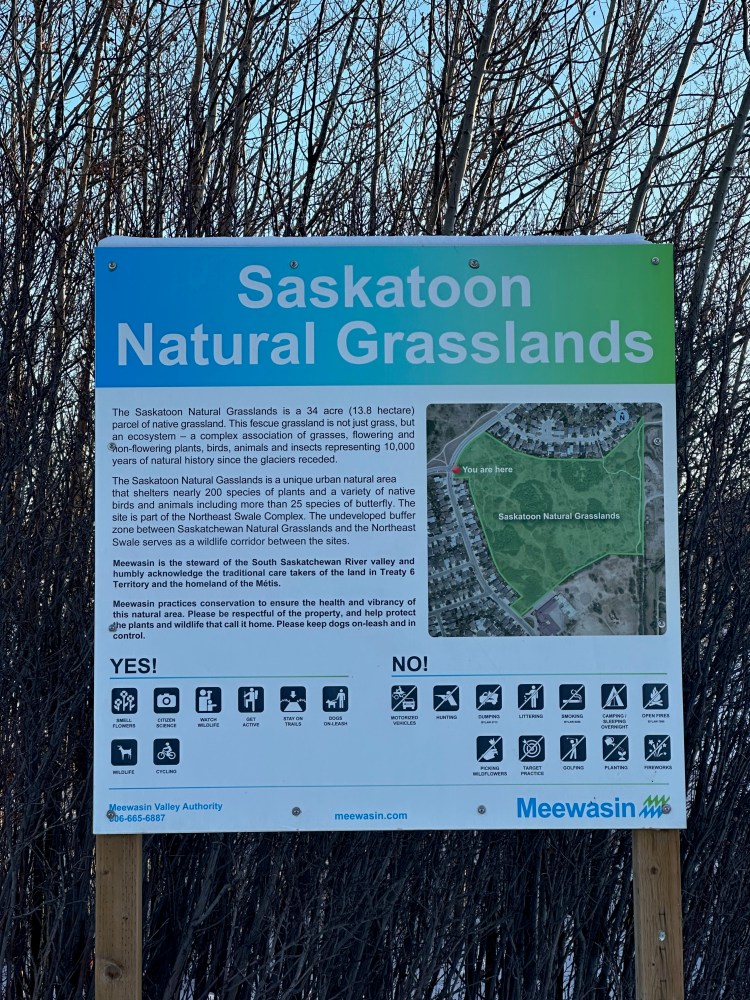
Like the Louvre, perhaps Meewasin has prioritized the visible and attractive projects. In 2021, Meewasin installed six new signs, boot cleaners, and a bench in the Grasslands. The Meewasin sign in this article notes that this is a fescue grassland, that over 200 species are found in this ecosystem, and that it took 10,000 years for the plants, animals and insects to evolve together. While acknowledging this long natural history, Meewasin has omitted that this conservation area is no longer a fescue grassland, that only a fraction of those 200 species are still present and that 10,000 years of species co-evolution ended under its 30-year management. This sign raises compelling questions of accountability for Meewasin’s leadership and board, and what information is provided to the public about conservation in this area, as this degradation occurred over 30 years.
While I was busy photographing wildflowers in the Grasslands in summer 2021, the Magpie River in northern Quebec became the first river in Canada to receive the legal rights of personhood. Threatened by the creation of a hydro-electric dam, the Innu Council of Ekuanitshit and the Minganie Regional County Municipality collaborated to have the river assigned nine rights, the right to biodiversity and legal representation, among others. This Indigenous-led response to the threat of environmental degradation contrasts the typical settler Canadian model of nature as property.6 The right to legal representation is envisioned as a guardian who acts in the best interest of the river. While the Grasslands lacks the rights of personhood, it does have guardians written into the original resource management plan. Thirty years later, neighborhood residents continue to advocate for the Grasslands’ protection.
Local conservationists remind us that conservation goals are never expressed; there is no metric to measure success or failure. Meewasin can keep putting up signs about a keystone species that became extinct in this ecosystem under its management forever, but unlike an archive or museum, there is no accountability for the loss of irreplaceable public resources. This loss of remnant prairie is inexcusable.
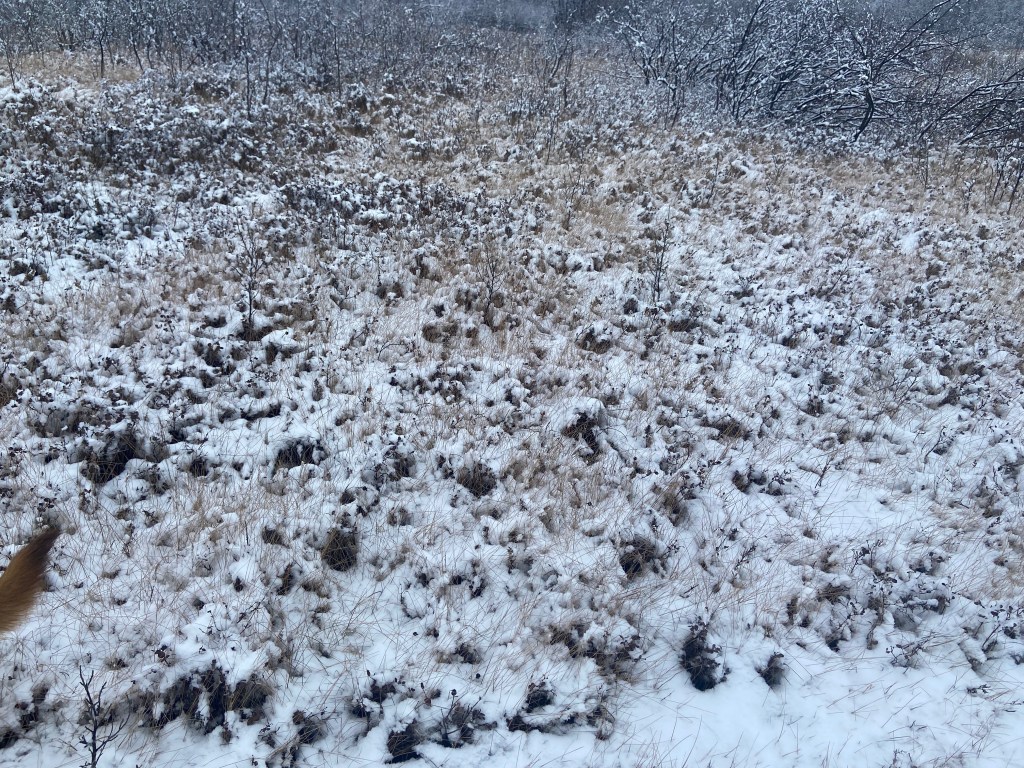
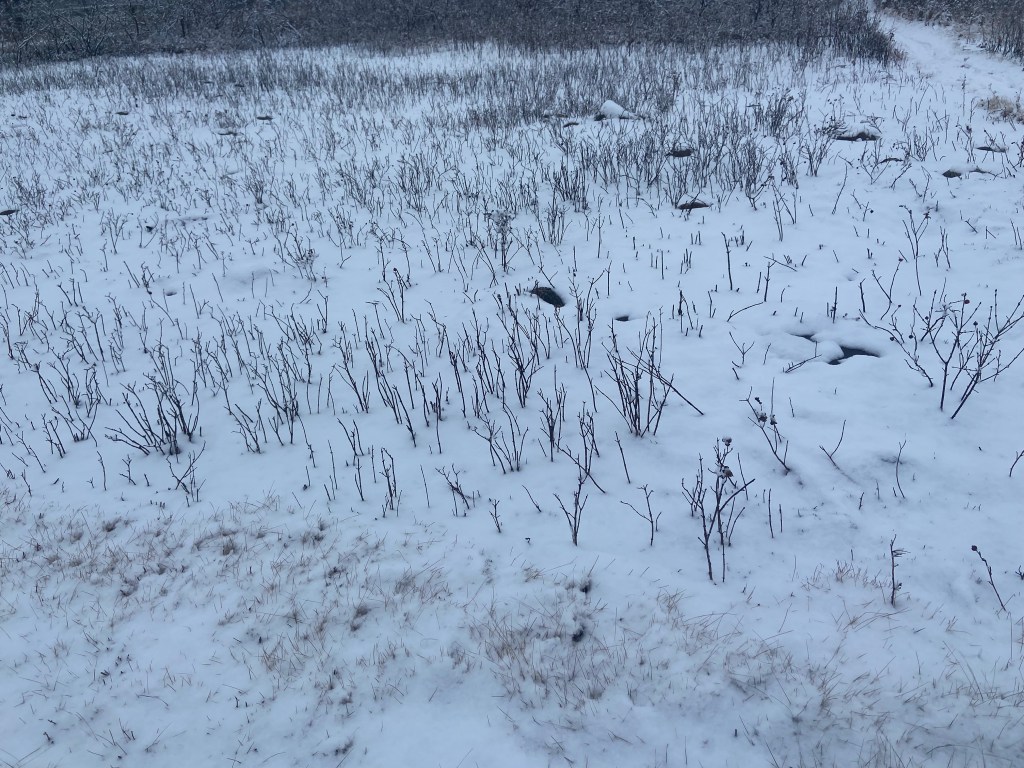
The Grasslands can’t be saved now, even if it had the legal rights of personhood—the cost of restoration and maintenance would be prohibitive—but it can be memorialized. The lessons of its benign destruction and neglect could be learned, but only if Meewasin was brave enough to admit its failure. In the meantime, neighborhood residents have planned a memorial to mourn the loss of this ecosystem and detail the institutional failures in its conservation. The Grasslands may not be able to speak, but its guardians will keen loudly about its biodiversity loss on its behalf using Meewasin’s own words: this prairie “represents a small, remaining token of what we already have destroyed with our urban developments and agricultural activities. Preserving such a native grassland will allow us and future generations the chance to observe, experience and appreciate the natural prairie environment that once existed here as the first settlers saw it.”7
Carmen Gilmore is an environmental advocate and essayist. She is the author of Field Notes from the Ravine, forthcoming from Dundurn Press. Her essays, critiques and reviews have appeared in the The Field Stone Review, Quill & Quire, The Blue Jay and The Goose: a Journal of Arts, Environment and Culture.
Featured Image (at top): Photo of Saskatoon Natural Grasslands sign provided by the author in 2026
- Meewasin. SNG Brochure. Undated. https://meewasin.com/wp-content/uploads/2019/09/SNG-Brochure.pdf ↩︎
- Declan Western Ltd, Saskatchewan Research Council, and Jones Heritage Resources Consulting. Saskatoon Natural Grasslands Resource Management Plan. Final Report. March, 1994. Page 1. ↩︎
- Meewasin. Saskatoon Natural Grasslands: A fescue prairie in our backyard.
↩︎ - iNaturalist shows only one observation of fescue as of 2025 but this observation has not yet received research grade status. ↩︎
- Declan Western Ltd, Saskatchewan Research Council, and Jones Heritage Resources Consulting. Saskatoon Natural Grasslands Resource Management Plan. Final Report. March, 1994. Page 197 of 200. ↩︎
- Kia Dunn. Standing for Nature – Giving natural territories the status of a legal person. Ecotrust Canada. April 25, 2024. https://ecotrust.ca/latest/blog/standing-for-nature-giving-natural-territories-the-status-of-a-legal-person/
↩︎ - Declan Western Ltd, Saskatchewan Research Council, and Jones Heritage Resources Consulting. Saskatoon Natural Grasslands Resource Management Plan. Final Report. March, 1994. Page 197 of 200.
↩︎
 The Metropole