

[Editor’s note: To read our other selections for Best of 2025, see here]
Beyond the obvious – Beyoncé, Taylor Swift, and a handful of others – there are fewer big stars, groups or bands around to set any kind of dominant sound these days. Music journalism, like much of the rest of the industry, has been a shrinking proposition for over a decade, such that discovering popular music today, particularly new music that falls outside one’s usual “algorithm,” has become harder. Fragmentation is real. Granted, we’re historians, and outside of a few exceptions, not exactly seen as authorities on music. However, we’re also humans. Humans with ears, so for what it’s worth, here’s some of what departing senior editor, Ryan Reft, listened to in 2025.
Ryan Reft
At my age, I won’t profess to be on the cutting edge of anything, but I’m also not some Generation X reactionary who remains steadfastly attached to Pearl Jam or Goodie Mob or opines on the importance of Pavement (though they all have their virtues; re: Pavement see Crooked Rain or the criminally underrated Wowee Zowee). New music is new music, and I’m game.
2025 delivered several albums that I enjoyed immensely. For the older heads out there, The Clipse dropped Let God Sort Them Out and then embarked on an early aughts-era publicity campaign celebrating the album. The Clipse are honestly in my top hip hop acts of the 21st century, and I’ve been on that corner for some time (see here if you doubt me). There’s a softness and, dare I say, empathy that emerges throughout Let God Sort Them Out. Take the first cut, “The Birds Don’t Sing,” a tribute to Malice and Pusha T’s parents who passed within months of one another in 2021 and 2022. It opens with lament: “Lost in emotion, mama’s youngest/Tryna navigate life without my compass/Some experience death and feel numbness/But not me, I felt it all and couldn’t function.” The Clipse never lacked for emotion, but it was often clipped (no pun intended), such as on the track, “We Got It For Cheap” from Hell Hath No Fury: “And to little Brother Terrance, who I love dearly so/If I ever had millions, never would you push blow.” On Let God Sort Them Out, Malice and Pusha T dig deeper into that bag without forgoing the forthrightness that has been their trademark.
For those looking for something not so millennial-coded, the band Friendship released the very Silver Jews- tinged Caveman Wakes Up (for those of us of a certain age, it’s hard not to envision the late Phil Hartman as Unfrozen Caveman). The best song, in my opinion, is “Free Association”: “I thought I was wise/I thought I knew about love/Cleaning out your garage, where did you get all this stuff?” Dan Riggins sings wearily. Plus, who can beat an album that includes the line “who’s that shithead in my living room playing Resident Evil?”
While I wasn’t so big on their first two efforts, this year’s work by Geese, Getting Killed, is one of the best albums I’ve heard in years. I’ll confess the first time I listened to Getting Killed, considering all the hype I’d read online, I was underwhelmed. But the album works its way under your skin as it mixes elements of The Velvet Underground (notably the Nico era), Beirut, and, one might argue, Big Thief, among other influences. There’s a shiny, optimistic melancholy to the album. If on “Trinidad,” lead singer Cameron Winter opens the album caterwauling “There’s a bomb in my car,” later on “Cobra” he croons “You can make the cobras dance, but not me yeah/Cobra in my hand she’s calling me back again,” and still further on he pleads on “Au Pays du Cocaine” “You can change baby, you can change/and still choose me.” Sam Sodomsky described Winter’s voice as a “straining warble whose cryptic delivery can feel like both sides of an argument you’re overhearing through apartment walls,” a pretty good evaluation in my opinion. It’s an emotionally resonant album that musically flows over you, immersing you in a worldview clear-eyed but hopeful.
Finally, speaking of Beirut, I’ve been a fan for years and while A Study of Losses is not the band’s best album, it’s worth a spin (especially in these says of iTunes and Spotify). If you dig Zach Condon’s work, check it out.
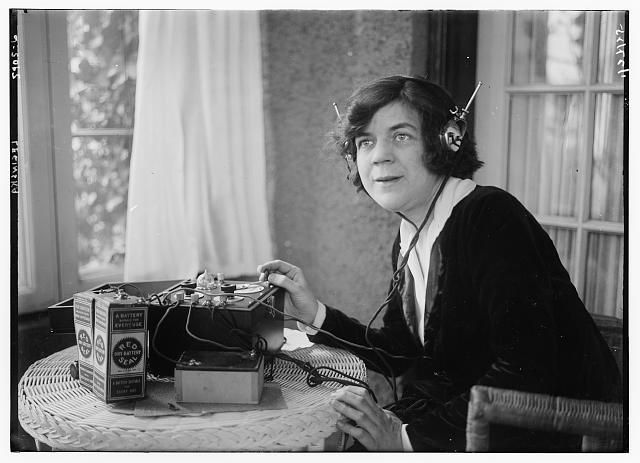
Featured image (at top): Photograph shows Ethel Leginska, born Liggins (1886-1970) who was a British pianist, music teacher, composer and conductor. Leginska is listening to a battery powered radio, Bain News Service, between 1920 and 1925, Prints and Photographs Division, Library of Congress.
 The Metropole