

By Colin Wood and Stephen M. Koeth
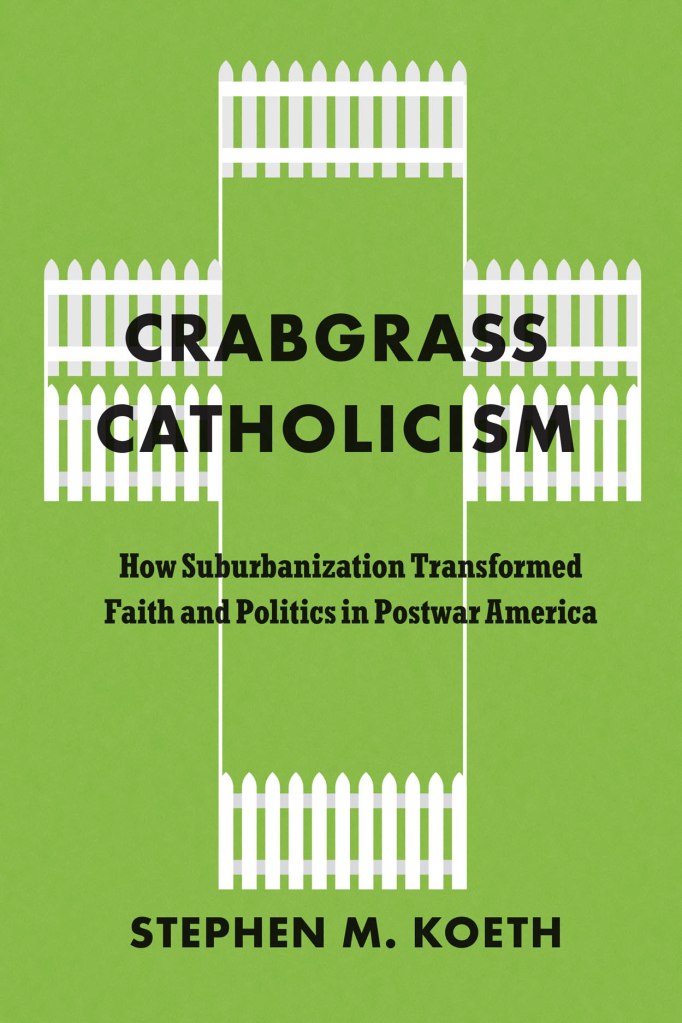
Stephen M. Koeth’s bold new monograph, Crabgrass Catholicism: How Suburbanization Transformed Faith and Politics in Postwar America contributes to an expanding field of religious, urban, and political historiography, while elucidating how America’s largest religious denomination shaped and was shaped by postwar suburbanization. The book offers a salient reappraisal of many of the important forces that created modern America, while providing a powerful critique of how suburbanization destabilized and undermined religion.
In your introduction, urban and religious history are placed in tandem both historiographically and methodologically. By connecting “suburban history” to “Catholic history” what are you trying to accomplish in this book?
My title is, of course, an homage to Kenneth T. Jackson’s seminal Crabgrass Frontier. But like Jackson, many of the suburban historians who followed have largely ignored religion, and almost all Catholic historians have assumed but not actually explored the effects of postwar suburbanization on religion. I take Jay P. Dolan’s The Immigrant Church (1975) as a model. As he detailed the way that urbanization and immigration transformed American Catholicism by studying select parishes on Manhattan’s Lower East Side over a fifty year span from 1815 to 1865, I outline how the immigrant Church gave way to the suburban Church by studying the Diocese of Rockville Centre on Long Island between 1945 and 1985. In doing so, I not only show how suburbanization changed religion but how the institutions that Catholics built were crucial in creating suburban infrastructure and culture. Altogether, this accomplishes another goal of the book: placing American Catholics at the center of some of the most significant cultural and political developments of the late twentieth century.
In your first chapter you assert that there is a particularly interesting paradox in how Catholics imagined cities and suburbs through the postwar years and call the shifts in these understandings “ironic.” How so?
In The New Suburban History, Becky Nicolaides’ described “How Hell Moved from the City to the Suburbs” in the minds of twentieth century scholars and commentators. I argue that something similar happened in American Catholic conceptions of city and suburb. From the late nineteenth century through World War II, American Catholic leaders decried the city as vice-ridden and godless and idealized rural life as conducive to the protection of faith and family. But as the suburbs exploded after World War II, Catholic intellectuals and pastoral leaders ridiculed suburbia as shoddily constructed, materialistic, and morally bankrupt for ignoring the plight of the city. Amid the civil rights movement and the urban crisis, Catholic leaders found a new appreciation for the city. The irony in this is that when Catholic leaders attacked the city and advocated a return to the land the majority of American Catholics lived in the industrial cities of the Midwest and Northeast. And when, in the postwar period, millions of these Catholics moved to the suburbs, in part, to find a safer, cleaner, and more leisurely setting for family life, Catholic leaders dismissed suburbia and celebrated the city.
As you assert in Chapter 3, “space shapes religious practice.” What religious values and practices, and ecclesial structures, were altered or lost amid the shift from urban to suburban spaces?
I argue that suburbia’s spatial arrangement helped shift Catholic practice from public, communal expressions of piety in the parish, to domestic and private forms of prayer in the family home. Because newly formed suburban parishes lacked the infrastructure of church, rectory, school, and convent, gatherings that normally occurred within parish buildings had to be held in a variety of temporary spaces. Masses and religious education classes were held in airplane hangars, factories, drive-in movie theaters, and especially private homes. As a result, domestic rituals and forms of devotion such as home Masses, block rosaries, and self-guided retreats rose in popularity, replacing the public and communal devotions that had marked the urban ethnic parish. Even expressions of charity and activism came to be centered in the family home including ecumenical gatherings and efforts to improve race relations. All of these changes undermined the traditional sense of the parish as a permanent and sacred space. And the overcrowding in suburban parishes further diminished a sense of true community. Suburbanization thus led not only to changes in pious practice but even to the questioning of the parish as a viable ecclesial structure.
One of the central claims of the book is that in the postwar suburbs the laity gained power and authority in the Church and that this change “preceded the Second Vatican Council.” What were the causes of this power shift and what challenges did it pose for the Church?
Among Catholic laity and historians alike, the Second Vatican Council of the 1960s has often been treated as a bolt of reform that came out of the blue. Recently, Catholic historians have begun exploring the antecedents to conciliar reforms but have focused mainly on theologians and religious associations which paved their way. One of the more significant changes of the era was the rise of the laity into positions of leadership and authority in the Church. Historians and theologians have typically focused on 1930s Catholic Action, and conciliar documents defining the Church as “the People of God,” in an attempt to explain this revolution. But I argue that postwar suburbanization was a crucial catalyst for shifting the balance of power from priests to the lay faithful and raising the laity’s expectations for a greater voice in the Church. With an insufficient number of priests and religious sisters, and rapidly expanding congregations, new suburban parishes relied on the lay faithful to renovate temporary worship spaces, spearhead building drives, teach religious education classes, and staff parochial school boards. Additionally, in the suburbs, traditional parish associations like the Holy Name Society which were single gender, based in the parish, and led by priests gave way to new family apostolates like the Christian Family Movement which enlisted married couples, were based in family homes, and were led by lay people. Altogether, these changes opened new avenues of lay leadership but also altered the traditional role of the clergy and raised expectations of further reform which were often frustrated by traditionalism and by class and ideological divisions within the laity.
Within the purported racial and social homogeneity of suburbia, you highlight pockets of Black Catholics and a rising population of Hispanic Catholics. How do non-white Catholic minority groups impact the overall story of Crabgrass Catholicism?
The power of ethnicity in American Catholicism had already begun to wane as the experience of immigration receded into memory, but postwar suburbanization seemingly completed the process by which Catholics shed their European heritage, or at least confined its expression to the private sphere. Parishes were no longer defined by ethnic traditions but were generically American in their piety and practice. Given the racial exclusion of suburbia, however, suburban parishes were defined by race. In the suburbs, ethnic Catholics became “white” and, as I show, sometimes chose their parish in order to maintain racial exclusivity. Meanwhile, the small number of Black Catholics in the suburbs of Long Island struggled to find connections with one another and to attract the pastoral attention of the diocese. Similarly, newly arriving Latin American immigrants, scattered wherever they could find affordable housing, struggled to find their place in the US Church. Whereas in a previous era national parishes helped European immigrants to assimilate while maintaining their religious identity, Hispanic immigrants in suburbia had to find their place in mixed parishes. And so, ironically, given the supposed homogeneity of suburbia, crabgrass Catholicism today must grapple with how to unite the faithful from diverse backgrounds, and with how ethnic cultural traditions should inform religious practice.
Possibly one of the most consequential challenges Catholics had to face in the suburbs was how to educate the next generation in the faith. How did education create conflict amongst Catholics and between Catholics, the state, and other religious groups?
Amid rapid demographic expansion, suburban Catholic parishes found it impossible to provide enough classrooms and desks for all eligible children to attend parochial schools. Catholic parents, already paying mortgages and suburban taxes, found parochial school tuition difficult to afford, especially as the number of religious sisters declined and tuition rates rose in order to pay unionized lay faculty. American Catholics began fighting among themselves about the advisability of maintaining their parallel school system. Ultimately, the parochial school lost its centrality in the task of inculcating the faith in the next generation. More and more Catholic youth received religious instruction in weekly afterschool catechetical sessions. Catholics then began debating the effectiveness of such programs as forays into novel theology and experiments in pedagogical methods left a whole generation of Catholic youth less knowledgeable about the tenets and practices of the faith. Meanwhile, some suburban laity joined the US bishops in demanding state funding for non-public schools in an attempt to save parochial schools. And others fought for the inclusion of prayer and moral formation in public education and found themselves at political odds with their Jewish neighbors. So, yes, education perhaps more than any other single issue changed both Catholic practice and politics in suburbia.
Many historical studies have linked postwar suburbanization to the rise of the Christian Right, including Lisa McGirr’s Suburban Warriors (2007) and Darren Dochuk’s From Bible Belt to Sunbelt (2009). But such studies have typically omitted Catholics. How does Crabgrass Catholicism situate suburban Catholicism in the so-called rise of the Right?
From the 1980s to today, American Evangelicals have been reliably Republican voters, so scholars’ focus on Evangelicals, the Sunbelt, and the Religious Right is more than warranted. But in abandoning the New Deal coalition and becoming classic suburban swing-voters, Catholics too played a crucial role in the 1980s rise of the Right. Scholars have tended to focus on racial backlash and opposition to abortion to explain why Catholic voters were willing to ally themselves with conservatives including in the so-called Reagan Revolution. Although these are undeniably factors in Catholic political realignment, I argue that from at least the 1950s, Catholic voters were open to conservative political positions on the size of government and taxes because of the economic pressures exerted by suburbia. So, too, when suburban mortgages and skyrocketing taxes drove Catholic parents to place their children in public schools, these parents resisted sex education and advocated prayer in public schools. I argue that Catholics’ fight for school prayer in the 1960s, and the arguments and methods they employed in those legal battles, foreshadowed the coalition building role they would play in the gathering culture wars.
Throughout the book one gets the impression that the Church in the suburbs was out of its element, trying to adapt and evolve in an alien environment. Indeed, your epilogue is particularly riveting, arguing that postwar suburbanization “sowed seeds that would ultimately erode the vitality of the Church.” What made suburbia so corrosive to faith and how might religious groups counteract these ill effects?
From the immigration boom of the late nineteenth century, the Church in the United States was accustomed to serving an urban immigrant population in ethnic parishes where church steeples marked the bounds of neighborhoods and religious rituals spilled out of churches onto city streets in the form of festivals and processions. So, yes, the suburbs were an alien environment for the Church because they were premised not on the communal life of public spaces but on private spheres. In the suburbs, family homes – and the gadgets they were filled with – were the center of people’s lives, not city streets and the parish church. Altogether, these changes signaled the rise of a more individual and consumerist understanding of the faith and, I argue, thereby sowed the seeds of religious disaffiliation in the decades to come. But in this is also the model and opportunity for potential religious revival: in a world of virtual realities and deepening social isolation, religious communities have an opportunity to once again answer people’s longing for real human connection.
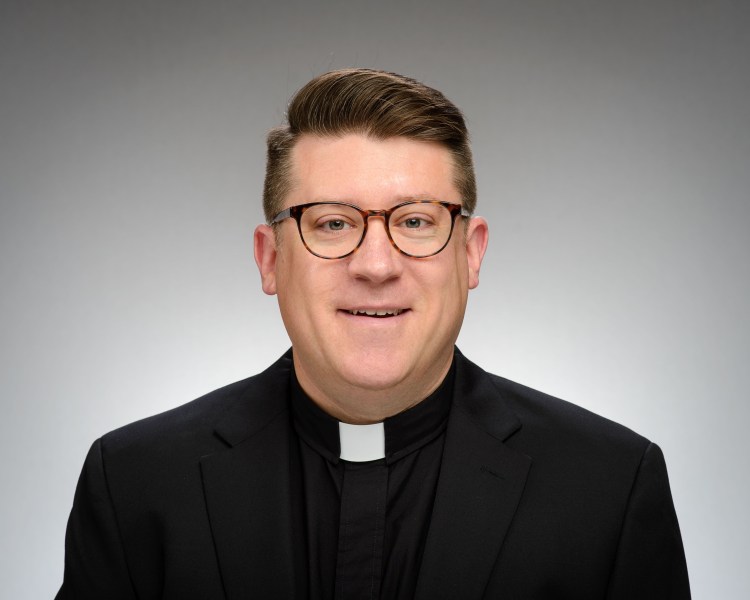
Stephen M. Koeth, C.S.C. is Assistant Professor of History at the University of Notre Dame and a priest of the Congregation of Holy Cross. He is an urban, religious, and political historian of twentieth-century America whose research focuses on U.S. Catholic involvement in postwar metropolitan development, including urban renewal projects, public housing, and suburbanization, and the effects of these interactions on Catholic faith and politics. His first book, Crabgrass Catholicism: How Suburbanization Transformed Faith and Politics in Postwar America, was published in Fall 2025 by The University of Chicago Press.

Colin J. Wood is a graduate student studying the Social Sciences at the University of Chicago. His research interests revolve around the relationship between religion and capitalism in modern America, with particular emphasis on the New Deal political economy, social transformations, and the labor movement. He is published in Anglican and Episcopal History and Journal of the American Revolution and forthcoming in the Journal of Church and State. He is from Tacoma, Washington.
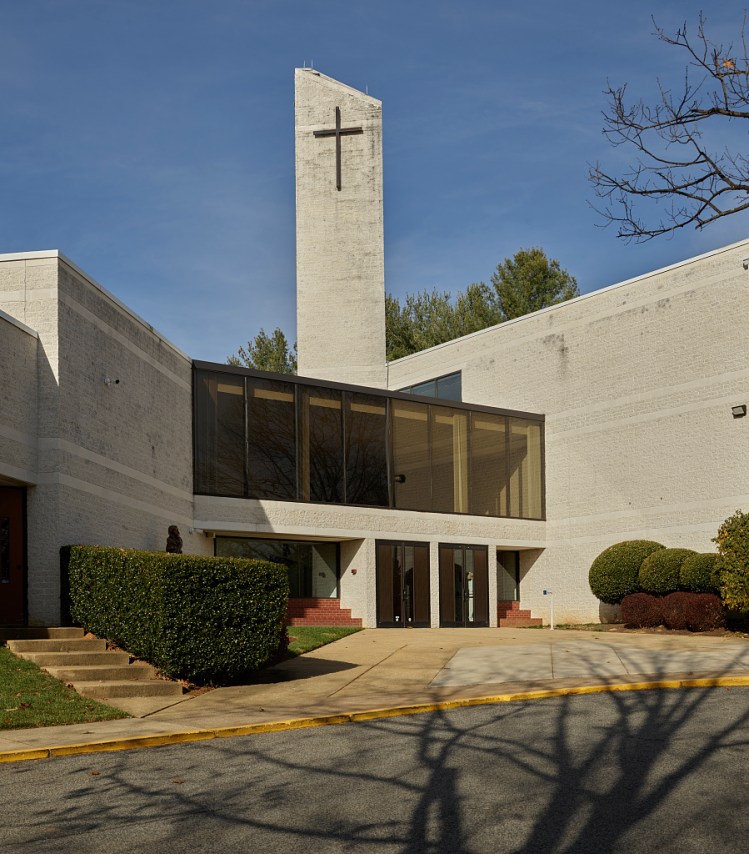
Featured image (at top): St. Luke Catholic Church in the Northern Virginia suburb of McLean, photograph by Carol M. Highsmith, December 8, 2019, Prints and Photographs Division, Library of Congress.
 The Metropole
In this far-ranging and interesting discussion at no point is there mention of the quite substantial differences between Irish and Italian Catholicism in regard to politics, law and social development. What say? As a college and high school teacher, I tried to stress importance of religious differences in understanding historical development.But guess what? Few students were able to explain, even in a rough sort of way, the difference between Protestant and Catholic. But maybe that’s progress. After all those two tribes battled it out for 500 years and now even in Ireland, the quarrel may be over. Ignorance is bliss.
LikeLike