

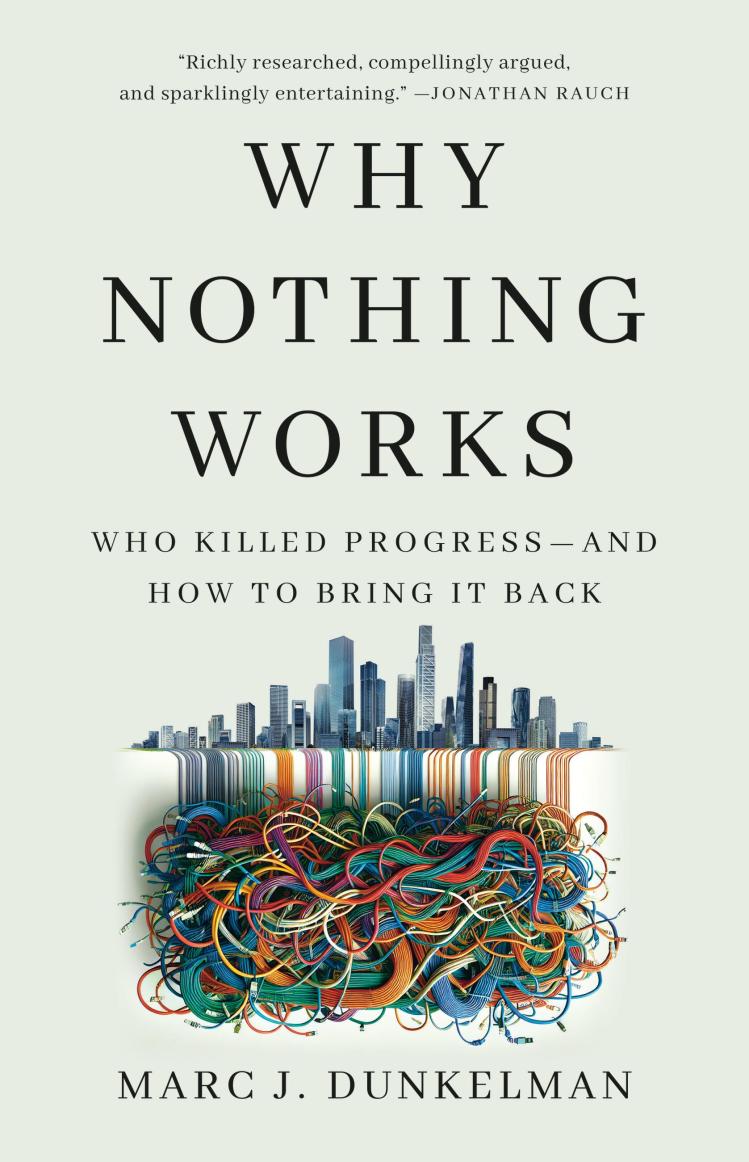
In Why Nothing Works: Who Killed Progress – And How to Bring It Back, Marc J. Dunkelman argues that well-intentioned efforts by progressives have contributed to “render[ing] government incompetent.” Once championing a technocratic elite to run government from the top down, the post-Robert Moses mid-century shift, which questioned this elitism and sought to undermine it by democratizing policy and policy enactment by giving the public a larger voice in squashing development, policymaking, and other reforms, has led to gridlock and inaction.
In creating a less effective government through overzealous reform, progressives ultimately “pried open the door for MAGA-style populism.” While Dunkelman doesn’t absolve the Right from its own culpability — “conservatives can (and should) be assigned some bulk of the blame for convincing portions of the public that government is invariably bad”– the Left needs to reflect on and evaluate its own approach to government and power and how reforms may have helped grease the slide into our current state of affairs.
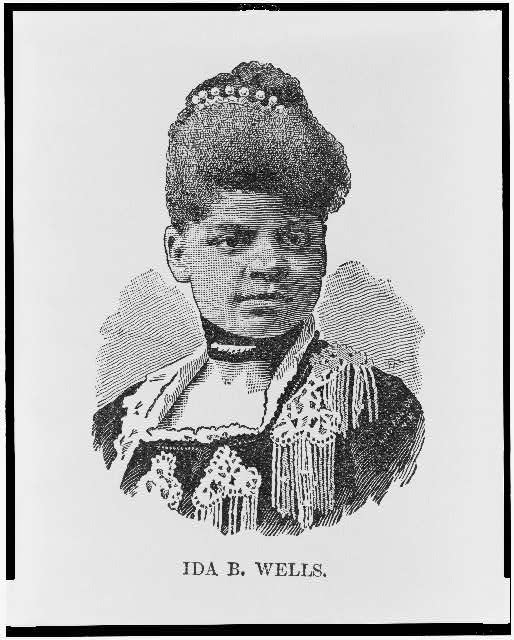
Dunkelman deploys two broad lenses from which to review Progressivism from the early twentieth century to today to demonstrate the core tension within the movement and illustrate how reforms have been at cross purposes. Granted, the Progressive movement of the early twentieth century was the biggest of tents; political leaders came from both parties; presidents Theodore Roosevelt (R), William H. Taft (R), and Woodrow Wilson (D) were all described as progressives. Moreover, progressive leaders often held contradictory ideas or policies: for every prohibitionist there was a burgeoning civil libertarian; every settlement house founder countered by an immigration restrictionist; for every Ida B. Wells and W.E.B. DuBois, a Woodrow Wilson.
The first lens is derived from the beliefs of Alexander Hamilton. Hamilton feared and opposed chaos and thereby favored a top-down, elite-driven government. Too much democracy, he argued, led to disorganization, division, and disorder. “Pulling power into a leadership class would deliver more for the public,” writes Dunkelman, summarizing progressive Hamiltonianism as being exemplified by the movement’s support of technocratic/meritocratic leadership by trained experts.
In contrast, the Jeffersonian lens, based on the beliefs of Thomas Jefferson, emphasizes the Virginia founding father’s fear of tyranny, which he saw as more damaging than occasional chaos. Jefferson guarded against “overbearing authority” by placing greater faith in the people (or really landholding white men) attempting to protect them from “abuse of public authority” by elites, notably unelected ones. The granting of standing to a broader swath of Americans to bring court and legal challenges to development, particularly in the last few decades, is one modern example of progressive Jeffersonianism.
These two ideologies have lived within the progressive tent for decades, and while not always in conflict, they often counter each other, limiting the ability of each to enact government reform. For example, President Lyndon B. Johnson’s Great Society program attempted to utilize a Hamiltonian approach to addressing poverty and inequality by using the federal government to enact expert-led programs to solve such issues. Within that approach, LBJ’s programs simultaneously deployed a Jeffersonian check, in the form of the idea of maximum feasible participation by the public, which often rewarded opponents of the government with federal support for programs that sought to undermine LBJ’s larger efforts.
While not exactly an urbanist book, Why Nothing Works is broadly applicable to the study of urban history, not least of all because cities have always mattered to progressives, whether we are talking about the first decades of the twentieth century or the first quarter century of the 21st. We sat down with Dunkelman (virtually) to discuss how his new book relates to urban history.

Using the dual Hamiltonian/Jeffersonian lens, do you worry that ascribing these broad belief systems from the eighteenth century might miss the complexities of modern life and politics, particularly when discussing urban history, which includes countless cities with significant difference in governance? Or are these wide ideological vistas capacious enough to address the issues of today and the complexities of municipalities?
It’s a terrific question. You’re absolutely right that the realities are complex. But in too many cases, progressivism has been flattened into one thing. By conventional wisdom, Republicans are the party of free enterprise, and Democrats are the party of government. The Right is for unencumbered markets, the Left for regulation. Why Nothing Works is a plea for progressives to zoom out for a second and register that their own ideology is more complex and, in many cases, contradictory. We want powerful bureaucracies to do certain things—to force polluters to limit climate emissions, for example. But simultaneously we’re deathly afraid of those same bureaucracies telling women what to do with their bodies. The same is true at the municipal level—progressives want government to expand transit access, for example, but they worry about government bureaucracies failing to stand up to developers eager to make a buck on gentrification. The book simply asks progressives and scholars to register that contradiction, and to understand the role it has played in frustrating progressive ends.
Historians often use the term Progressivism to describe the period between 1900 and 1920 and to describe the dominant political movement of the era, but the term encapsulates a large umbrella of political beliefs that included both Republicans and Democrats, and which could be contradictory. For example, historians sometimes describe progressives as divided between Restrictionists (anti-immigration, prohibition) versus Anti-Restrictionists (civil rights, suffrage). Since you’ve utilized a Hamiltonian/Jeffersonian lens, how does this approach change our view of Progressivism and what does it offer urban historians?
Fundamentally, I think urban history needs to incorporate two different narratives which framed progressive worldviews during this period. One was reflected in Louis Brandeis’ veneration of smallness—that is, his aversion to bigness. Brandeis wanted to preserve the rhythms of the Louisville he’d grown up in during the late nineteenth century. That’s the impetus behind anti-trust—push power down to preserve the old ways. Teddy Roosevelt and his supporters have a very different view—one of big government meeting big business in a balanced way that supports the public interest. They had no interest in keeping things small. This perspective puts a different veneer on the underlying motivations. Neither entirely benign, neither entirely corrupt.
Early in the book you write about turn of the twentieth century America: “In that moment, set little more than thirty-five years since the end of Reconstruction, many believed America was on the brink of being swallowed by industrialization. The concerns weren’t new–the economy had been changing for decades. And yet, to that point, neither of the two parties had emerged with a compelling vision of how to set things right. The ragtag Democrats were viewed as little more than an ineffectual collection of rural populists and immigrants eager to scapegoat the nation’s behemoth trusts and corporations. The Republicans, by contrast, appeared to enthralled with laissez-faire economics to whip an out-of-control corporate world into shape.”
This seems to describe the modern political environment–neither party offering a real answer to the issues that impact citizens. To what extent do you think this aspect of the nation’s political life is unique, cyclical, or even a constant in American life?
Oh, I think you’re absolutely right that this present moment is incredibly similar dynamically to the turn of the twentieth century. Then, as now, government seemed completely on its back foot. Then, as now, it was almost impossible to imagine public bureaucracies being able to deliver. Frankly, both eras are, in my view, similar to America’s Articles of Confederation moment, when the national government seemed incompetent and thus was born the Constitution. So, to that extent, I’d choose cyclical, or at least vacillating. During the early 1780s, during the late nineteenth century, and during our present moment, the government was too feckless. In each of those periods, reformers eventually sought to imbue centralized executive decision-makers with more authority.
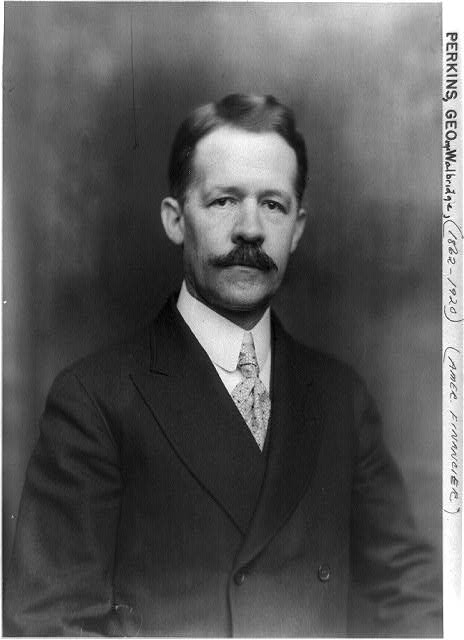
When you discuss the missing Progressive plank from 1912, you note that the party struggled with how to resolve the distance between radicals in the party and more establishment figures like George Walbridge Perkins, the latter having ridden to prominence by coming up with a solution to insurance rebating. “The radicals viewed Perkins as a shill for the corporate world, with one framing his plank as ‘merely a means of perpetuating trust extortion.’ Perkins and his peers viewed the radicals as impractical dreamers who had no real understanding of how business actually worked.” Is this a uniquely progressive issue, does this sort of conflict only afflict the liberal side of American politics or would one find similar dynamics from the Right? Would your lens, if situated on conservatives reveal a similar tension?
This is not a uniquely progressive issue whatsoever—the right is similarly caught between states’ rights libertarianism and sending the military into cities as occupying forces; hardly intellectually consistent. But the fact that neither side is intellectually consistent in all circumstances is not, in and of itself, an indictment of either. Both sides have wanted at various times to empower and to neuter centralized executive authority. For progressives to succeed in any given movement—for them to see their end prevail over conservative ends—they need to find the better balance.
You address the contradictions of the 1960s in several places, but notably in regard to LBJ’s Great Society/War on Poverty, where Johnson tried to balance his Hamiltonian impulses with the rising Jeffersonianism of the day. Since many of these programs were specifically aimed at cities, can you explain how this dynamic unfolded?
The old guard believed that the problems of cities could be addressed from above—with programs like Jobs Corps, which would be a centrally managed federal effort primarily to employ disaffected urban youth. A younger cohort thought this was upside down—that the key wasn’t to fix things from above, but rather to empower those same youth to raise themselves up from below. The Community Action Program that became the focus of the War on Poverty—the program we now associate with the phrase “maximum feasible participation”—was essentially the Jeffersonian approach prevailing over the Hamiltonian alternative Jobs Corps was designed to embody. That was emblematic of the larger sea change happening within progressivism at the time.
In the book you make strong points regarding the need for reigning in some of the more Jeffersonian impulses governing cities particularly in housing and environmental law; the latter of which has been harnessed by NIMBY’s to thwart largely beneficial development. However, minority communities (working and middle class) have often been subject to the most damage from urban renewal and environmental violations. Moreover, laws protecting historical preservation have not benefited their communities in any way close to their white peers. This is all to ask, how does one assure minority Americans that relenting on Jeffersonian reforms won’t make things worse for their communities many of which are found in cities?
This is the $100,000 question—and it’s largely why I wrote the book. When those worried about the gentrification of more modest communities use Jeffersonian tools to block development, they’re employing many of the same levers that rich communities utilize to thwart the development of affordable housing. In both cases, the people who are hurt most are those without the means to make the (more expensive) rent born from a shortage of supply. How do we make sure that communities from both sides of the proverbial tracks are able to advocate for themselves without leaving bereft the people who would have moved into newly constructed housing? We need to find processes that give them a voice in the process, but not a veto. We can’t abide another era of Robert Moses-type figures running roughshod over powerless communities. But neither can we allow anyone to stop housing from being built down the road. Cities, in particular, need systems that allow the common good to be served by a better balance.
 The Metropole