

With UHA2025 just around the corner next month, historian Elaine Lewinnek, with assistance from Elsa DeVienne, offers some tips of the trade for conducting walking tours and tours generally. Sign up for LA tours at this year’s UHA here!
By Elaine Lewinnek
The spatialized nature of urban history often means we end up leading tours for our students, fellow conference-goers, or the wider public – but very few of us were ever formally trained in tour-leading. Many of us have figured out some strategies, so here are tips from those who will be leading the tours at the UHA conference in Los Angeles in October.
PLANNING
Every tour is fraught with the power relations of the tourist gaze, especially tours that visit communities of which we are not a part. What can make tours better is when they include local businesses, local voices, and local engagement, whatever that means for your particular site. Stacy Yung, a high school teacher who works with UC Irvine’s History Project, has started calling her tours “learning walks,” to better distinguish them from tourism.
In addition to planning that high-level theory, you will also want to plan basic logistics. Some of us like to make maps with talking points like this, some of us like to create a timed itinerary (by 2:45 pm, reach Pershing Square…), and many of us like to pre-walk the route to plan for comfortable, shady spaces where a group can stop. If your tour involves a van or bus, think about bus-sized parking spaces along your route. Planning out these mundane details will keep your tour running smoothly and show your audience that you have mastery of the material.
INTRODUCING THE TOUR
Like a good essay or a good lecture, a good tour begins with a hook. Read aloud a poem about the space, pass around a set of historic photos, ask audience members to each read from a printout of scholarly quotes raising questions about the space, or invite every tour member to introduce themselves and share a single sentence about what they already know about the space. There’s no single way to create a hook, as long as you do create one.
You will also want to introduce your tour by doing a headcount or organizing a buddy system so you can make sure everyone who begins your tour will end it, passing out sunscreen or anything else folks may need, and letting people know what to expect: “We’ll be walking about a mile and stopping so often that it will take us two hours…” This includes letting people know if there will be bathrooms or water breaks along the way. Fun fact from museum studies: guests who already know where the bathroom is will consistently learn more than other guests, who apparently get distracted from the tour’s topic because they are worrying about where the bathroom might be.
Consider how to do a meaningful land acknowledgment. In the Los Angeles area, Elaine begins most public tours by asking people if they can name which nations have claimed the land they are currently standing on. It usually takes more than one audience member to name the Tongva Gabrieliño and Kizh, Spain, Mexico, and the U.S. – and getting that basic historic chronology together as a group leads to explaining that with conquest comes erasure, so that is why so much of the information in the tour may be new to them. Do what works for you to set up your tour’s themes.
ENCOURAGING INTERACTION
Tours will naturally follow the sage-on-a-stage model of teaching: you will be doing most of the talking. It can help to plan to stop at shady areas to invite folks to ask you questions, or you can ask open-ended questions of the audience. Remind them to use all their senses (“What do you smell, what do you notice here, why do you think this sidewalk looks this way…”) in order to make the tour experience different from sitting in a classroom hearing about this space. Tours should be immersive. You can prompt the audience with discussion questions for the parts of the tour when you’re moving from space to space (‘While we take the Metro/walk to the next stop, chat with your neighbor about the politics of public memory…”)
Bringing historical photographs is a great way to bring the past to life – but beware that an ipad slideshow that might work really well if you’re in a dimly-lit environment (or just on a gray day), may be completely useless in the LA sunshine with too much glare on the screen.
Younger audiences can be engaged by having them fill out bingo cards like this one, especially if you have some books to give as prizes to the first to get bingo or blackout bingo (checking every box). Mariana Ramirez of the UCI History Project used the ArcGIS Survey123 program to set up a survey like this, inviting participants to take photos of our stops and tag them with keywords. It can be great to take a group photo to post to social media with the conference’s hashtag.
CONCLUDING
Just as you wrap up your writing & teaching with a conclusion, tie a bow around your tour at its end. This could mean inviting every audience member to share a single word reaction, reading a pithy quote, or challenging each audience member to consider ways to bring the tour’s subject into their own work.
It can be helpful to follow up after the tour by emailing all participants a list of the places visited with key facts and a bibliography of the works that inspired your tour. Having a feedback form to send to all attendees is also a great way to collect impressions and comments – and can be useful for future grant applications that may ask for evidence of impact.
There’s no one way to do any of this, but thinking through planning, introductory hook, logistics, audience engagement, conclusions, and power relations can help you design a tour that people remember, one that truly takes advantage of being in the space you care about.
Elaine Lewinnek is a professor of American Studies and coordinator of Environmental Studies at California State University, Fullerton. She is co-author of A People’s Guide to Orange County and co-chair of the Local Arrangements Committee for UHA’s 2025 conference in Los Angeles.
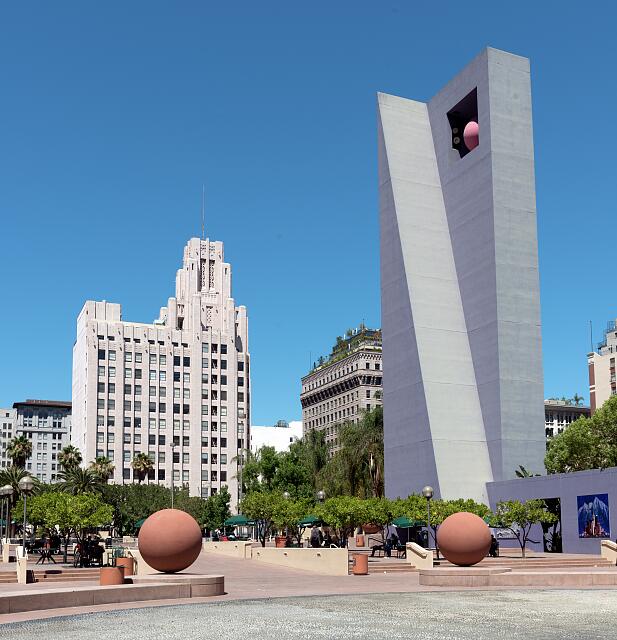
Featured image (at top): Art in Pershing Square Park, a public park in downtown Los Angeles, California, Carol M. Highsmith, photographer, 2012, Prints and Photographs Division, Library of Congress.
 The Metropole