

Rose, Mark H. and Roger Biles. A Good Place to Do Business: The Politics of Downtown Renewal Since 1945. Philadelphia: Temple University Press, 2022.
Reviewed by David Goodwin
As public concern over the COVID-19 pandemic shifts from a guiding fear to a collective memory, American urban centers struggle to reimagine and restructure themselves to an emerging and presumptive new normal: downtowns with fewer white-collar workers and with more underutilized office buildings. This quieting of commercial districts results in shorter morning lines at cafes, smaller crowds of lunchtime shoppers, and emptier nighttime bars. Collectively, this leads to plummeting tax revenues and strained city budgets. Meanwhile, long-simmering challenges—homelessness, housing, education, and infrastructure—appear to be reaching a critical mass. The policies now being forged and the actions being pursued by municipal leaders might very well shape both the socioeconomic health and the public perception of cities for years, if not decades, to come.
Older American cities in the Northeast and the Midwest found themselves navigating even more powerful and traumatic headwinds in the decades following the Second World War and the era of deindustrialization in the 1970s and 1980s. In their recent book A Good Place to Do Business: The Politics of Downtown Renewal Since 1945 historians Roger Biles and Mark H. Rose examine how urban leaders confronted the linked forces of divestment, white flight, suburban development, and political disempowerment afflicting their respective cities. Thematic case studies of Chicago, Cleveland, Detroit, Philadelphia, and St. Louis demonstrate how business communities and public officials settled upon a similar strategy for their individual locales: the prioritization of downtown centers and commercial real estate, often at the expense of investment in more equitable amenities and infrastructure, such as robust public transportation or well-performing school systems. The pursuit of urban growth projects, as profiled by Biles and Rose, often resulted in the displacement of working-class and impoverished minority and white ethnic residents and sometimes the literal bulldozing of their neighborhoods.
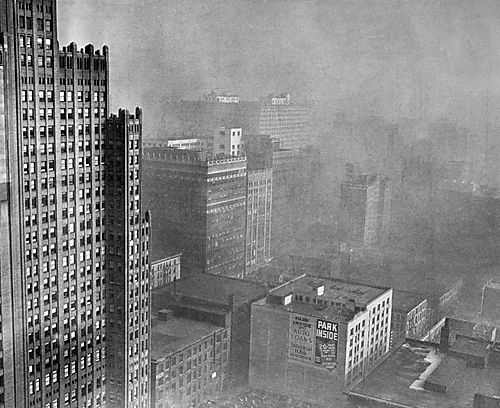
A Good Place to Do Business begins with an analysis of the intentional transformation of Pittsburgh by that city’s powerbrokers from a center of heavy industry and soot-filled streets to one of knowledge-based work and glittering skyscrapers. The cities profiled by Biles and Rose looked to the Steel City as a model to follow, its perceived successes as worth emulating. The first section of the book largely centers on how civil servants and other nonelected civic figures worked to reshape their own cities during the immediate postwar decades, such as baseball player Stan Musial advocating for a bond referendum to finance a new baseball stadium in St. Louis or longtime technocrat William L. Rafsky supervising the historical restoration of the Society Hill neighborhood in Philadelphia. An analysis of the development ambitions and visions of mayors, such as Coleman Young in Detroit and George Voinovich in Cleveland, amid the inevitable realities of a post-manufacturing environment comprises the second section of A Good Place to Do Business. The volume concludes with a study of the shift toward an emphasis on educational, health care, and leisure institutions and industries in twenty-first-century cities.
Biles and Rose present urban specialists, policy wonks, and urban enthusiasts with a well-researched, clearly written, and narratively compelling work of scholarship. The book could have benefited from a stronger connective thread. Certain cities are profiled with more depth than others, and some subjects appear to have been added to achieve an editorial balance. For example, all the explored cities are located in the Midwest with the exception of Philadelphia, and the inclusion of the City of Brotherly Love disrupts a defined geographical emphasis. Meanwhile, the authors essentially limit themselves to Chicago and Detroit when discussing the policy drive to cater to the needs and demands of affluent residents and visitors for high-quality urban amenities (e.g., dining, culture, and entertainment) over those of less well-heeled individuals or families.
Many of the actions of the featured civic and political leaders attempt to resolve the chicken-or-the-egg dilemma. Vital downtowns will contribute to the general well-being of a city and provide the resources to fund schools, parks, and other common goods. Thus, downtowns should be prioritized. However, many businesses and corporations most likely to contribute to a strong and stable economy rely upon physical and human infrastructure to expand, and these organizations partially base their investment decisions upon the health of such attributes in a given city. Biles and Rose adequately and convincingly diagnose this perplexing and bedeviling challenge.
A Good Place to Do Business offers a cautionary tale for municipal leaders chasing after perpetual growth without attending to the public services essential to convince current citizens to remain in their cities and to realistically pursue success in an evolving economy and society. The much touted and imitated Pittsburgh model embodies a critical flaw in such a strategy: all the economic gains of that city’s downtown failed to stymie population loss or mitigate poverty rates. Commercial development alone cannot nourish American cities.

David J. Goodwin is an author, historian, and the Assistant Director of the Center on Religion and Culture at Fordham University. His most recent book is Midnight Rambles: H. P. Lovecraft in Gotham, a biography of the horror writer’s New York City years.
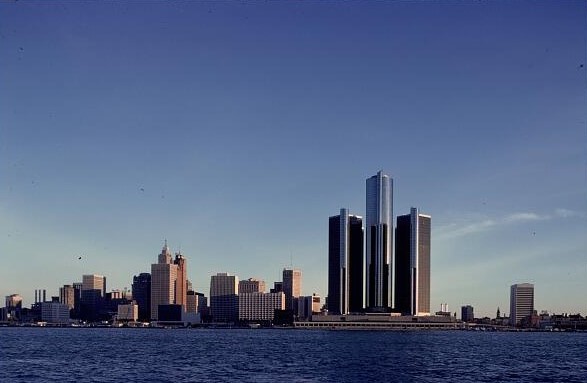
Featured image (at top): The Renaissance Center on the Detroit River waterfront, Detroit, Michigan. Photograph by Balthazar Korab, 1979, Prints and Photographs Division, Library of Congress.
 The Metropole