
Leech, Brian James. The City that Ate Itself: Butte, Montana and its Expanding Berkeley Pit. Reno: University of Nevada Press, 2018.
Reviewed by Troy A. Halsell
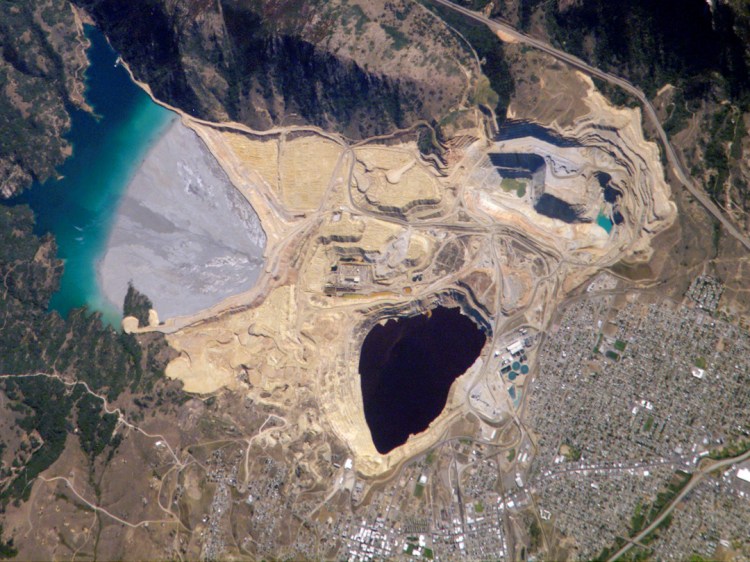
Butte, Montana, is an interesting place. When I first visited the city in the spring of 2019, its turn-of-the-twentieth-century architecture in the uptown central business district and its ubiquitous Irish-ness (relics of which were oddly everywhere and nowhere) stood out to me as remnants of the city’s heyday as an underground hard rock mining town. Dubbed “The Richest Hill on Earth,” Butte produced copper for a rapidly electrifying world. But what blew my mind was the defunct Berkeley Pit, a massive open pit mine that measured one mile long by one-half mile wide with a depth of 1,780 feet, on the city’s eastern boundary. As one of the nation’s largest Superfund sites, it is now a toxic lake filled with a mix of arsenic and cadmium. I lacked the words to describe my experience, but to paraphrase author Ivan Doing, there was something interesting about a city that lived by eating its own guts.
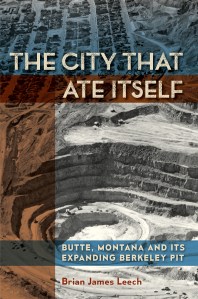
In The City that Ate Itself: Butte, Montana and its Expanding Berkeley Pit Brian James Leech answers a straightforward, albeit complicated, question: what happened when the Anaconda Copper Mining Company placed an open pit mine next to Butte, Montana? Using a wide range of traditional archival sources, like the Anaconda Company’s records and union files, along with hundreds of oral history interviews with area residents and mine workers, he demonstrates the social and environmental consequences of open pit mining on workers, residents, and Butte’s physical landscape. By following the creation of the Berkeley Pit to near present day, Leech argues that “open-pit mining had a surprisingly dramatic, long-lasting, and often detrimental consequences for both miners and their communities.”
The first six chapters chronicle the rise of open-pit mining in Butte. First, Leech provides the historical context for Butte’s mining industry. He focuses on the Anaconda Company’s mining business, the underground hard rock miners’ labor that brought millions of pounds of copper out of the earth, the ethnic communities miners created, and the shift to open pit mining following World War II. Next, Leech explores the changing nature of miners’ work. As mining went from underground into the open, miners witnessed their jobs become less skilled, more automated, and under the persistent eye of management. This brought workers and unions into conflict with the Anaconda company in an increasingly lose-lose situation as the number of jobs decreased and workers increasingly found themselves in conflict with one another. Open pit mining may have turned miners’ lives upside down, but it also consumed wide swaths of Butte’s eastern neighborhoods.
By the time Anaconda shifted to open-pit mining, Butte had become home to a wide array of Italian, Finnish, Irish, and Welsh neighborhoods (to name a few). These tight knit ethnic enclaves supported workers during the underground mining period, but, as the Berkeley Pit chased ore deeper into the ground, it also expanded its borders outward to ensure the pit did not collapse on itself. As a result, entire neighborhoods, like Meaderville and portions of others such as Finn Town and East Butte, became mining fodder. Some families lost their homes but only received compensation for the physical structure and not the earth upon which it sat. Others battled real and perceived threats from blasting, such as debris and noise. By the 1970s the very industry Butte residents depended on also destroyed the institutions, neighborhoods, and social ties that created a once vibrant city.
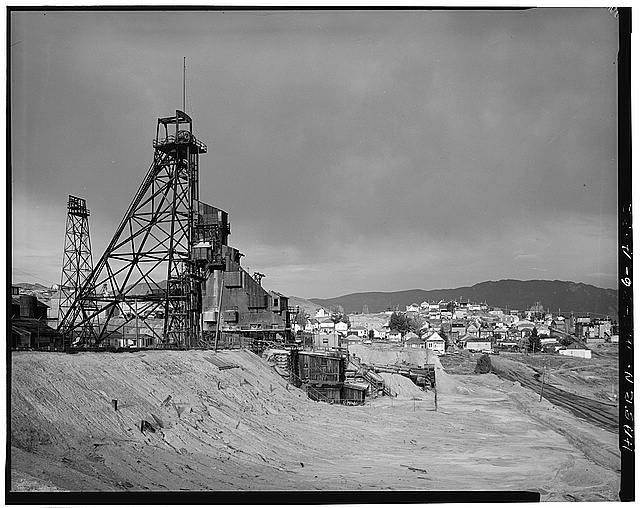
Leech’s greatest contribution to the history of Butte are his final two chapters on the city’s long, drawn-out bust, which began in the 1970s. By focusing on this period readers see the many ways Butte’s residents fought some of deindustrialization’s worst symptoms, namely mass out-migration, a depleted tax base, reduction in city services, arson, and subsequent demolition of historic buildings. In response, local officials turned to federal programs, like Model Cities, for relief and for a period considered moving the central business district from its location in uptown to an area down the hill on the flats. After the pit closed in 1983, Butte entered an economic death spiral; unemployment hit twenty percent, which exacerbated pre-existing problems with alcoholism, and many former miners killed themselves. Residents and local government responded the best it could by diversifying its economy, but an influx of younger out-of-towners helped drive a historic preservation movement. Residents used this movement to save and revitalize the city’s old structures and then leveraged them into a nascent tourism industry.
However, Butte still had to reckon with copper mining’s toxic legacy. The 1983 decision to shut down the Kelly Mine’s water pump station that removed 5,000 gallons of water a minute turned the Berkeley Pit into a lake full of heavy metals by 1990. Residents then (and now) feared this toxic lake could overflow and spill into the aquifer and Silver Bow Creek, poisoning the entre waterway. Others lamented the pit as the final resting place for migratory birds. As the only body of “water” in the region, in 2016 thousands of migrating geese died from heavy metal poisoning after landing in this “toxic soup.” After failed attempts by state legislators to clean up the pit, in 1994 (and through a 2002 consent decree) the Environmental Protection Agency and the Atlantic Richfield Corporation (ARCO), the now-owner of the Berkeley Pit, agreed to a water treatment plan that would treat and discharge 7,000,000 gallons of treated water a day into Silver Bow Creek. (See Montana Public Radio’s podcast, Richest Hill, which follows the city’s efforts to clean up one of the nation’s largest Superfund sites.)
With these concerns mediated, the pit was leveraged as a tourist draw–the Butte Chamber of Commerce erected a viewing stand at the pit. In 2009, 27,005 people visited this spectacle as a form of disaster tourism. Combined with residents’ historic preservation efforts, this approach attempted to flip Butte’s narrative on its head: no longer was it one of a failed mining industry, but one that celebrated its mining heritage. Butte has made steadfast progress towards reclaiming its mining landscape, but unlike other towns that shifted to a different industry following their deindustrialization–Pittsburgh and its transition to a “Medical Metropolis,” for example–Butte has been struggling to recover ever since.
The City that Ate Itself is a welcome addition to the history of Butte, Montana, and western mining towns broadly. It is the first to look beyond the city’s heyday and track its trajectory into the bust of the 1970s and beyond. Despite being an academic title, Leech does an excellent job explaining technical and complex mining concepts in a clear and easily-to-read manner. In the process he created a compelling narrative for the general public and academic historians alike.
Troy A. Hallsell is the 341st Missile Wing Historian at Malmstrom AFB, Montana. His first book, The Overton Park Freeway Revolt: Place, Politics, and Preservation in Memphis, Tennessee, 1956-2017, is under review at the University of Tennessee Press. The opinions expressed in this post do not represent those of the 341st Missile Wing, the United States Air Force, or the Department of Defense.
Featured image (at top): The Berkeley Pit (center) and Yankee Doodle Tailings Pond (upper left) with terraced levels/access roadways. The city of Butte is in the lower right corner. “Berkely Pitt, Butte Montana“ (2006), NASA.


Great article… My father worked in the copper mines in Butte from 1962-70. I attended Webster Garfield Elementary School…. Best years of my life!! I visit there often….
LikeLike
Etta,
Your music teacher at Webster Garfield was my mother. Mrs Williams. I would like to think that you have a bit of Butte in you that you’ve carried throughout your life. What the author of that piece will never grasp is the uniqueness of ButteAmerica. Butte was America at its finest. We possessed a melting pot of people who risked their lives and were protecting each others lives 24 hours a day, 365 days a year, down in those mines and in the “Pit”. Not just wire for electricity was the copper and other metals retrieved. These miners in Butte produced the metals we needed to fight two world wars, the Korean War and the Vietnam War.
And as a side note, none other than Butte High School’s alumni set a record for a community of its size to have by December 1943; close to 2000 of its past students fighting in our Armed Services during WWII.
The author of this “book” truly is an unfortunate wretch. He hadn’t lived among us nor broke a sweat along side a man or woman of Butte. If he had, well, he just may have understood that ButteAmerica is never out of a fight, even if outsiders count it out, the people always find a way to look out for each other. You see, being from Butte is being family. You have to had eaten a Pastie one day and John’s Pork Chop the next to get the gist of being a ButteAmerican.
LikeLike
LikeLike