

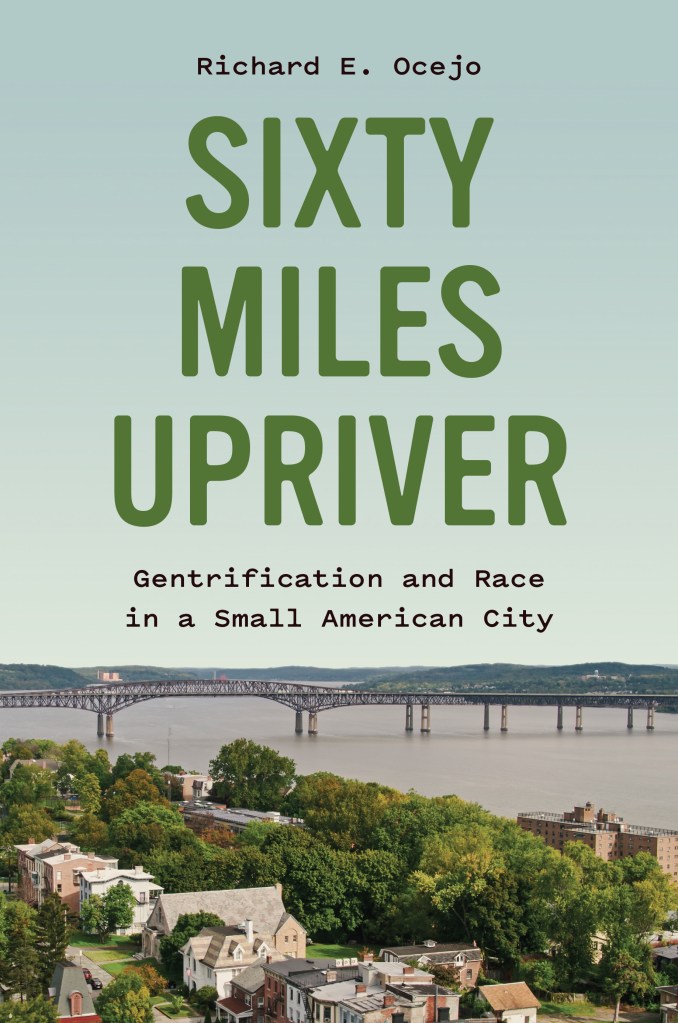
Richard E. Ocejo. Sixty Miles Upriver: Gentrification and Race in a Small American City. Princeton, NJ: Princeton University Press, 2024.
Reviewed by Mario Hernandez
Focusing on small cities rather than the large metropolitan areas typically covered in gentrification literature, Richard Ocejo’s Sixty Miles Up River makes significant contributions to the study of gentrification. Beyond location, the author emphasizes the moral dimension of gentrification, including the “narratives, discourses, and actions of gentrification stakeholders.”[1] This perspective also highlights the crucial role of race in gentrification studies. Together, these elements create an engaging narrative that enhances our understanding of gentrification in smaller cities. As cities and the forces driving gentrification evolve continually, this work provides a valuable addition to the field.
The first part of the book provides a brief overview of the political and economic factors and specific stakeholders that have driven Newburgh’s initial growth, subsequent decline, and contemporary wave of gentrification. After an initial period of growth attributable to the emergence of a few key industries in close proximity to New York City (“Thomas Edison’s company built the country’s second municipal electric power state in Newburgh”[2]), Newburgh’s decline was engendered by a set of circumstances familiar to larger cities hit hard by manufacturing loss, suburbanization, and disinvestment. Newburgh’s real estate market all but collapsed as a result. Racism played a fundamental role in the destruction of entire communities, with individual and collective trauma lasting into the present. The author depicts this destruction, particularly felt during the urban renewal era, as undergirding and overshadowing the city’s contemporary resurgence, or what he describes as “gentrification-led growth.”
As with typical patterns of gentrification, Newburgh’s gentrifiers tend to be mostly white and educated professionals moving into an area of depressed real estate value occupied by predominantly low-income communities of color.[3] But unlike gentrification patterns elsewhere that have driven traditional narratives, Newburgh’s gentrifiers are not artists on the periphery or recent college graduates in search of cheap rent creating a primer for gentrification for larger real estate and commercial interests. Instead, they are affluent individuals who have been priced out of residential or commercial real estate in the city, or who feel alienated by the changes in their previous living places over time. Thus, they tend to be older and have more wealth, primarily looking to invest in the city’s real estate to establish roots and gain equity. While younger gentrifiers who rent still occupy a space in this process, Ocejo focuses primarily on this ownership class and describes them as “gentrification stakeholders,” as their real estate investment ties them directly to the economic development of the city as a whole. [4]
Newburgh’s gentrifiers predominantly work in creative industries such as art, technology, and design, which mirrors many of the common patterns of contemporary gentrification. For these individuals, Newburgh offers a curated lifestyle similar to places like Brooklyn, featuring craft bars, artisanal foods, and boutique stores, but at a more affordable price. Experienced with the effects of gentrification, this “tamer bohemia” is a community of savvy urbanites accustomed to the challenges of urban living, including crime. [5] The fact that Newburgh is predominantly Black and lower-income does not deter these newcomers; instead, they see it as an added value, celebrating diversity as part of the urban mosaic. More on the paradoxical aspects of this topic follows.
Chapter 5, describes three main ways gentrification stakeholders work to shape or “curate” Newburgh’s urban environment; this includes what he describes as “curating activities,” “curating the built environment,” and “curating the civic and political landscape.” By transposing their labor, consumption, and lifestyle practices and preferences onto the city itself, gentrifiers valorize their activities and see themselves as a universal good for the city. This includes creative co-working spaces, nouveau cocktail bars, “artist-in-vacancy” programs, and open studio events.[6] Such practices are predicated on a specific set of underlying industries and promote a particular type of urban aesthetic taste preferences. With regard to curating the built environment, an appreciation for history and architecture entitles gentrifiers to renovate apartments and buildings “the right way” even if it means evicting existing tenants and raising rent and real estate purchasing prices. As the author states, the value of and need for renovating buildings take precedence over the needs of existing residents.[7]
Finally, in regard to the curation of the civic and political landscape, gentrifying stakeholders conflate their personal financial interests with those of the city. While many were not politically engaged in their former cities, homeownership in Newburgh and the city’s relatively small size spur them to become politically active. They promote a traditional, self-interested conservative rhetoric of NIMBYism (“not in my backyard”) and trickle-down economics, which seems counterintuitive for this otherwise liberal demographic.[8] The final sections of the book highlight this paradox, noting how gentrification stakeholders rationalize their actions within the broader context of race and class. Indeed, the moral justification and racial implications of these actions are central to the book’s argument.
Focusing on the moral logic of gentrifiers might seem counterintuitive since, as the author and most gentrification literature state, gentrification is driven by larger structural forces rather than individual choices.[9] Indeed, the underlying factors driving personal decisions to move to Newburgh are motivated by changing labor relations and technological advancements, such as remote work, as well as creative and tourism industries. These changes have led to the creation of spin-off industries, including person-to-person home-sharing apps like Airbnb, which facilitate such personal decisions. The centrality of home and business ownership means economic market forces play a central role. Gentrifiers are directly invested in the gentrification of the neighborhood and city based on this fact alone. In other words, in the pursuit of an affordable place to live or invest, individual actors will, more often than not, rationalize their actions to justify their behavior.
However, the book shows that it would be a mistake to underestimate the ideas that motivate individual actors. Ocejo describes a dual paradox among Newburgh’s gentrification stakeholders throughout the book that drives their personal perceptions and actions that work to shape the city according to their interests. On the one hand, and as described, they tend to promote the very same market-driven solutions to the city’s problems that displaced them from the cities they were forced to flee in the first place. On the other, their actions often work in direct conflict with their stated embrace of diversity, if not race-neutral discourse. Through various examples throughout the book, Ocejo describes how Newburgh’s gentrification stakeholders place themselves individually and collectively (i.e., their industries, tastes, lifestyle choices, and political interests) at the center of determining the city’s fate. Examples of urban curation are “based on a conflation of the economic, social and cultural interests of property and business owners with those of the city itself”.[10] Though sensitive to the “moral dilemma of gentrification,” they use a variety of moral justifications to promote a kind of “conditional gentrification” or what he describes as “a positive process that they control.”[11] These include downplaying the displacement of existing residents by noting limited profit, looking at collective problems in individual terms, expressing disinterest in economic gain, and “conflating the value of renovating buildings with the housing needs of residents.”[12] With regard to race, they celebrate diversity as consumers of the city but employ a race-neutral logic when advocating for their own interests. Though promoted as universal gains, as Ocejo shows through various development projects in the final chapter, these are in direct opposition to existing Black and Brown communities. These paradoxes arise because gentrification stakeholders simultaneously occupy four roles typically treated separately in the literature: they are both gentrified from their former cities and gentrifiers in Newburgh; they are consumers who appreciate and celebrate urban complexities and producers who shape the city as influential tastemakers.[13]
The book concludes with separate larger revitalization projects that failed because they did not meet the expectations of what gentrification stakeholders saw in the city’s (i.e., their own) best interest. While the process of gentrification can take on a variety of patterns, Sixty Miles Up River provides a strong argument for how discursive moral narratives can be used to cultivate and perpetuate individual and collective group interests at the grassroots level. Moreover, the book shows how the racial violence of decades past can serve as a source of wealth in the present and how racism, more generally, can continue to operate as a regenerating source of wealth production for its beneficiaries.
Mario Hernandez is an Assistant Professor of Sociology at Mills College at Northeastern University. Dr. Hernandez is an urban sociologist who specializes in the study of race and gentrification. His most recent book, Bushwick’s Bohemia: Art and Revitalization in Gentrifying Brooklyn, examines the proliferation of the creative art scene in the neighborhood of Bushwick in Brooklyn. He is currently doing research and writing about the history and revitalization of West Oakland.
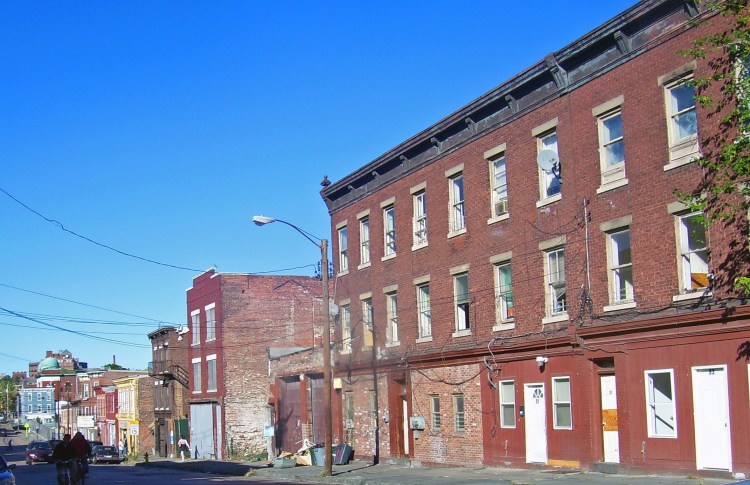
Featured image (at top): William Street in Newburgh, NY. Located in the East End Historic District. Photograph by Daniel Case, 2007. CC BY-SA 3.0.
[1] Richard Ocejo, Sixty Miles Upriver: Gentrification and Race in a Small American City (Princeton, NJ: Princeton University Press), 207.
[2] Ocejo, Sixty Miles Upriver, 11.
[3] Ocejo, Sixty Miles Upriver, 9.
[4] Ocejo, Sixty Miles Upriver, 22.
[5] Ocejo, Sixty Miles Upriver, 34.
[6] Ocejo, Sixty Miles Upriver, 147-149.
[7] Ocejo, Sixty Miles Upriver, 158-159.
[8] Ocejo, Sixty Miles Upriver, 137, 182.
[9] Ocejo, Sixty Miles Upriver, 9, 209.
[10] Ocejo, Sixty Miles Upriver, 145.
[11] Ocejo, Sixty Miles Upriver, 114, 157.
[12] Ocejo, Sixty Miles Upriver, 158-159.
[13] Ocejo, Sixty Miles Upriver, 22, 208.
 The Metropole

